Including other body size measures with BMI does not meaningfully change estimates of excess adiposity for surveillance purposes
Abstract
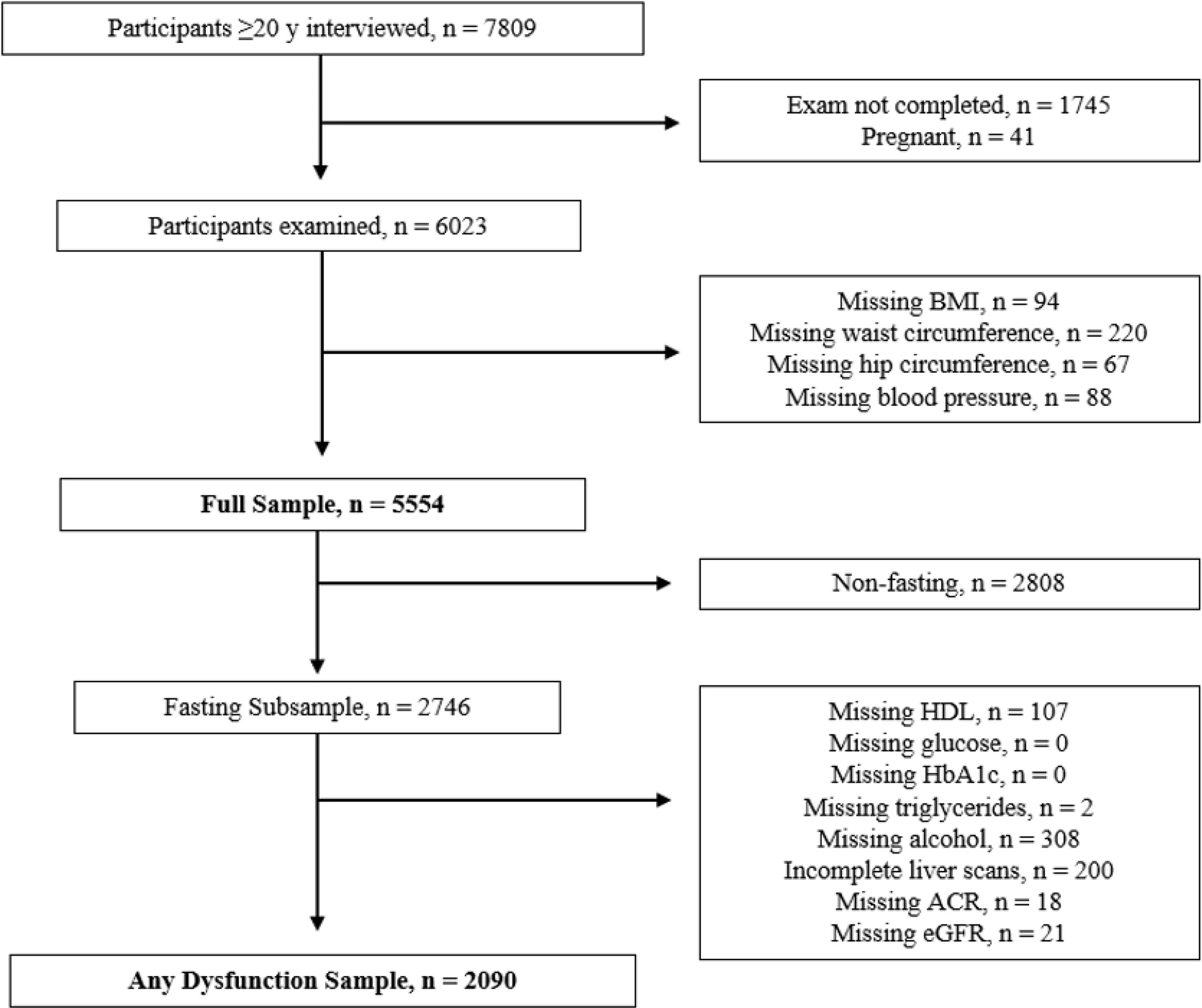
BACKGROUND: The Lancet Diabetes & Endocrinology Commission on the Definition and Diagnosis of Clinical Obesity proposed definitions and diagnostic criteria for pre-clinical (excess adiposity, ExAdip) and clinical obesity (ClinOb). OBJECTIVE: To investigate the impact definitions of ExAdip and ClinOb on obesity surveillance among US adults ≥20 years. METHODS: National Health and Nutrition Examination Survey August 2021-August 2023 data for US adults (n=5554) were used to compare obesity defined by body mass index (BMI) alone to prevalences based on 4 ExAdip definitions: defined as high BMI and high 1) waist circumference, 2) waist to hip ratio, 3) waist to height ratio, or 4) ≥2 high body size measures regardless of BMI (2BS). ClinOb prevalence, based on 5 of 18 proposed measures of dysfunction, (≥Stage 1 hypertension, metabolic cluster, metabolic liver dysfunction with fibrosis, kidney dysfunction, and limitations of activities of daily living) was also calculated. Differences between demographic subgroups within one definition were tested using t-tests. Definition estimates were compared to BMI-alone 95% confidence intervals to assess differences from the current obesity definition. RESULTS: Obesity prevalence using BMI alone (40.8%, 95% CI 37.2-44.4%) was similar to ExAdip prevalence based on definitions that included BMI and other body size measures (∼40%), but differed compared to high 2BS (77.5%, 95% CI 74.0-80.8%). Almost 39% (38.7%, 95% CI 34.4-43.1%) of adults with BMI<25 had high 2BS. Similarly, ClinOb prevalence was comparable across ExAdip definitions that included BMI (∼25%) but higher based on high 2BS (43.4%, 95% CI 40.2-46.7%). Patterns by demographic subgroups were similar based on definitions that included BMI but differed based on ExAdip defined as high 2BS. CONCLUSIONS: Including other body measures beyond BMI to define ExAdip did not change ExAdip or ClinOb prevalence in the US. However, using two body size measurements regardless of BMI resulted in higher ExAdip.
- Excess adiposity
- Clinical obesity
- Obesity
- Hypertension
- Metabolic dysfunction-associated steatohepatitis
- Humans
The paper
The Journal of Nutrition, 10 Oct 2026