Driver or Passenger? A Bradford Hill Framework for Aging-Associated lncRNAs
Abstract
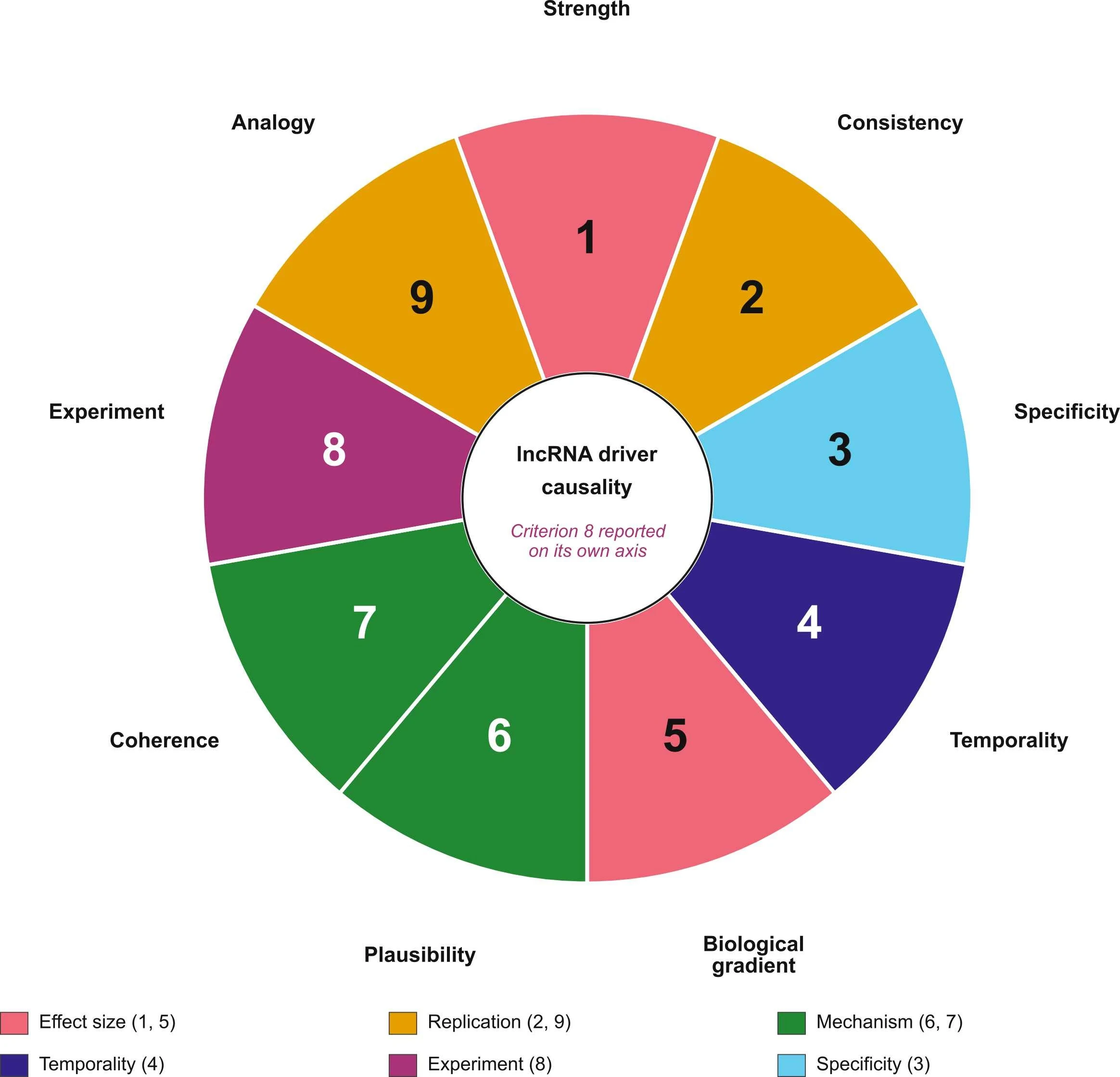
Transcriptomic surveys of aging tissues routinely report hundreds to thousands of differentially expressed long non-coding RNAs (lncRNAs), and the field has no agreed way of separating causal drivers from passengers that merely track the aging phenotype. I translate Sir Austin Bradford Hill's nine criteria for causal inference, formulated in 1965, into operational tests for aging-associated lncRNAs. Each criterion is recorded as 0, 1 or 2, and the per-criterion profile is the result: no sum or band decides a category. Hill offered viewpoints, not independent quantities to be added; here half of the cited studies support two or more criteria, so a total counts some evidence twice. Two axes are reported separately - molecular causal evidence, and organism-level validation (criterion 8), recorded as supportive, not evaluated, or in vivo at a non-aging endpoint - so that an animal experiment on development, reproduction, cancer or injury is not read as a negative test of aging. Applied to ten worked examples chosen to illustrate rather than to sample the field - NEAT1, MEG3, lincRNA-p21, MALAT1, MIR31HG, SALNR, TERRA, PANDAR, HOTAIR, TUG1 - the profiles separate candidates awaiting an animal experiment from those whose animal experiments addressed something else. MALAT1 is instructive: of six in-vivo perturbation studies, one assays a senescence endpoint. No candidate has an aging experiment that returned a negative result, and none reaches the top of criterion 8, which requires conditional deletion or a titrated antisense regimen with rescue. Organism-level evidence, not literature volume, is the structural bottleneck.
The paper
Yokohama University of Pharmacy
Ageing Research Reviews, 10 Oct 2026