Associations of Vision, Hearing, and Dual Sensory Impairments With Functional Outcomes: A Nationwide Analysis
Abstract
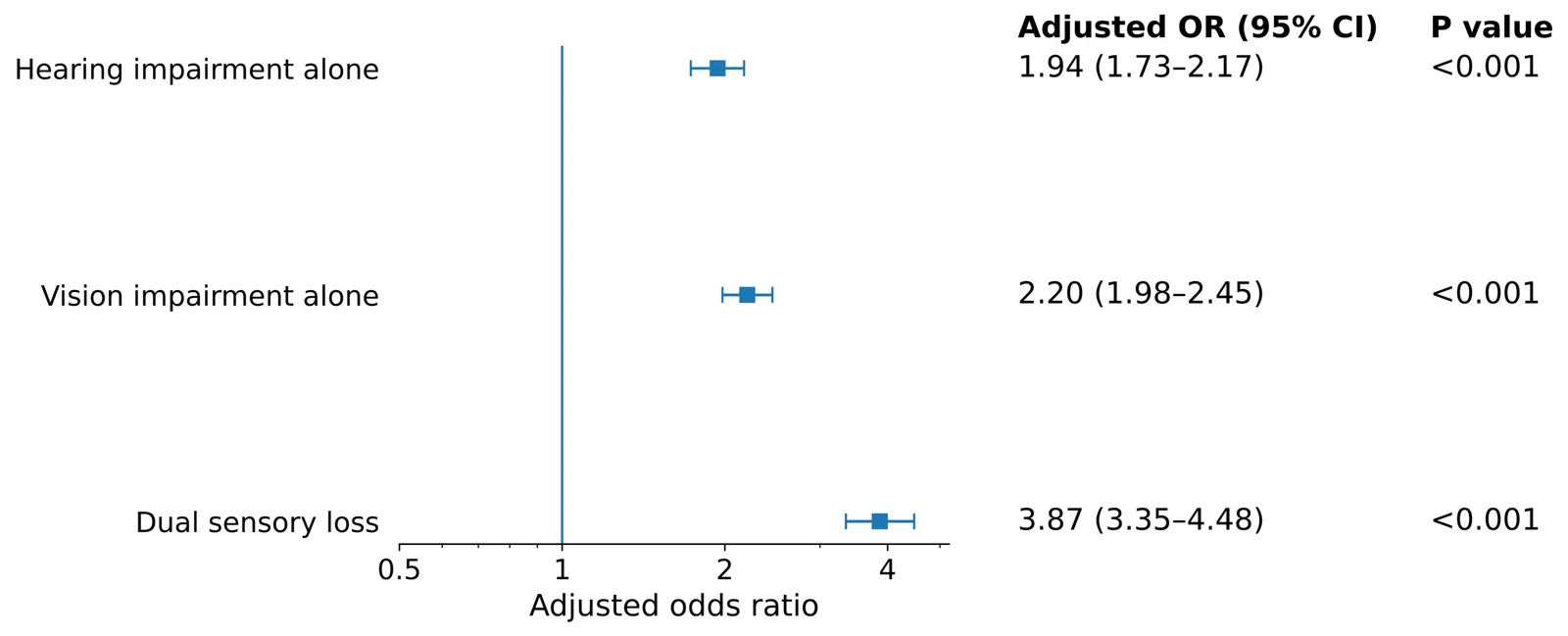
Introduction The co-occurrence of hearing and vision impairment, known as dual sensory impairment, is thought to impose a larger functional burden than either impairment alone. The purpose of this study was to identify characteristics that are independently related to dual sensory impairment and investigate its relationship with functional limitations across five domains of daily living in comparison with isolated sensory impairment. Methods This retrospective, cross-sectional study utilized data from the 2023 National Health Interview Survey (NHIS), using sampling weights, strata, and clusters to produce nationally representative estimates. A population of 29,522 adults was included in the analysis. Vision and hearing impairments were identified through self-reported difficulties, and individuals with both were classified as having dual sensory impairment. Five domains of functional impairment were evaluated: communication, social participation, independent errand performance, ambulation, and self-care. Multivariable logistic regression, while controlling for demographic and clinical covariates, was conducted to identify factors associated with dual sensory impairment and to assess the relationship between sensory impairment status and functional limitation, with results presented as adjusted odds ratios (aORs) and 95% confidence intervals (CIs). Results Of the 29,522 participants, 1,858 (5.6%) exhibited dual sensory impairment. This group was significantly older and had higher rates of obesity and smoking, as well as poorer self-rated health and lower life satisfaction, compared to individuals without sensory impairment. Dual sensory impairment was independently associated with older age, smoking history, hypertension, stroke, coronary artery disease (CAD), cancer, chronic obstructive pulmonary disease (COPD), dementia, anxiety, and depression (all p < 0.05); the association with diabetes mellitus was no longer statistically significant after adjustment. Throughout all five functional areas, dual sensory impairment exhibited the strongest association with impairment in comparison to solely visual or hearing impairment, encompassing ambulation (aOR: 3.87), self-care (aOR: 3.55), communication (aOR: 6.03), independent errands (aOR: 3.81), and social participation (aOR: 4.08) (all p < 0.001). Conclusion Dual sensory impairment is prevalent among a significant number of adults in the United States and is associated with considerably higher odds of functional limitation across multiple domains compared with isolated visual or hearing impairment.
From the paper
- Participants
A population of 29,522 adults was included in the analysis.
Quoted word for word from the full text on cureus.com.