Fall risk in rheumatoid arthritis revisited: A follow-up study focusing on sarcopenia and glucocorticoid use
Abstract
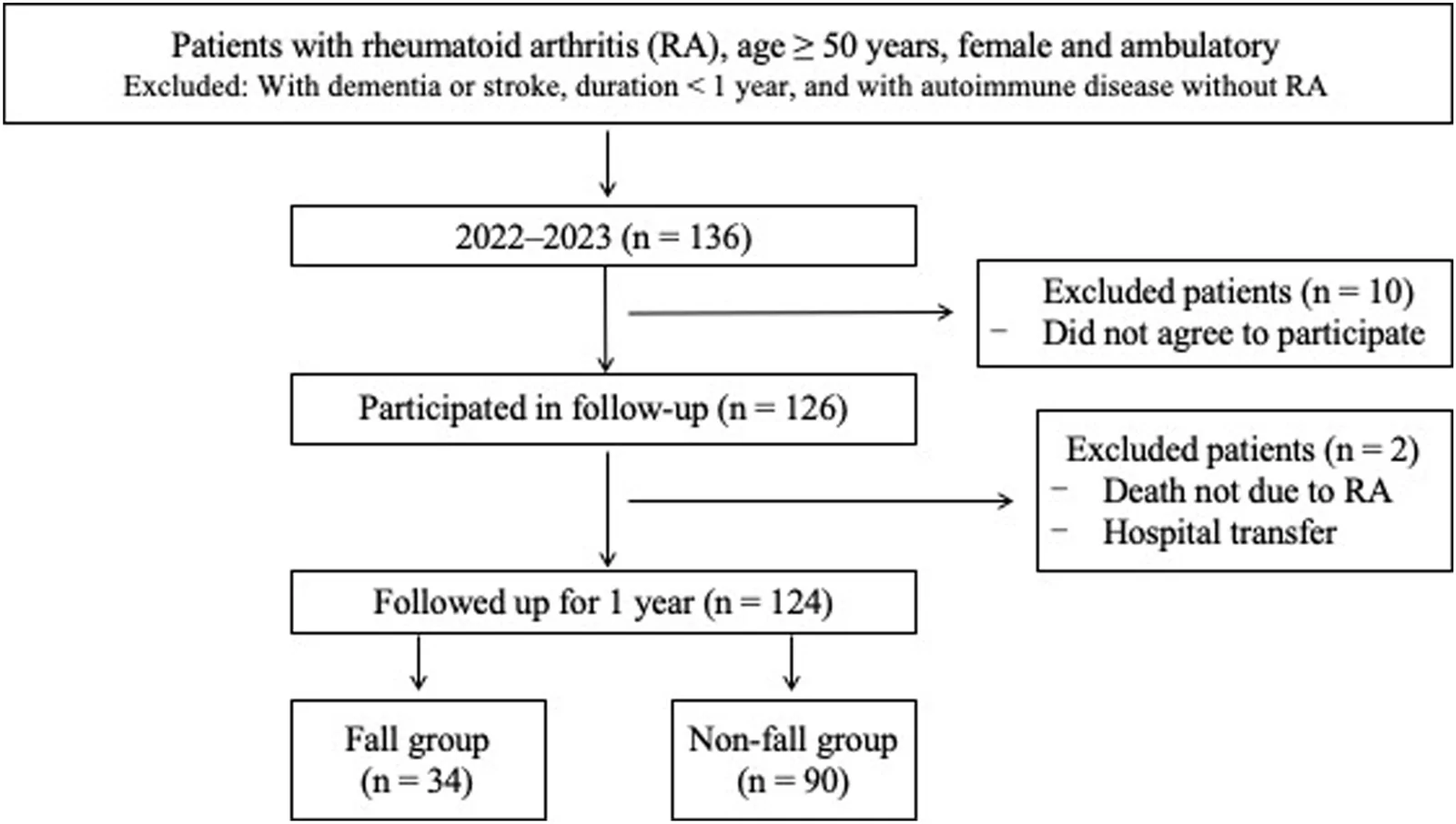
OBJECTIVES: To re-evaluate fall incidence and its determinants in a contemporary cohort of ambulatory women with rheumatoid arthritis (RA) in a follow-up study based on our previously published cohort data. METHODS: We prospectively evaluated 124 ambulatory female patients aged ≥50 years with RA at a single institution in 2022-2023, monitoring falls for 1 year. Outcomes included patient characteristics, sarcopenia, disease activity, and physical function. Multivariable logistic regression and Firth-penalized logistic regression were used in sensitivity analysis to assess the interaction between sarcopenia and glucocorticoid (GC) use. RESULTS: The annual fall rate in the 2022-2023 cohort was lower than in our previous cohort (27.4% vs. 50.0%). History of falls (odds ratio [OR] 2.76, 95% confidence interval [CI] 1.02-7.45, P = 0.045) and hypnotics/anxiolytics use (OR 3.92, 95% CI 1.01-15.20, P = 0.048) were independent risk factors for falls. A significant interaction between sarcopenia and GC use was observed in the initial analysis but was no longer statistically significant in sensitivity analyses. CONCLUSIONS: Compared with our previously reported cohort, the contemporary RA cohort showed a lower fall rate and a different pattern of associated risk factors. Further research is needed to explore the potential interaction between sarcopenia and glucocorticoid use. The observed interaction should be considered exploratory.
The paper
Tottori University
Osteoporosis and Sarcopenia, 8 Sep 2026