Comparative effects of six exercise modalities on global cognitive function in Alzheimer's disease, Parkinson's disease, and mild cognitive impairment: a systematic review and network meta-analysis
Dose-response
Abstract
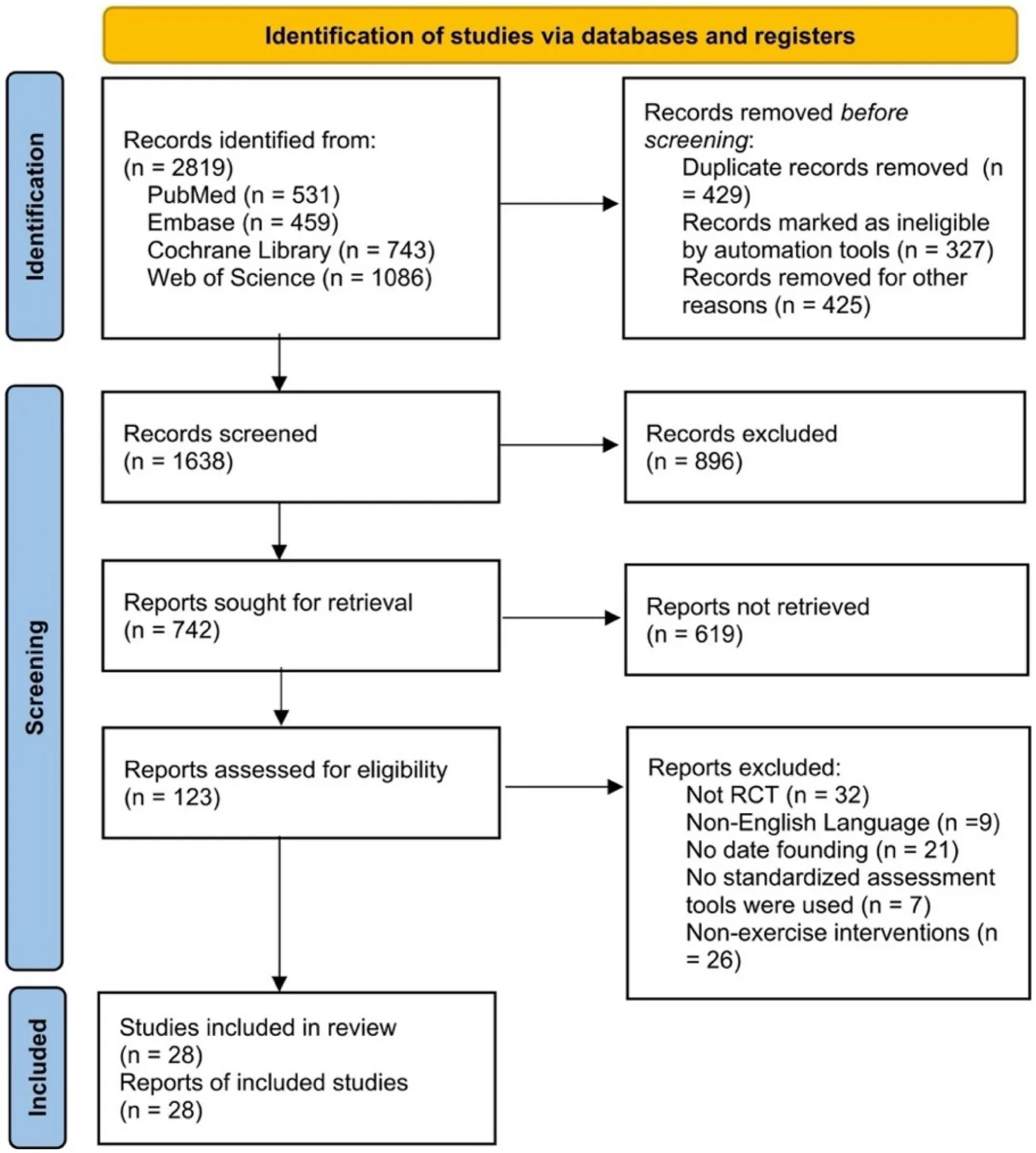
BACKGROUND: Alzheimer's disease (AD), Parkinson's disease (PD), and mild cognitive impairment (MCI) are commonly accompanied by cognitive decline. Although exercise is recommended as a non-pharmacological strategy, the comparative effects of different exercise modalities on global cognition remain uncertain. OBJECTIVE: To compare six exercise modalities-aerobic exercise (AE), mind-body exercise (MBE), resistance training (RT), multi-component exercise (MCE), flexibility training (FT), and functional training (FTr)-for global cognitive function in people with AD, PD, or MCI, and to explore dose-related associations. METHODS: PubMed, Embase, the Cochrane Library, and Web of Science were searched from inception to January 26, 2026. Randomized controlled trials (RCTs) were synthesized using a frequentist random-effects network meta-analysis (NMA) with standardized mean differences (SMDs) and 95% confidence intervals (CIs). Treatment rankings were summarized using SUCRA. Subgroup analyses, meta-regression, diagnosis-related sensitivity analyses, and CINeMA certainty assessments were also performed. RESULTS: Twenty-eight trials involving 1,993 participants were included. Compared with control group (CG), AE [SMD = 0.47, 95% CI (0.18, 0.77)], MBE [SMD = 0.79, 95% CI (0.46, 1.11)], RT [SMD = 1.50, 95% CI (0.77, 2.23)], MCE [SMD = 0.83, 95% CI (0.26, 1.40)], and FTr [SMD = 0.83, 95% CI (0.13, 1.53)] improved global cognition, whereas FT showed no clear effect [SMD = -0.20, 95% CI (-1.27,0.87)]. RT ranked first, followed by MCE, FTr, MBE, AE, and FT. Heterogeneity was substantial (τ² = 0.23; I² = 80%), although no statistically significant global incoherence was detected. RT remained first after the exclusion of AD, PD, or MCI studies. Studies lasting more than 12 weeks, delivered 3-5 times per week, and using sessions of 31-60 min showed favorable pooled effects, but subgroup interaction tests and meta-regression were not significant. Certainty of evidence ranged from low to very low. CONCLUSION: AE, MBE, RT, MCE, and FTr may improve global cognition in people with AD, PD, or MCI. RT showed the largest effect estimate and the most favorable ranking. However, substantial heterogeneity and sparse evidence for several modalities limit firm conclusions. Exercise selection should be individualized, and dose-related findings require confirmation in adequately powered comparative trials.
From the paper
- Participants
The 28 included RCTs enrolled 1,993 participants aged 58–86 years across 13 countries (China, France, America, England, Australia, Spain, Croatia, Italy, Canada, Denmark, Germany, Brazil, Netherlands).
- Result
Compared with CG, AE [SMD = 0.47, 95% CI (0.18, 0.77)], MBE [SMD = 0.79, 95% CI (0.46, 1.11)], RT [SMD = 1.50, 95% CI (0.77, 2.23)], MCE [SMD = 0.83, 95% CI (0.26, 1.40)], and FTr [SMD = 0.83, 95% CI (0.13, 1.53)] showed significant benefits.
- Limitation
The evidence network was uneven, with RT, FTr, and FT informed by only three, two, and one trials, respectively.
Quoted word for word from the full text on frontiersin.org.
The paper
Hebei Normal University
Frontiers in Neurology, 25 Sep 2026