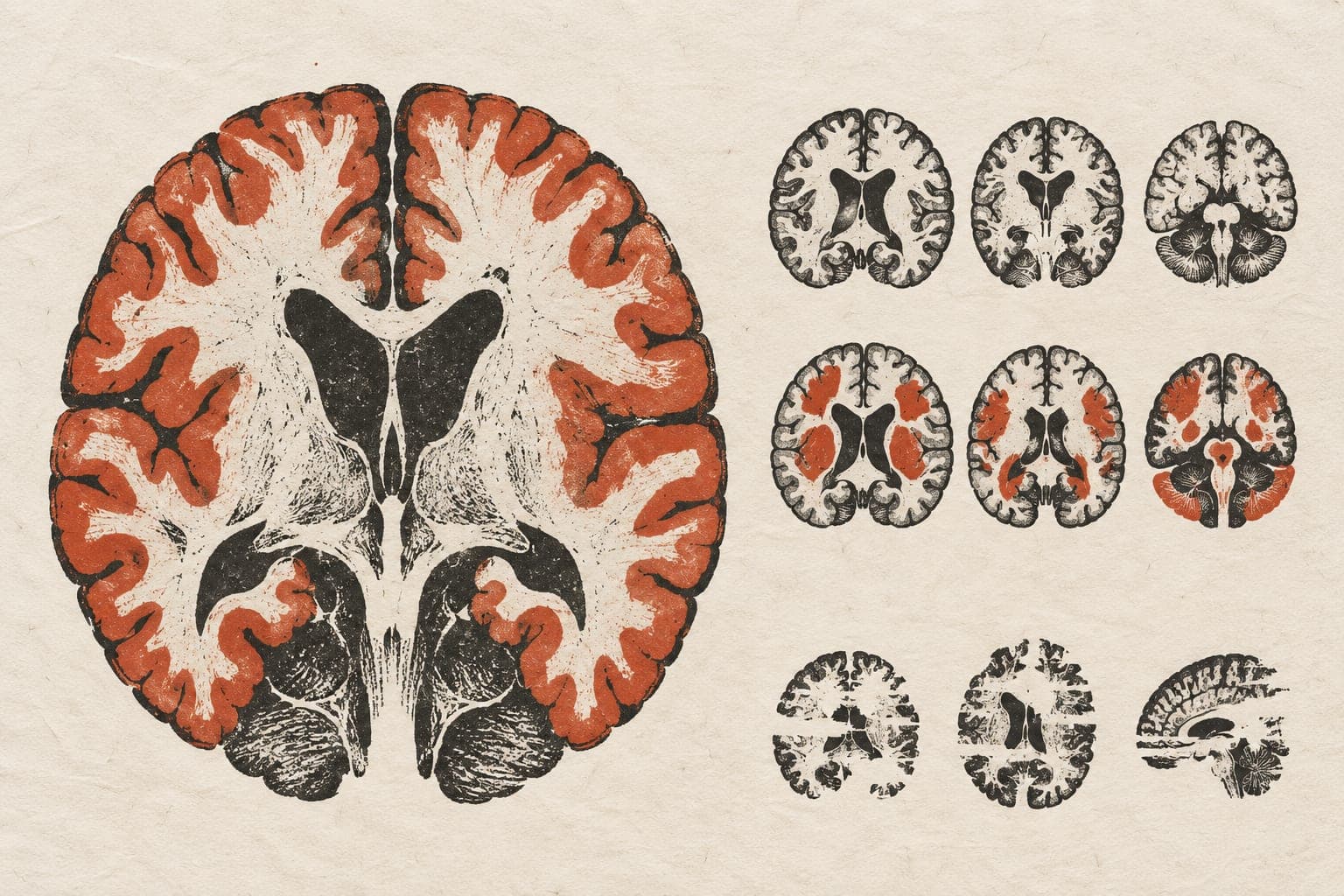
Human white-matter connections form four reproducible patterns
Four patterns captured most variation in connections across 438 brain regions and were reproducible across repeated scans and independent datasets.
Research Square
An observational study in people used diffusion magnetic resonance imaging, a type of brain scan, to map white matter—the nerve fibres connecting brain regions. The researchers developed a method to summarise connections across 438 regions as a few broad patterns. Four patterns captured most variation in these connections and were reproducible across repeated scans and independent datasets, including a young-adult cohort.
The structural patterns showed limited correspondence with patterns of coordinated brain activity. Older age was associated with less separation within one structural pattern between the cerebellum, a brain region involved in coordinating movement, and regions of the brain’s outer layer that integrate different kinds of information.
Why it matters
The framework offers a way to study how the organisation of connections between brain regions differs with age.
Caveats
The observational age associations do not show that aging caused the differences in connection patterns. The paper is a preprint and has not been peer-reviewed.
The paper
A reproducible low-dimensional architecture of human white-matter connectivity
Research Square · 14 Aug 2026 · Preprint, not peer-reviewed