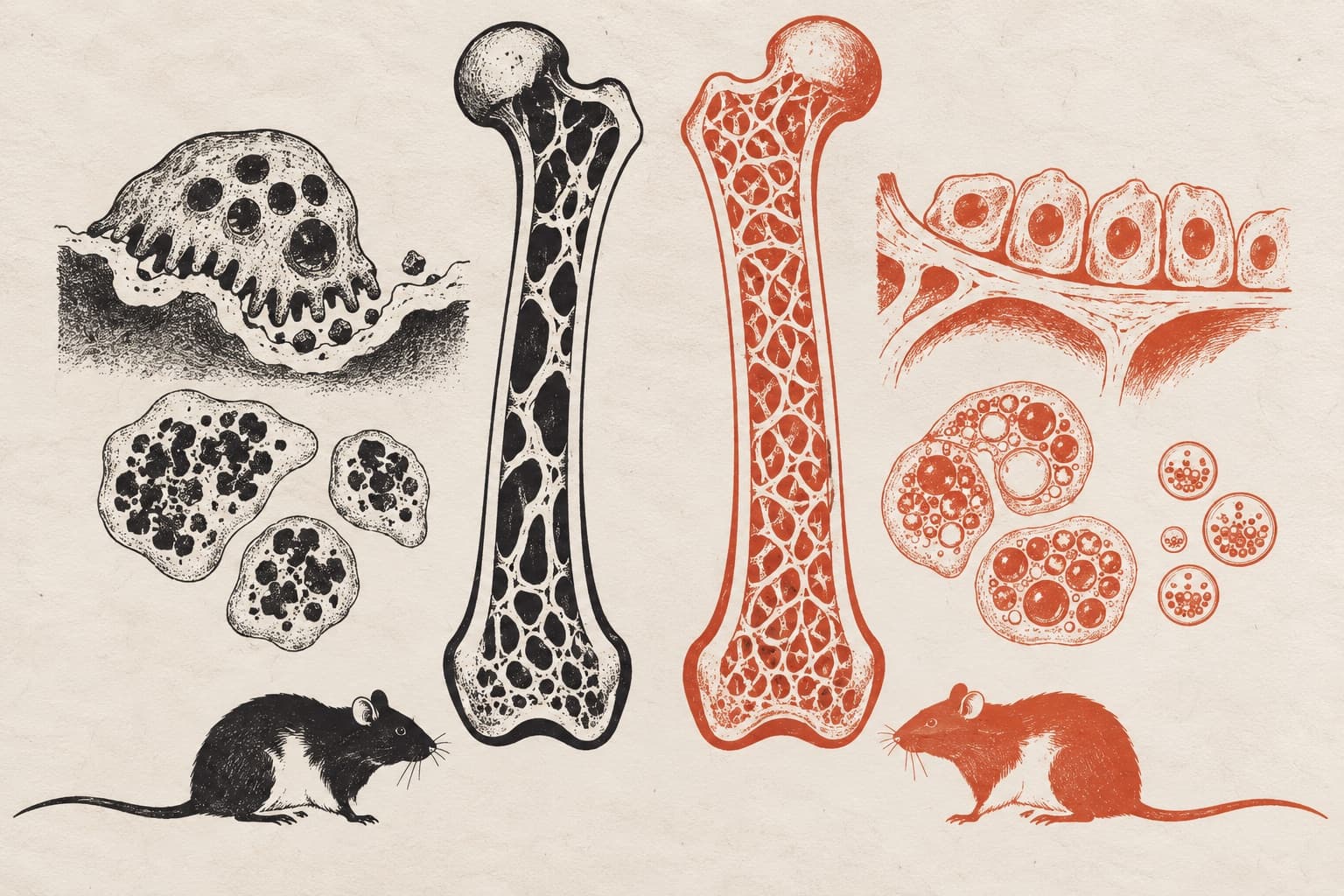
Chronic stress worsened bone loss in mice after ovary removal
In an animal experiment, mice whose ovaries had been removed showed worse osteoporosis and anxiety- and depression-like behaviour after eight weeks of chronic stress.
Journal of Cellular Biochemistry
In an animal experiment, researchers studied ovariectomised mice—mice whose ovaries had been removed—with osteoporosis, a condition that weakens bones. After eight weeks of chronic stress, the mice showed anxiety- and depression-like behaviour and worse osteoporosis. Bone tissue contained more cathepsin K, a protein-cutting enzyme, alongside markers of inflammation and cell death. Markers also indicated reduced autophagy, the process by which cells break down and recycle their components. E64d, an inhibitor of protein-cutting enzymes, reversed these changes.
The researchers also exposed lab-grown mouse cells resembling bone-forming cells to serum, the fluid left after blood clots, from stressed mice. This reduced cell viability, their ability to stay alive. Inhibiting cathepsin K restored autophagy and reduced cell injury. The researchers concluded that stress accelerated bone loss at least partly through cathepsin K activation and reduced autophagy.
Why it matters
Osteoporosis is an age-related disease that makes bones fragile. Understanding how mood-related disturbances interact with bone maintenance may help guide research into this disease.
Caveats
The evidence came from an animal model and cells grown in the lab, not people. The abstract did not report the number of mice studied.
The paper
Show 10 more authors
Chaozhi Xu, Wanhua Wu, Guixian Wu, Yulin Zhang, Zongyi Zhang, Yue Hu, Lin Yang, Xianji Piao, Wenjun Lu, Hongxian Wu,Guilin Medical University
Journal of Cellular Biochemistry · 1 Oct 2026