DECIPHER decodes cell types and predicts age from bulk omics
Tested across multiple molecular platforms, the framework separates technical variation from biological signal to infer cell proportions and chronological age across independent human cohorts.
Our read
AI & data- Studied:
- Preprint: computational study
Editor of record: Boris Djordjevic · AgingResearch.News
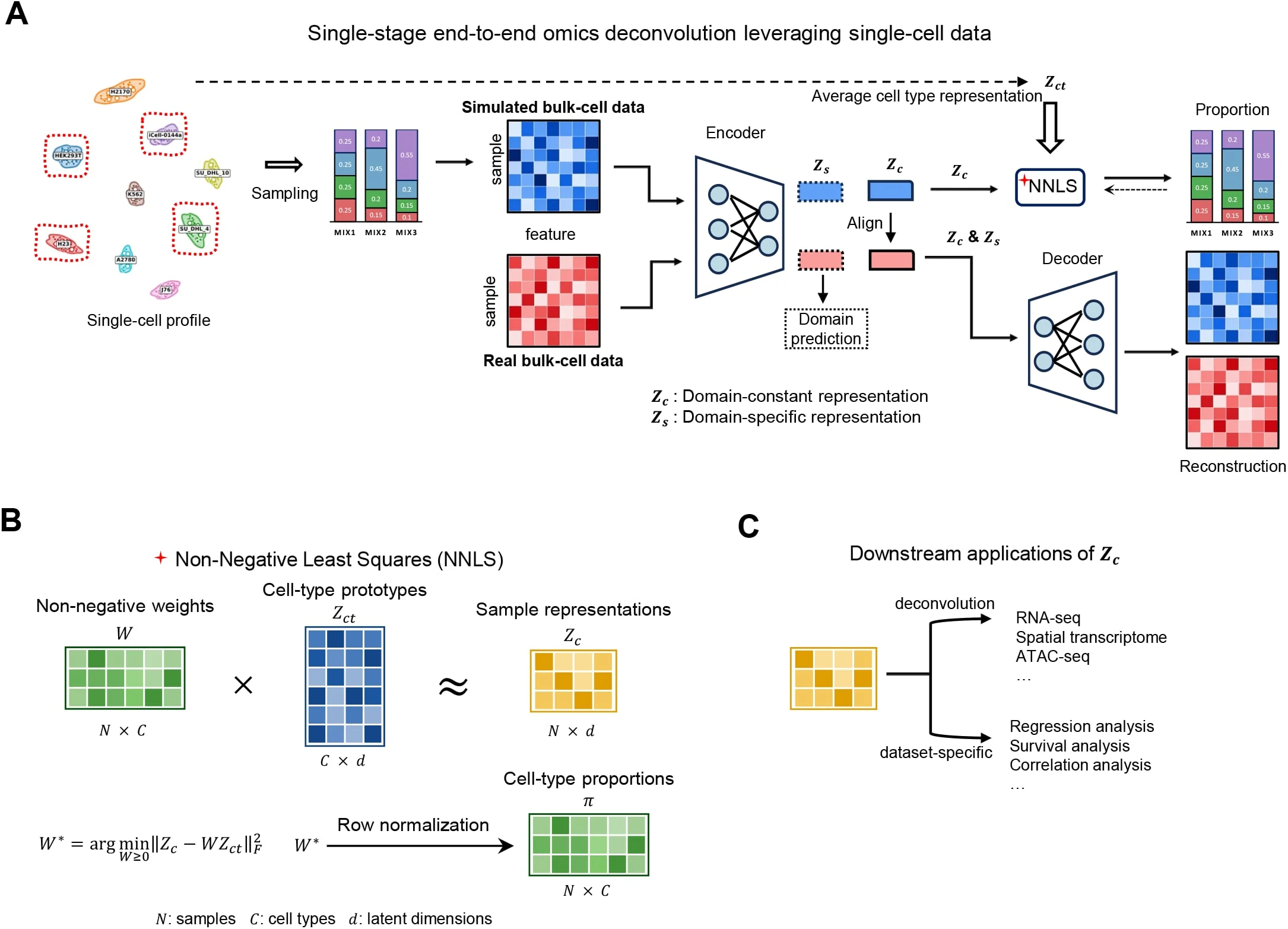
In a computational study using simulated benchmarks, experimental cell mixtures, and human datasets, researchers developed DECIPHER to infer cell-type composition from bulk omics data across multiple molecular modalities. The framework addresses technical batch effects by learning two distinct components: a domain-constant representation that captures shared biological features and a domain-specific representation that models platform-associated noise. By integrating nonlinear representation learning with differentiable non-negative least-squares optimization, the algorithm estimates cell-type proportions directly from the domain-constant space. Across simulated datasets, experimental cell mixtures, and real-world multi-omics benchmarks, DECIPHER produced robust and competitive deconvolution performance. Beyond identifying cell fractions, the learned domain-constant representations successfully predicted chronological age across independent cohorts and stratified clinical prognosis in lung adenocarcinoma.
Why it matters
Tissues shift in cellular makeup as they age, but bulk molecular profiling masks cell-specific shifts behind aggregate signals. A method that accurately resolves cell types across different omics platforms while preserving biological age signatures helps researchers extract cell-level aging insights from massive existing tissue databases.
Caveats
The study was published as a preprint and has not undergone peer review. As a computational method, its utility depends on the quality of reference datasets and requires further validation across broader prospective cohorts.
From the paper
- Result
The risk score remained prognostic in both cohorts (GSE81089: HR = 2.14, 95% CI = 1.15-3.99; C-index = 0.600; GSE143486: HR = 2.57, 95% CI = 1.00-6.56; C-index = 0.603).
Results, Prognostic stratification using latent representations of DECIPHER in lung adenocarcinoma
- Limitation
First, although DECIPHER can be applied across multiple molecular modalities, the current implementation remains task-specific and requires separate model training for individual reference-target settings rather than allowing a single trained model to be directly transferred across tissues …
Quoted word for word from the full text on bioRxiv.
The paper
Jinan University
bioRxiv, Sep 29, 2026, Open access, Preprint, not yet peer-reviewed


Comments
Be the first to comment.