White matter damage is linked to greater cortical thinning in men
In 104 older adults followed for nine years, white matter aberrations grew 7.2% annually, tracking greater cortical thinning and expanded cortical area in men.
Human Brain Mapping
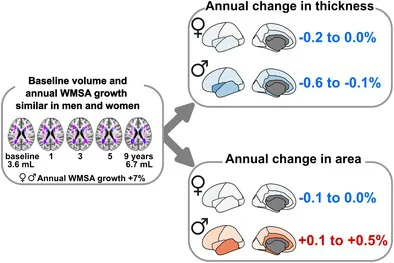
In a longitudinal study of 104 older adults followed over nine years, researchers tracked how white matter signal aberrations—a proxy for cerebral small vessel disease—relate to cortical changes. Participants had an average baseline age of 72.4 years and underwent brain MRI scans at baseline and at one, three, five, and nine years. Across both sexes, baseline aberration volume was 3.6 cm³ and grew at an average annual rate of 7.2%. Increasing aberrations were associated with accelerated cortical thinning over time, compounding typical aging changes. This link was more pronounced and occurred in more lobes in men than in women, despite both sexes having similar aberration volumes and growth rates. In men alone, these affected lobes also showed an unexpected increase in cortical area. Aberration growth was not associated with hippocampal volume changes.
Why it matters
The findings suggest that cerebral small vessel disease may contribute to sex-specific patterns of brain aging and cortical structural shifts beyond typical age-related decline.
Caveats
The observational design means the findings remain correlational, and white matter aberrations were evaluated as a proxy for small vessel disease. The cohort was also limited to 104 older adults.
The paper
Norwegian University of Science and Technology · University Hospital of North Norway
Human Brain Mapping · 29 Sep 2026 · CC BY-NC-ND