More brain training may sustain gains in everyday tasks
A randomized trial compared 10 and 20 hours of digital training, with self-rated daily-task gains lasting six months in the higher-dose group.
67 participants, double-blind, registered NCT03911765
Limit: Physical exercise and social or cognitive activities were not strictly controlled during follow-up
Stake: An author founded NeuroForma.
Edited by Boris Djordjevic · AgingResearch.News
Researchers randomized 87 adults aged 60 or older with mild neurocognitive disorder, a modest decline in thinking abilities, in a double-blinded trial. Most participants were women, and their mean age was 74.9. One group completed 20 hours of digital cognitive training at home. The other played commercial computer games for 10 hours before completing 10 hours of training.
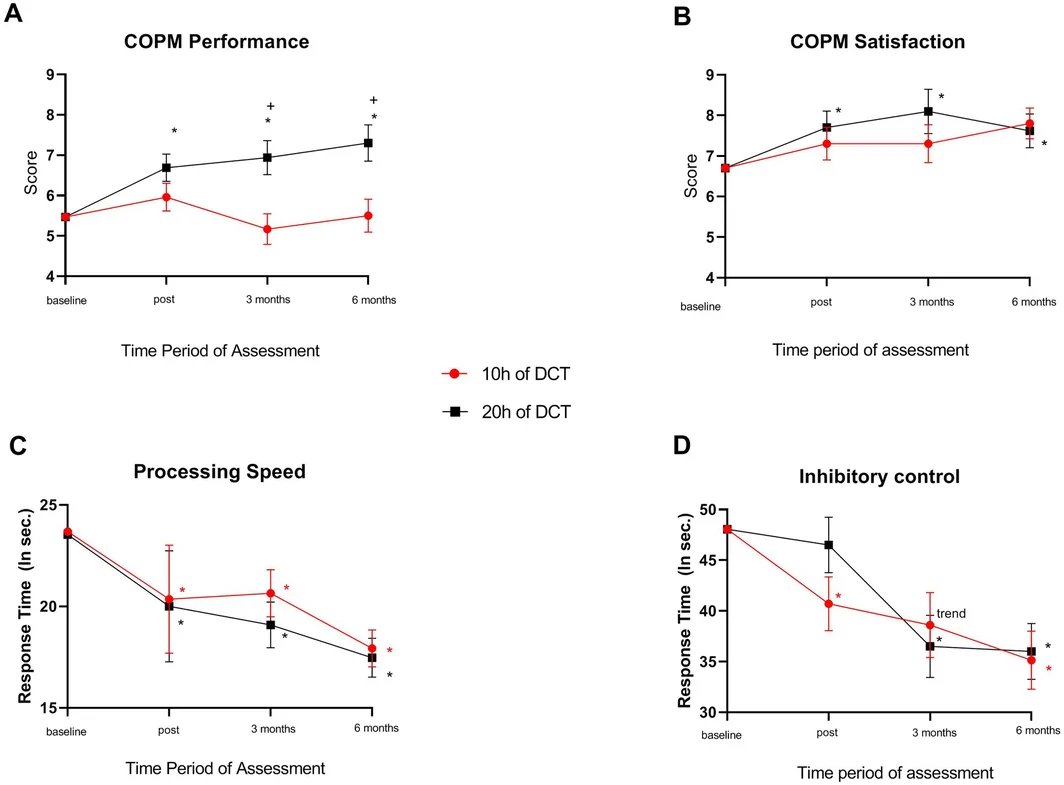
Sixty-seven participants completed training. The 20-hour group reported improved ability to perform personally important everyday tasks and greater satisfaction with that performance. These gains persisted at three and six months; no improvement was detected on these measures in the 10-hour group. Both groups improved in processing speed. Another questionnaire covering daily activities showed no benefit. The authors suggested that more training may yield more sustained gains in everyday functioning.
Why it matters
For older adults with mild neurocognitive disorder, the study addresses how much cognitive training may be needed to support everyday independence over time.
Caveats
The analysis included only completers, just 31 participants were assessed at six months, and the main functional gains were self-reported. The trial excluded people with dementia, dependence in daily activities or major medical conditions that prevented participation.
From the paper
- Participants
Eighty‐seven participants were randomly assigned to one of the two groups: 10 h of DCT (n = 45) or 20 h of DCT (n = 42).
- Who took part
Eligibility criteria for inclusion in the study were: age ≥ 60 years; normal or corrected vision and hearing; access to the internet; and diagnosis of Mild Neurocognitive Disorder based on DSM‐5 criteria.
- Ages
Participants were predominantly composed of women with 14 years of education (SD = 5.2) and a mean age of 74.9 (SD = 7.2).
- Duration
Thus, one group performed a total of 10 h of DCT and the other performed 20 h of DCT.
- Analyzed for functionality
Of the total number of randomized participants, 67 completed the protocol of DCT, while 41 were evaluated 3 months post‐training of DCT, and 31 were evaluated 6 months post‐training.
- Functionality
The follow‐up assessment revealed a main effect of time in COPM performance for the 20 h of DCT group after 3 months (F (1, 14) = 14.0, p = 0.001, d = 2.37) with a significant group‐by‐time interaction (F (1, 33) = 14.11, p = 0.001, d = 1.03).
Results, Changes in Functionality and Cognition in the Follow‐Up
- Cognitive function
Post hoc analyses demonstrated improvements over time in specific domains for the 10 h DCT group, including processing speed (F (1, 31) = 14.81, p = 0.001, d = 1.38), recognition (F (1, 25) = 33.44, p < 0.001, d = 2.31), learning over trials (F (1, 25) = 9.74, p = 0.004, d = 1.24), and inhibitory control (F (1, 31) = 10.01, p = 0.003, d = 1.13 …
Results, Changes in Functionality and Cognition Post‐Training
Quoted word for word from the full text on PubMed Central.
The paper
Universidade Federal do Rio de Janeiro
Geriatrics & Gerontology International, Sep 26, 2026, Open access, CC BY