Blood protein score linked to disease and death in adults
The 50-protein score tracked a conventional measure of cumulative physiological strain, with a correlation of 0.72 in participants withheld from model development.
Independent replication
Limit: Diabetes and kidney disease associations may partly reflect hemoglobin A1c and creatinine in score training
Edited by Boris Djordjevic · AgingResearch.News
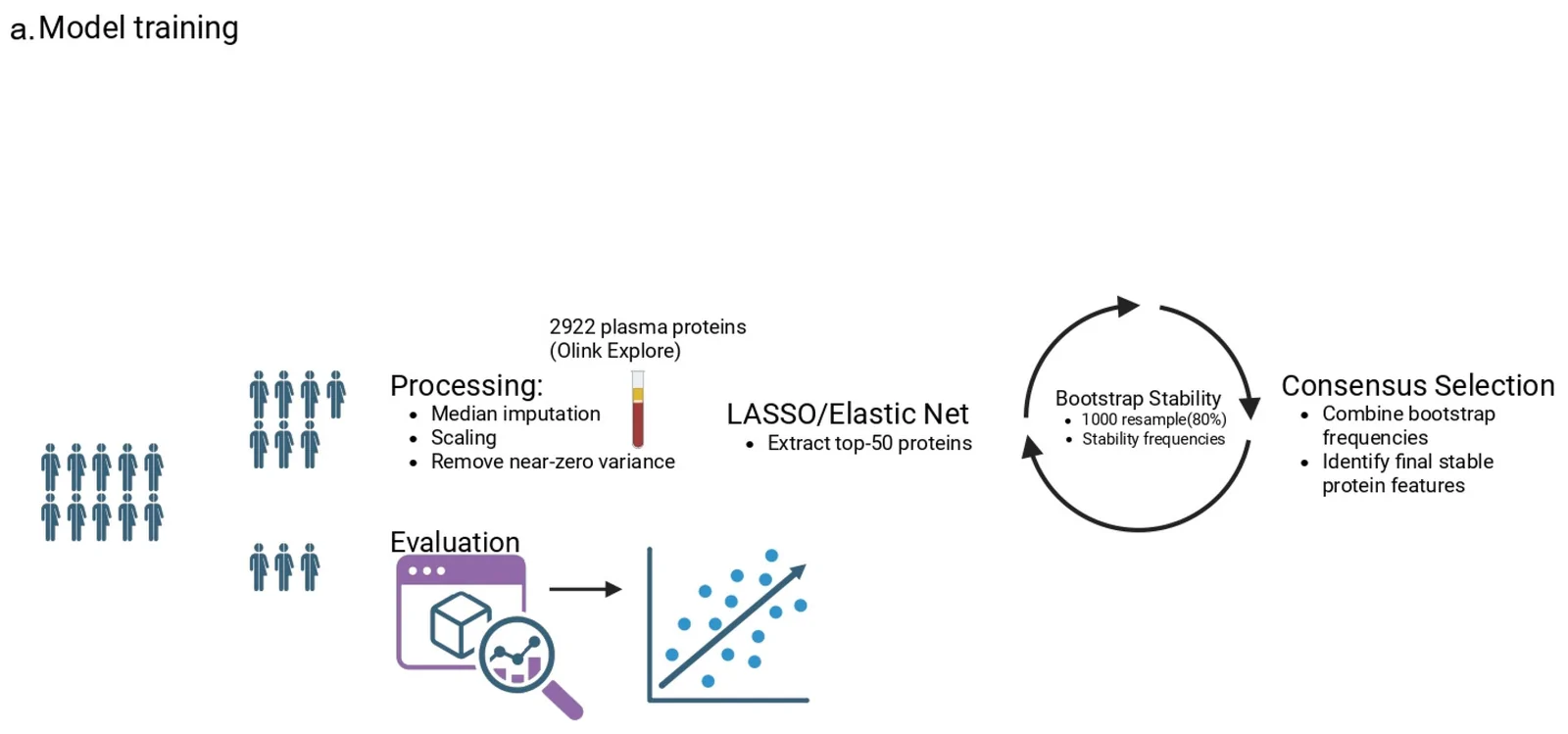
An observational cohort study used UK Biobank data from adults enrolled at ages 40–69 to develop a blood protein score and examine its associations in 37,089 participants. The score, ProAL50, used 50 proteins to estimate allostatic load, the cumulative strain on body systems associated with chronic stress. Researchers trained it against a conventional score based on clinical measurements and tested it in a separate subset.
The protein score correlated with conventional allostatic load at 0.72 in the UK Biobank test group and 0.62 in an independent US cohort. Over approximately 11.8 years in UK Biobank, higher scores were associated with several chronic diseases, including type 2 diabetes, chronic liver disease and cancer, and with death. These associations were broadly comparable to those of conventional allostatic load.
Why it matters
Cumulative physiological strain provides a way to study links between chronic stress and age-related disease. The authors propose the protein score as a research tool that complements conventional measures.
Caveats
This observational analysis cannot establish cause and effect, and its primary sample excluded people with disease at baseline. External validation assessed agreement with conventional allostatic load, not disease prediction; further validation and standardized protein testing are needed.
From the paper
- Participants
A total of 40,874 participants were included in the final score construction.
- Follow-up
… with 2405 subsequent events and a median post-landmark follow-up of 9.81 years (IQR 9.14–10.52); ProAL50 remained associated with incident disease in Model 1 (HR = 2.74, 95% CI 2.62–2.86) and in the mutually adjusted model (HR = 2.26, 95% CI 2.14–2.40), with an incremental ΔC beyond AL of 0.025.
Results, 3.4. ProAL50 Predicts Risk of Common Chronic Diseases
- Result
Compared with participants reporting a slow walking pace, those reporting a brisk pace exhibited substantially lower AL (β = −0.52, 95% CI −0.56 to −0.49) and ProAL50 (β = −0.54, 95% CI −0.57 to −0.50).
Results, 3.3. General and Mental Health Associated with ProAL50
- Limitation
First, ProAL50 is a supervised signature anchored to traditional AL, so it inherits limitations of the AL construct itself, including a dichotomization-based training target and the use of standard rather than ancestry-specific thresholds; reassuringly …
Quoted word for word from the full text on PubMed Central.

