Uric acid-to-lymphocyte ratio as a mediator between comorbidity and fall risk in older adults
5 years
Abstract
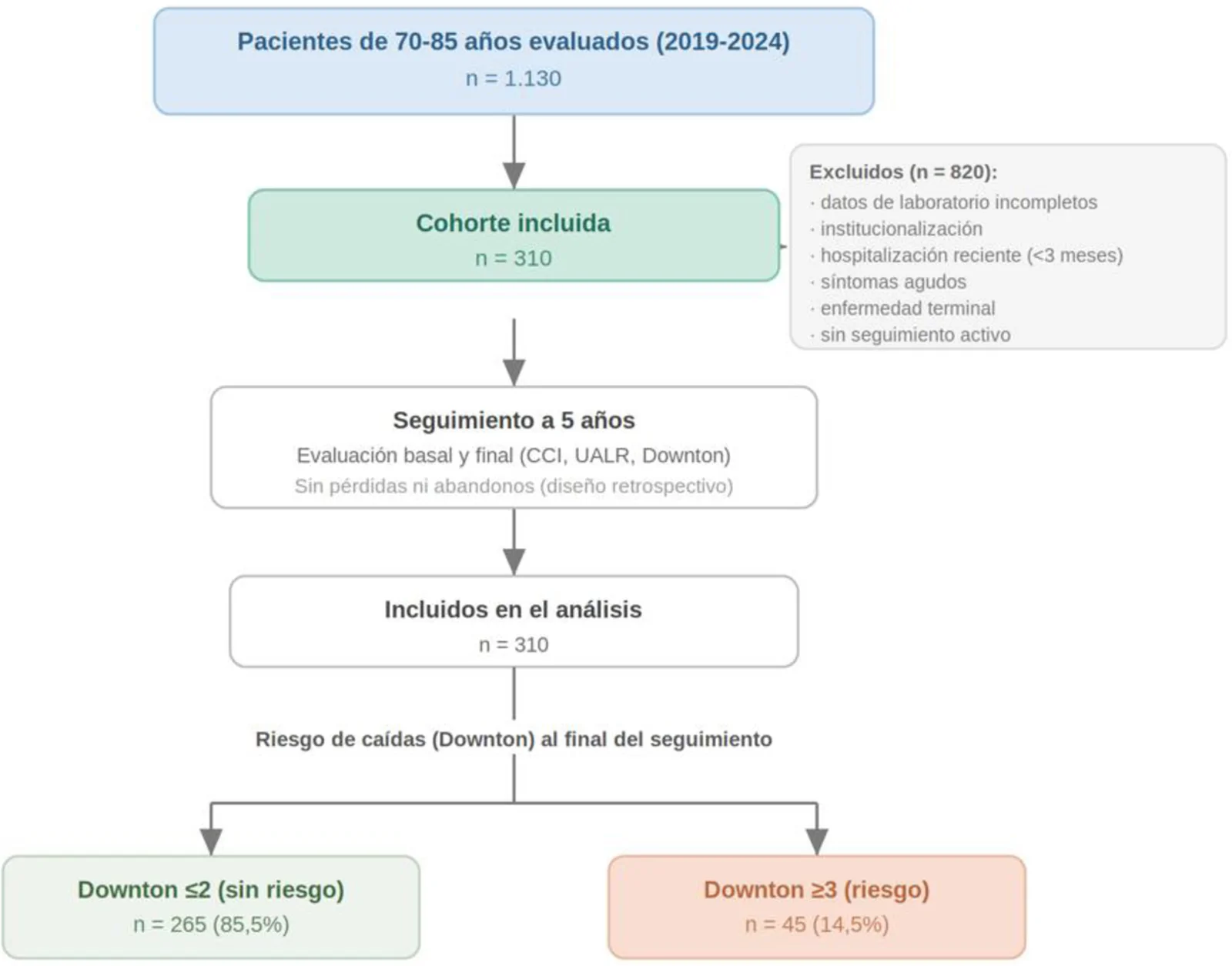
OBJECTIVE: To quantify the proportion of the association between comorbidity and fall risk mediated by the uric acid-to-lymphocyte ratio (UALR) in older adults, and to assess its invariance across sex. DESIGN: Observational retrospective longitudinal cohort study, with 5-year follow-up. SETTING: Primary care. PARTICIPANTS: 310 community-dwelling adults aged 70-85 years (52.6% women) under active follow-up. MAIN MEASUREMENTS: Charlson Comorbidity Index (CCI); baseline uric acid/lymphocytes (UALR) and its change; incident high fall risk (Downton fall risk index ≥3). Mediation was estimated using structural equation modeling (SEM-WLSMV) with bias-corrected and accelerated (BCa) bootstrap and replicated using the PROCESS macro for SPSS; sex invariance with the Satorra-Bentler Δχ² test. RESULTS: The indirect effect of UALR was significant (a×b=0,040; 95%CI 0,007-0,072; p=0,016), with a proportion mediated of 33.8% (p=0,054). The UALR → fall-risk association (B=0,402; P<0,001; OR=1.49) was about 4 times larger than CCI → UALR (B=0.099; p=0.003). The direct effect was borderline (c'=0,078; p=0,060). No sex differences were detected (Δχ²=1.133; p=0,769), with limited power. CONCLUSIONS: UALR mediates a substantial part of the comorbidity-incident high fall-risk association and is more strongly associated with falls than comorbidity itself. Obtainable from routine blood tests, it could be useful for risk stratification in primary care, pending validation in independent prospective cohorts.
The paper
Universidad de La Laguna
Atencion Primaria, 22 Sep 2026