Machine learning reconstructs bone signals in human cadaver hands
Across 38 cadaver hands, reconstructed bone signals had an average correlation of 0.987 with signals measured after the bones were exposed.
Our read
Biomarkers- Studied:
- Study of 38 female cadaveric donors
- What changed:
- Reconstructed bone signals had a mean absolute percentage error of 17.82% relative to directly measured signals
- The catch:
- Reconstruction overestimated organic matrix peaks in normal bones and underestimated them in osteoporotic bones
Editor of record: Boris Djordjevic · AgingResearch.News
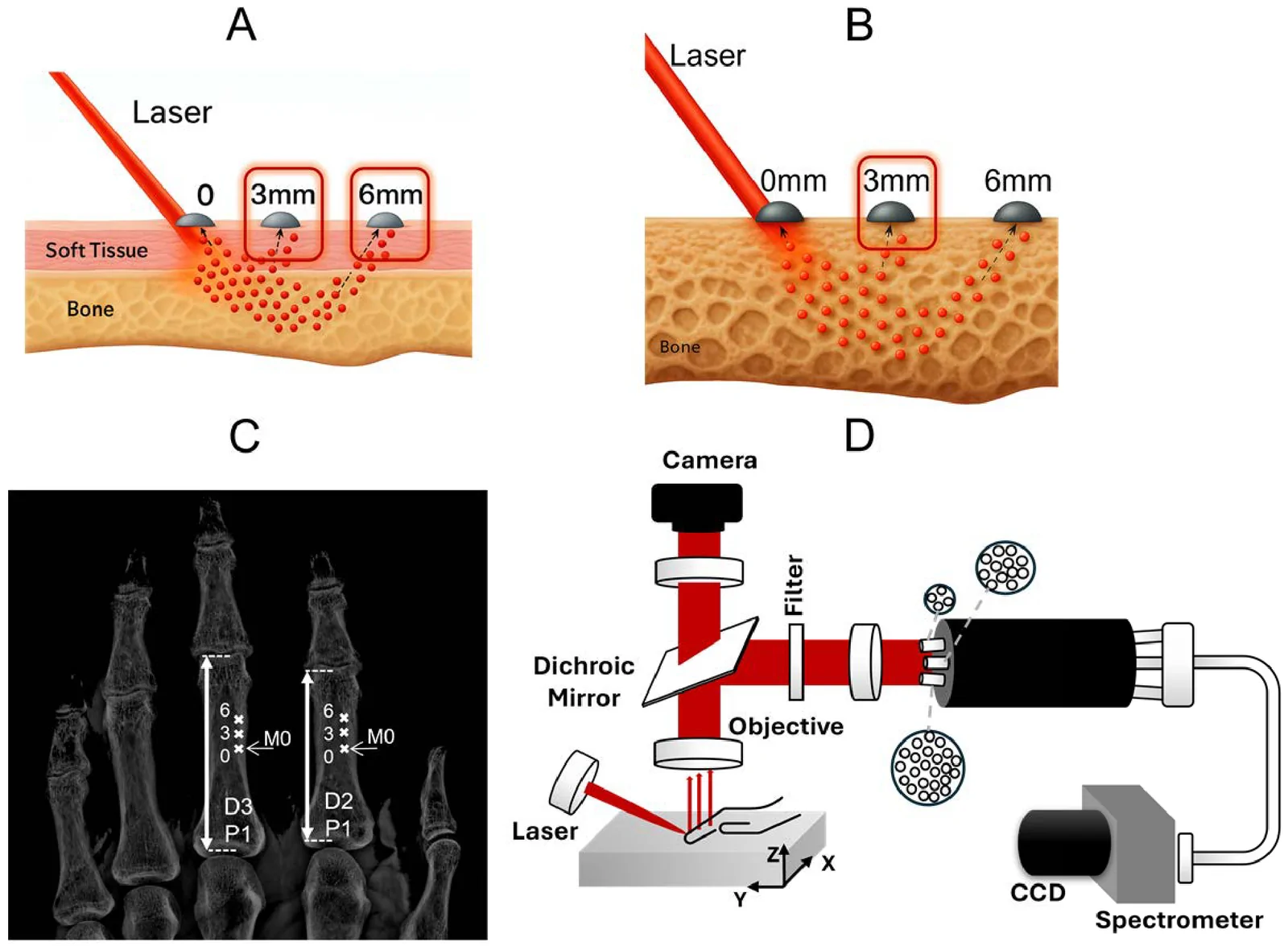
A human cadaver study used hands from 43 female donors aged 40–99, spanning normal bone density, low bone density and osteoporosis. Researchers measured patterns of scattered laser light from fingers through skin, then measured the same bones after removing the surrounding soft tissue. They trained machine-learning models to reconstruct the exposed-bone patterns from the through-skin readings. They tested each donor’s measurements using models trained on other donors.
The reconstruction analysis covered 38 hands. Reconstructed patterns retained differences in bone composition associated with bone health. Predictions based on these patterns correlated with forearm bone-density scan scores, with a correlation of 0.69.
Why it matters
Osteoporosis often remains undetected until a fracture. The authors see accessible finger measurements as a potential complement to standard bone-density screening.
Caveats
Model validation relied on cadaver measurements, not tests of osteoporosis detection in living people. Preliminary measurements in a 33-year-old man and a 28-year-old woman showed bone-related signals but did not validate screening performance.
From the paper
- Limitation
First, although the cadaveric model provides an essential subject-matched ground-truth framework for validating bone signal extraction, it does not fully reproduce physiological in vivo conditions such as blood perfusion, temperature regulation, and tissue hydration.
Quoted word for word from the full text on PubMed Central.
The paper
University of Rochester
Biomedical Optics Express, Aug 25, 2026, Open access


Comments
Be the first to comment.