Early Gait Responsiveness as a Predictor of Functional Trajectory in Older Adults Undergoing Postacute Rehabilitation
Abstract
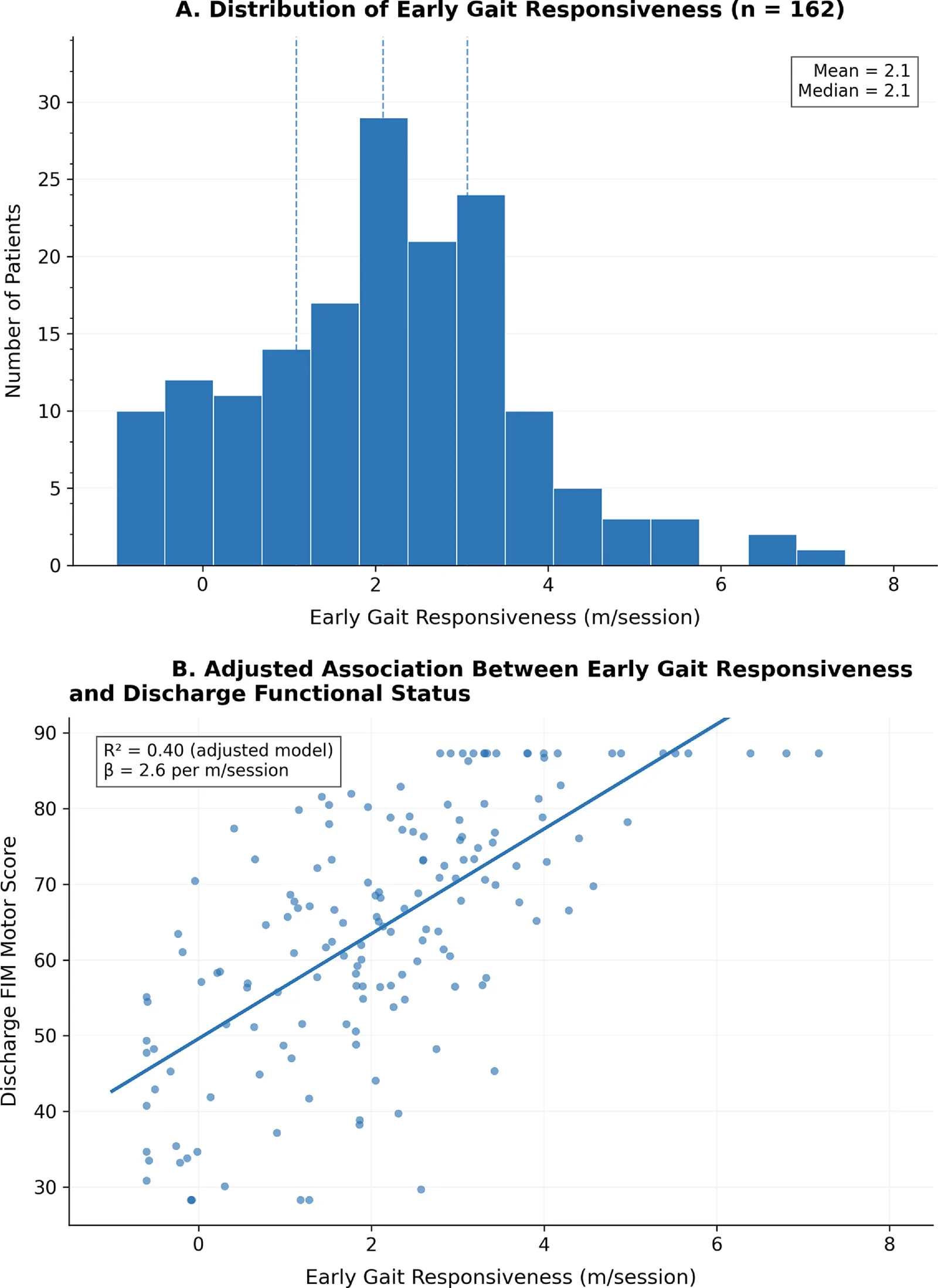
OBJECTIVE: To examine early gait responsiveness as a predictor of rehabilitation outcomes in older adults undergoing postacute rehabilitation. DESIGN: Retrospective cohort study. SETTING: Three skilled nursing facilities in Northern California. PARTICIPANTS: One hundred sixty-two adults aged ≥65 years admitted for postacute rehabilitation (2022-2023); 58% female; primary diagnoses: 38% orthopedic, 33% medical, and 28% neurologic. INTERVENTIONS: Not applicable (observational study). MAIN OUTCOME MEASURES: Discharge functional status (Functional Independence Measure motor subscale), length of stay, and discharge disposition. RESULTS: Early gait responsiveness was operationalized as the rate of change in gait distance across the first 5 physical therapy sessions. Mean early gait responsiveness was 2.1±1.6 m/session (range -0.6 to 7.4 m/session). Greater early gait responsiveness was independently associated with higher discharge functional status (β=2.6 per m/session; 95% confidence interval, [CI] 1.6-3.6), shorter length of stay (β=-2.0 d per m/session; 95% CI, -2.9 to -1.0), and increased odds of discharge home independently versus institutional placement (odds ratio=2.3; 95% CI 1.4-3.6). The addition of gait responsiveness improved model explanatory power beyond baseline function alone (R² 0.28-0.40). CONCLUSIONS: Early gait responsiveness is a clinically interpretable indicator of rehabilitation trajectory and may support earlier identification of patients at risk for suboptimal outcomes.
The paper
Department of Rehabilitation Services
Archives of Rehabilitation Research and Clinical Translation, 9 May 2026, Open access