Rates of 12 cancer types rose in younger Nordic adults
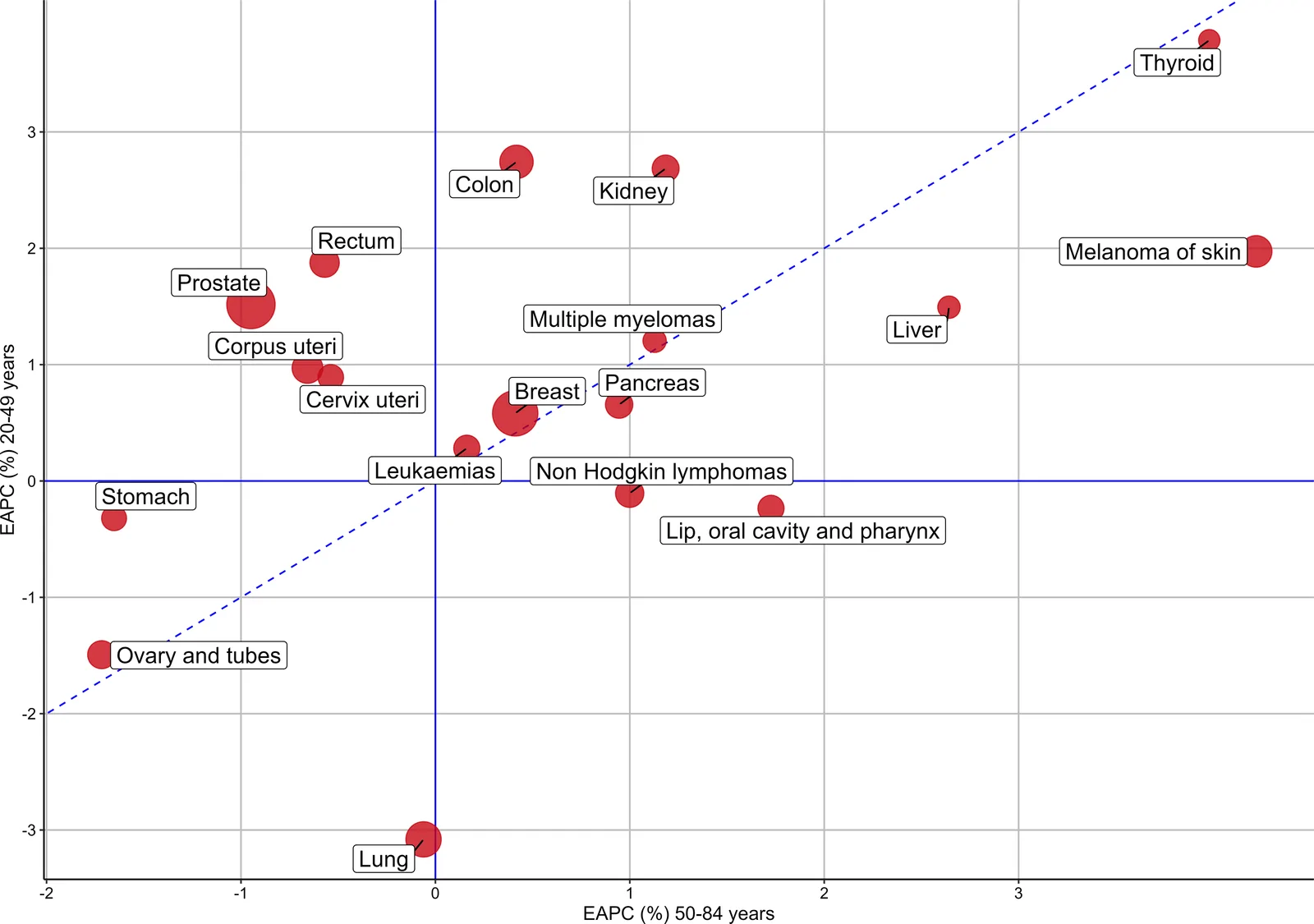
Colon cancer rates rose an estimated 2.7% annually at ages 20–49 versus 0.4% at ages 50–84; kidney cancer rates rose 2.7% versus 1.2%.
Our read
Populations- Studied:
- Study of Nordic adults aged 20-84 years, 2003-2022
- What changed:
- Cancer rates in younger adults rose for 12 of 18 cancer sites
- The catch:
- More intensive diagnosis can raise recorded cancer rates, particularly for thyroid cancer
- Stake:
- An author holds shares in Pfizer.
- Why it’s aging research:
- It looks at how biology varies with age or lifespan.
Editor of record: Boris Djordjevic · AgingResearch.News
In women and men aged 20–84 in Denmark, Finland, Iceland, Norway, Sweden, Greenland and the Faroe Islands, researchers examined 2,209,703 cancer cases recorded during 2003–2022. This population-based observational study used national cancer registry data to compare diagnosis rates at ages 20–49 and 50–84, accounting for differences in age distributions.
Rates increased for 12 of the 18 cancer types studied among adults aged 20–49. Colon, kidney and thyroid cancers had the largest estimated annual increases. Thyroid cancer rates rose 3.8% annually in younger adults and 4.0% in older adults. Across the 18 types, recorded cases at ages 20–49 rose from 47,491 in 2003–2007 to 56,665 in 2018–2022—an increase of 9,174 cases.
Why it matters
The comparison bears on how cancer patterns differ across adulthood and between generations. The authors suggested that changing early-life risk exposures and more intensive diagnosis likely contributed, with explanations differing by cancer type.
Caveats
Registry trends cannot establish what caused the increases. Denmark, Finland, Norway and Sweden contributed 98.3% of the cases diagnosed at ages 20–49.
From the paper
- Participants
In total, 2,209,703 incident cancer cases (women: N = 1,065,660; men: N = 1,144,043) were identified across the 18 selected cancer sites in the Nordic countries between 2003 and 2022.
Quoted word for word from the full text on PubMed Central.
The paper
Norwegian Institute of Public Health; Karolinska Institutet
The Lancet Regional Health Europe, Sep 12, 2026, Open access


Comments
Be the first to comment.