From domains to mechanisms of healthy psychological aging
Abstract
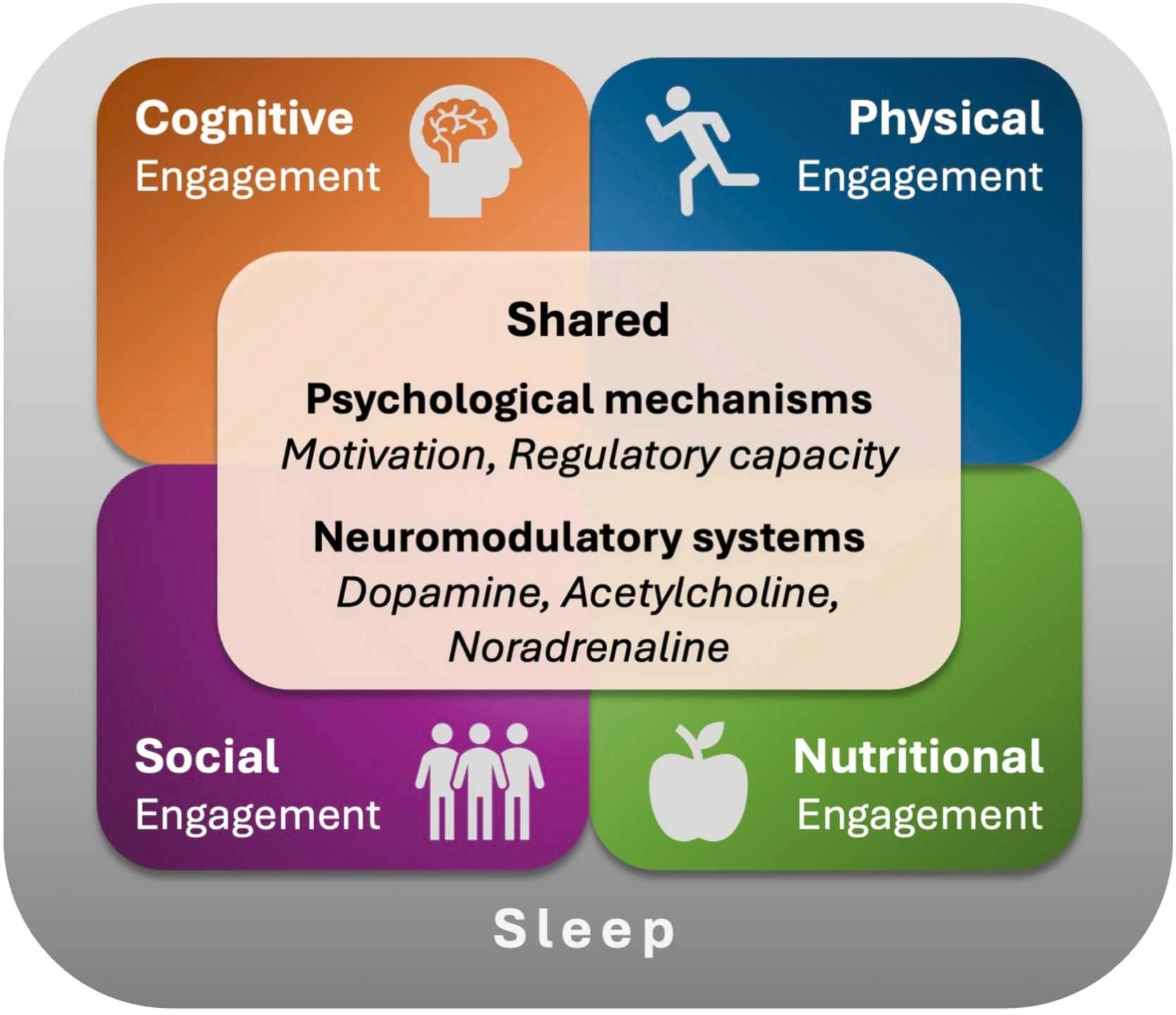
Healthy psychological aging has been consistently linked to patterns of behavioral engagement across everyday life, including cognitive, physical, social, and nutritional activities, alongside sleep. However, these domains are typically studied in isolation and conceptualized as additive risk or protective factors, which provides limited insight into how their effects are instantiated and maintained over time. Here, we propose a unifying framework in which diverse behavioral domains converge on shared psychological and neurobiological mechanisms that organize behavior across contexts and the lifespan. At the psychological level, motivational processes and regulatory capacity shape how behavior is initiated, sustained, and adjusted. At the neurobiological level, interacting dopaminergic, noradrenergic, and cholinergic systems coordinate valuation, arousal, and control processes, thereby translating motivational relevance into adaptive and flexible behavior. Within this framework, sleep occupies a distinct role as an integrative biological process that consolidates the effects of daytime engagement and feeds back onto motivational and regulatory functioning. By shifting the focus from domain-specific exposure to shared processes, this perspective provides a mechanistic account of interindividual variability and helps explain why domain-specific interventions often yield modest or transient effects. More broadly, it offers a principled foundation for understanding how behavior across domains is coordinated and stabilized over time in healthy psychological aging.
The paper
University of Lübeck
Neuroscience and Biobehavioral Reviews, 17 Sep 2026