Biological age adds little prediction beyond functional impairment
In adults aged 60 and older, biological age acceleration carried a modest link to mortality but showed no association with disability.
4,570 participants
Limit: Other biological age measures were omitted; both cohorts used the same 12-biomarker Klemera-Doubal panel
Edited by Boris Djordjevic · AgingResearch.News
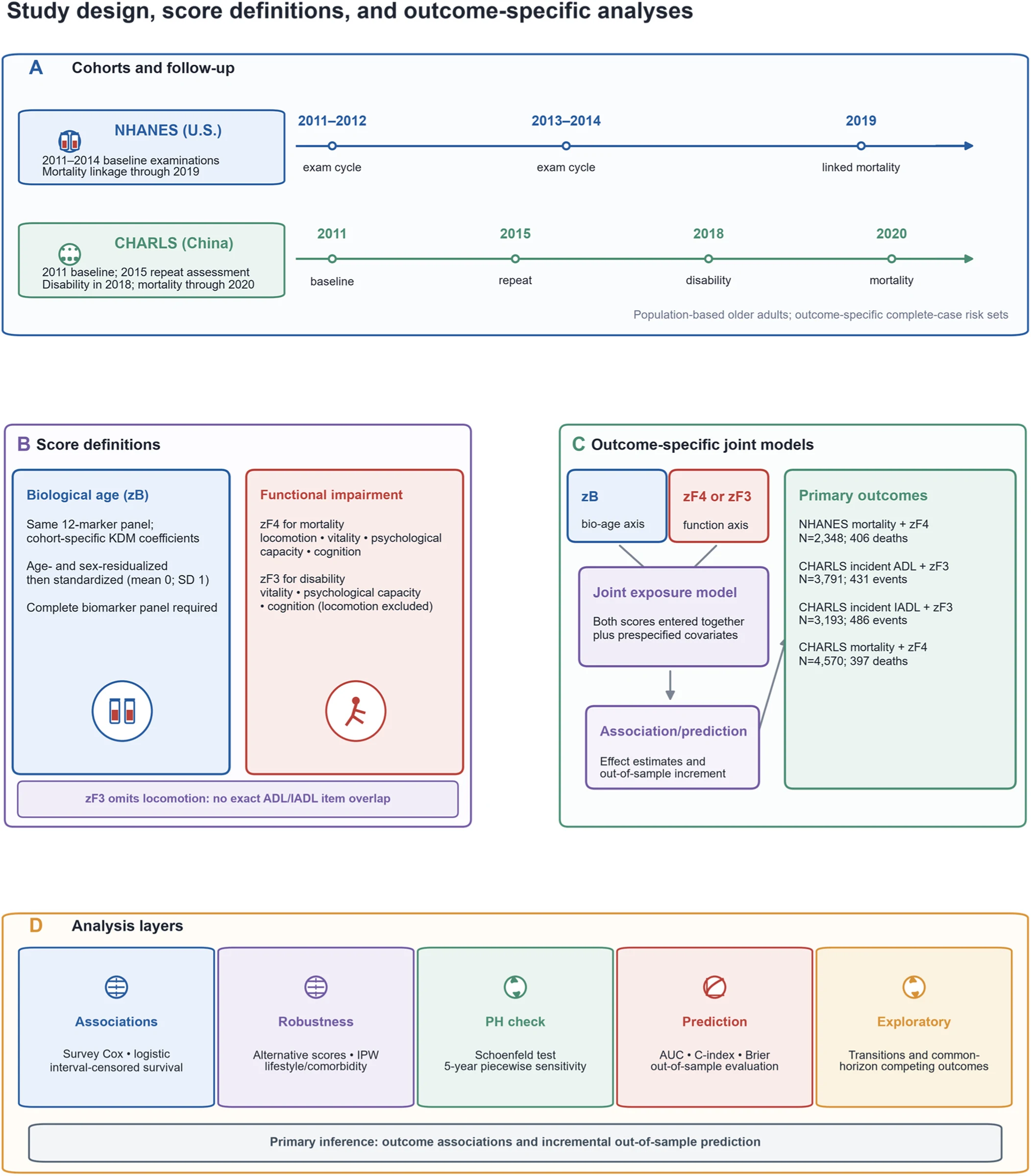
In an observational study, researchers analyzed adults aged 60 years or older in the US National Health and Nutrition Examination Survey and the China Health and Retirement Longitudinal Study. They measured biological age acceleration using a 12-biomarker panel alongside functional impairment scores.
In the US cohort of 2,348 adults with 406 deaths, biological age acceleration was associated with mortality, with a hazard ratio of 1.206, as was functional impairment, with a hazard ratio of 1.798. In the Chinese study, biological age acceleration was not associated with new daily living limitations, with likely values including no difference. For mortality among 4,570 Chinese adults, its association had a hazard ratio of 1.109, though broader adjustment attenuated this to 1.085, where likely values included no difference. Adding biological age acceleration did not consistently improve predictions beyond functional impairment.
Why it matters
For older adults, assessing physical and cognitive function may capture late-life vulnerability better than biomarker-based measures of biological age. The results bear on whether molecular panels add practical value when evaluating an aging person's risk of death or disability.
Caveats
The study was observational, which can identify associations but cannot determine cause and effect. The results also reflect adults aged 60 and older in the United States and China, so they may not apply to younger age groups or people in other countries.
- Four-domain functional impairment score
- Klemera-Doubal biological age
- Three-domain functional impairment score
- Humans
The paper
Chongqing Medical University; The Affiliated Yongchuan Hospital of Chongqing Medical University
Archives of Gerontology and Geriatrics, Sep 9, 2026


