Aging scores linked to death in cardio-kidney-metabolic stages 0–3
Two biological age measures linked accelerated aging to 41% and 103% higher relative death risks, compared with no acceleration on each measure.
Limit: Excluding people missing CKM information or key covariates could bias the mortality association
Edited by Boris Djordjevic · AgingResearch.News
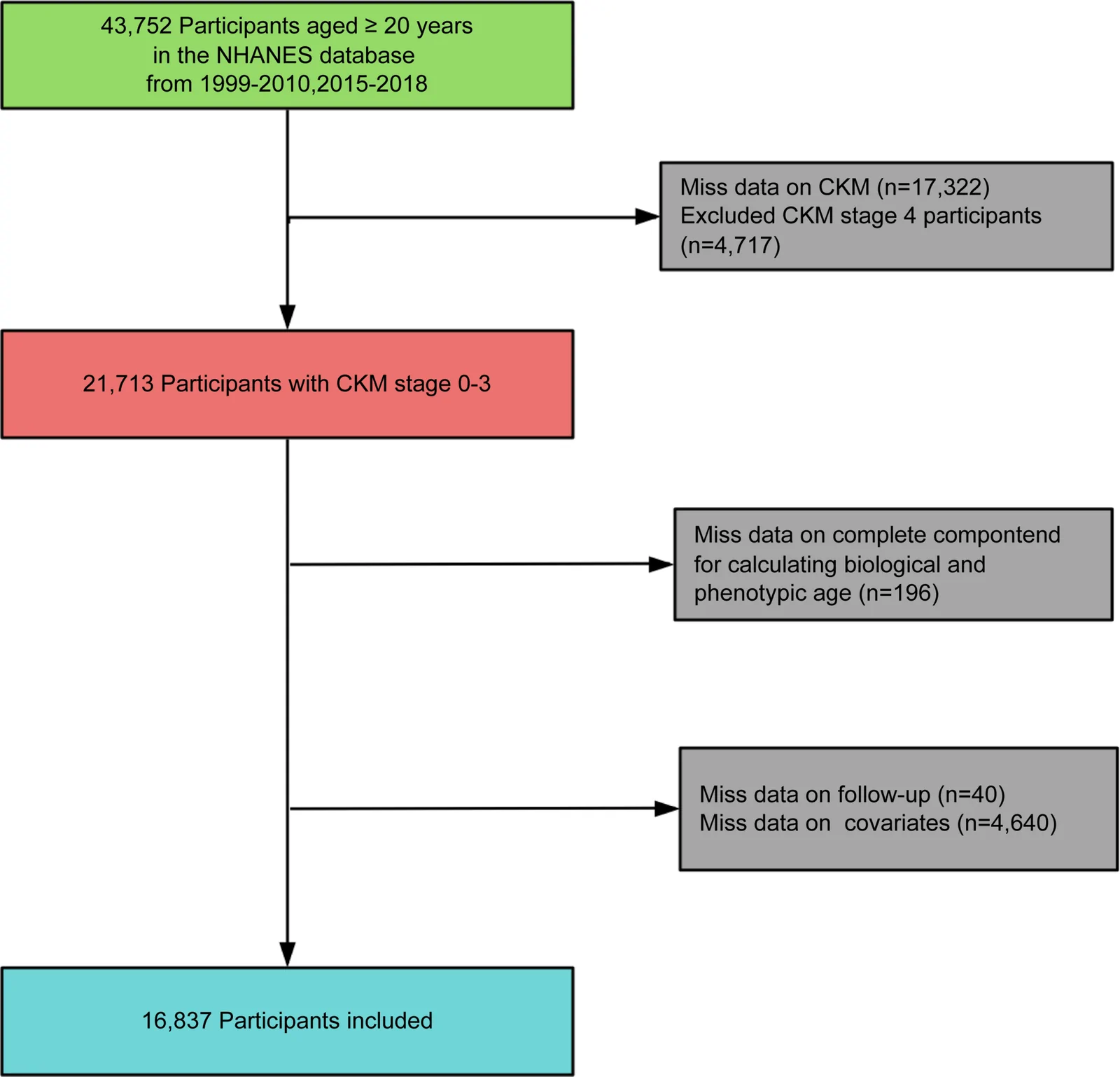
An observational cohort study included 16,837 U.S. adults aged 20 or older with cardio-kidney-metabolic syndrome stages 0–3, a framework covering heart and kidney health and how the body uses energy. Their mean age was 47.6 years; 50.9% were female. Researchers linked national survey data to death records through 2019.
They estimated biological age from laboratory and physical measurements using the Klemera-Doubal Method and Phenotypic Age. Scores above age-based expectations counted as accelerated aging. Over a median follow-up of 11.33 years, 10.8% of the population represented by the survey died. After adjustment for demographic factors, lifestyle and medication use, accelerated aging was associated with 41% higher relative death risk using the first measure and 103% higher using the second, compared with no acceleration on each measure.
Why it matters
The authors suggest that monitoring biological aging could help guide early intervention and improve long-term outcomes in people at these stages.
Caveats
The observational design cannot establish cause and effect or show that using these scores improves health. The findings do not cover adults under 20, institutionalized adults or people with clinically confirmed cardiovascular disease.
From the paper
- Participants
Ultimately, 16,837 participants were included in the final analytic cohort.
- Follow-up
During the median follow-up of 11.33 years (IQR: 4.25–15.58), weighted analysis indicated a total of about 9,754,249 deaths (10.8%), including 2,635,057 (2.9%) from CVD and 7,119,191 (7.9%) from non-CVD causes.
Results, 3.2. Association between biological age acceleration and all-cause/cause-specific mortality
- Result
As shown in Table, in unadjusted models, KDM-BAA was not significantly associated with all-cause mortality (HR = 1.00, 95% CI 0.91–1.10), whereas PAA positivity elevated mortality risk by about twofold (HR = 2.84, 95% CI 2.55–3.17).
Results, 3.2. Association between biological age acceleration and all-cause/cause-specific mortality
Quoted word for word from the full text on PubMed Central.
The paper
Fujian Medical University
Medicine, Aug 28, 2026, Open access


