Intrinsic capacity impairment and incident dementia across three population-based cohorts: a harmonized individual participant data analysis
6 years, meta-analysis, declared no competing interests
Abstract
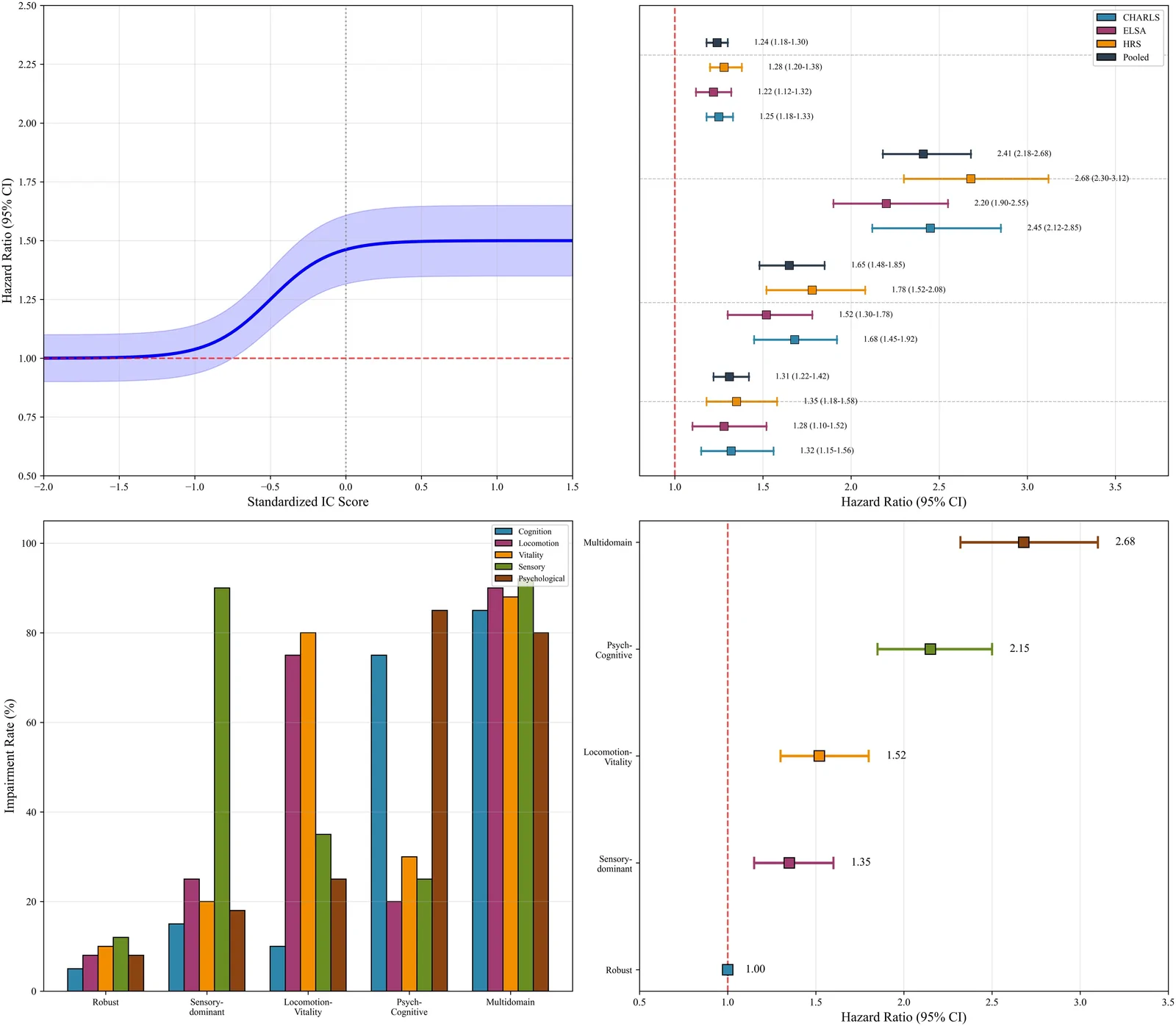
OBJECTIVES: To examine whether intrinsic capacity impairment predicts incident dementia across three countries and to evaluate its value for risk stratification. DESIGN: Harmonized multicohort study with individual participant data meta-analysis. SETTING AND PARTICIPANTS: Community-dwelling adults aged ≥50 years without baseline dementia from CHARLS (n = 17,708), ELSA (n = 9,432), and HRS (n = 22,034). MEASURES: Intrinsic capacity was assessed across five domains: cognition, locomotion, vitality, sensory, and psychological functioning. Multidomain impairment was defined as deficits in ≥3 domains. RESULTS: Pooled hazard ratios rose in graded fashion: 1.31 (95% CI 1.22-1.42) for one impaired domain, 1.65 (1.48-1.85) for two, and 2.41 (2.18-2.68) for ≥3 domains. A Psych-Cognitive impairment pattern approached Multidomain risk (HR 2.15 vs 2.68). Rapid IC decline predicted 42.3% cumulative dementia incidence over six years. Adding IC to a demographic model improved the C-index from 0.69 to 0.76 with net benefit on decision curve analysis. Associations persisted when the cognitive domain was excluded and with death as a competing event; psychological functioning was the most consistent independent domain. CONCLUSIONS: Intrinsic capacity impairment robustly predicts incident dementia across diverse populations. Its low cost and universal applicability support integration into geriatric assessment and primary care for early dementia risk stratification.
From the paper
- Result
Pooled HRs were 1.31 (95% CI 1.22–1.42) for 1 domain, 1.65 (1.48–1.85) for 2 domains, and 2.41 (2.18–2.68) for ≥3 domains versus none; per 1-SD decrease in IC score, risk increased 24% (HR 1.24, 1.18–1.30).
Quoted word for word from the full text on PubMed Central.
The paper
Second Military Medical University
The Journal of Nutrition, Health & Aging, 11 Sep 2026