Hospital-treated osteoporosis risk clusters in Swedish families
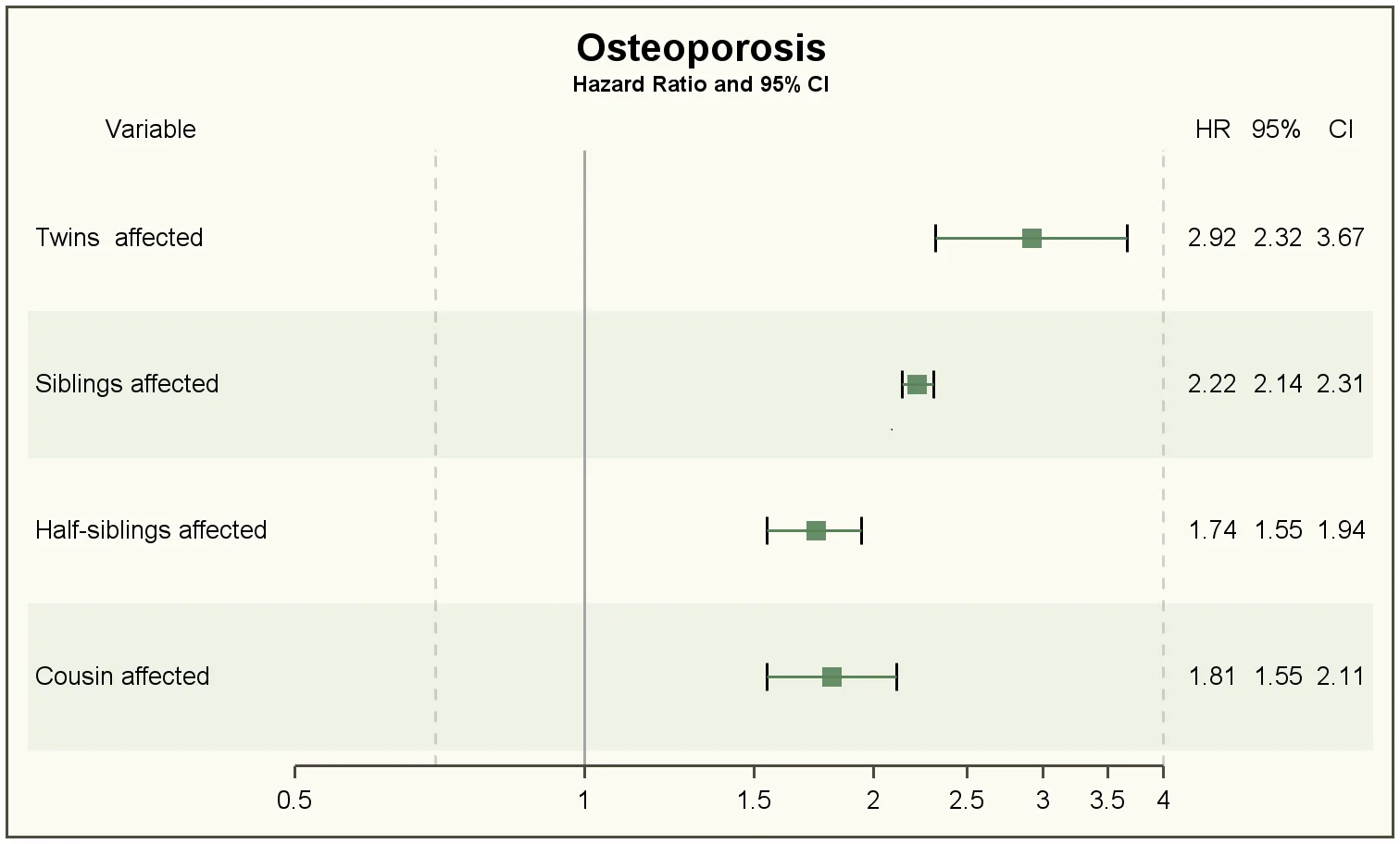
The adjusted hazard ratio, a measure of relative risk, was 2.22 for hospital-treated osteoporosis in people with versus without an affected full sibling.
Limit: Smoking was not directly adjusted for and could contribute to familial clustering
Edited by Boris Djordjevic · AgingResearch.News
An observational study of 6,548,562 people born in Sweden to Swedish-born parents used national registers covering 1997–2018. At follow-up’s end, their mean age was 41 years, ranging from 0 to 87; 48.77% were women. Researchers tracked hospital diagnoses of osteoporosis, a condition that weakens bones, and fractures at common osteoporosis-related sites.
During follow-up, 0.88% had hospital-treated osteoporosis and 6.16% had these fractures. Both outcomes were associated with having an affected twin, full sibling, half sibling or cousin after adjustment for birth year, sex, education and other illnesses. Among full siblings, the relative associations were strongest before age 20.
Why it matters
Family patterns in osteoporosis bear on the question of inherited susceptibility to age-related bone fragility across the life course.
Caveats
This observational study could not establish genetic causation and did not include primary-care diagnoses. It excluded people born outside Sweden or with a foreign-born parent, and did not distinguish identical from nonidentical twins.
From the paper
- Participants
A total of 6,548,562 individuals met the inclusion criteria.
- Result
The familial HRs for OP were markedly elevated at younger ages, decreasing progressively with increasing age, ranging from 125.70 (95% CI 59.44–265.84) among individuals younger than 20 years to 1.61 (95% CI 1.44–1.80) among those aged 80 years and older.
Results, Age-specific familial HRs of hospital treated OP and common osteoporitc fracture sites
- Limitation
A limitation is the lack of information about menopause, which cannot be accounted for.
Quoted word for word from the full text on PubMed Central.
Comments
Be the first to comment.