Calcium channel is needed for longer life in mutant worms
Genetic experiments in worms linked lifespan extension under mitochondrial stress to calcium signaling and changes in the cell’s internal scaffolding.
Our read
Mechanisms- Studied:
- Experiments in C. elegans worms with mitochondrial mutations (Blinded)
- What changed:
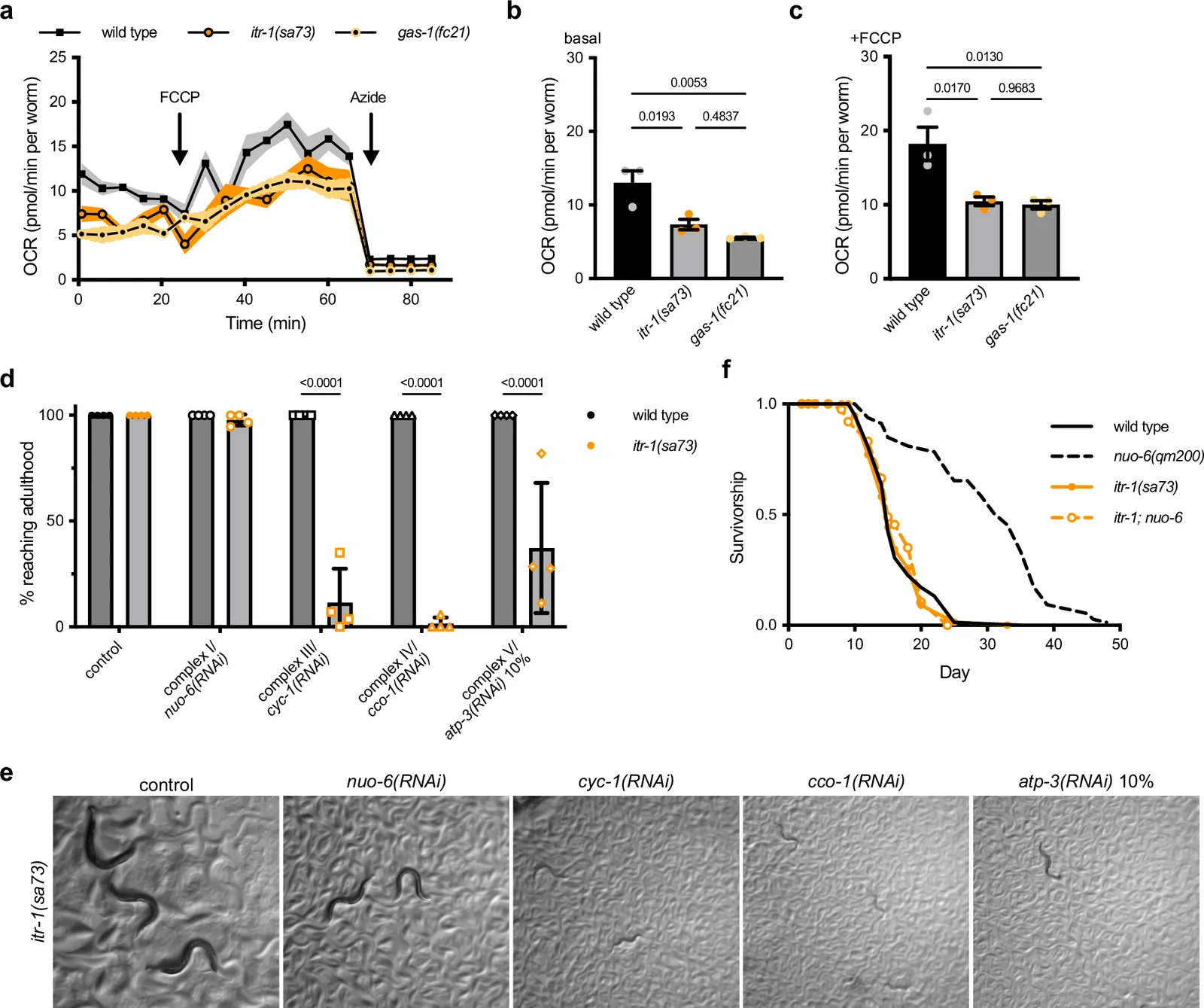
- Reducing calcium-channel function eliminated mutant worms' lifespan extension, which typically ranges from 75 to 120%
- The catch:
- Worms with reproductive rupture or internal hatching were censored from lifespan analysis
- In the record:
- One of 6 papers on itr-1 on record: none yet with results in people, 4 in animals.
Editor of record: Boris Djordjevic · AgingResearch.News
Caenorhabditis elegans worms carrying a mutation that impaired mitochondrial Complex I, part of cells’ energy-producing machinery, needed a calcium channel for their extended lifespan in genetic experiments. The channel, InsP3R, releases calcium from the endoplasmic reticulum, a compartment within cells.
A second mutation reduced the channel’s function, eliminated the lifespan extension and caused excessive expansion of compromised mitochondrial networks. Disrupting actin remodeling—the rearrangement of a protein-based cellular scaffold—or autophagy, the cell’s recycling process, produced similar effects. Encouraging mitochondria to split reduced the expansion and restored lifespan extension in worms carrying both mutations. The authors propose that InsP3R-dependent remodeling of the cellular scaffold helps separate mitochondria for clearance.
Why it matters
Mitochondrial impairment can have very different consequences for lifespan. The work addresses which cellular adaptations may distinguish life-extending stress from harmful dysfunction.
Caveats
The lifespan findings came from genetic experiments in worms carrying a particular mitochondrial mutation, not from people.
The paper
Vanderbilt University
Nature Communications, Aug 13, 2026, Open access
Comments
Be the first to comment.