Protein may aid function in obese older male veterans with prediabetes
During a randomized weight-loss and exercise trial, physical function scores rose 1.5 points with higher protein versus 1.2 with standard protein at three months.
Registered NCT03835416
Limit: Some outcome assessments were unblinded, allowing treatment knowledge to bias physical function scores
Edited by Boris Djordjevic · AgingResearch.News
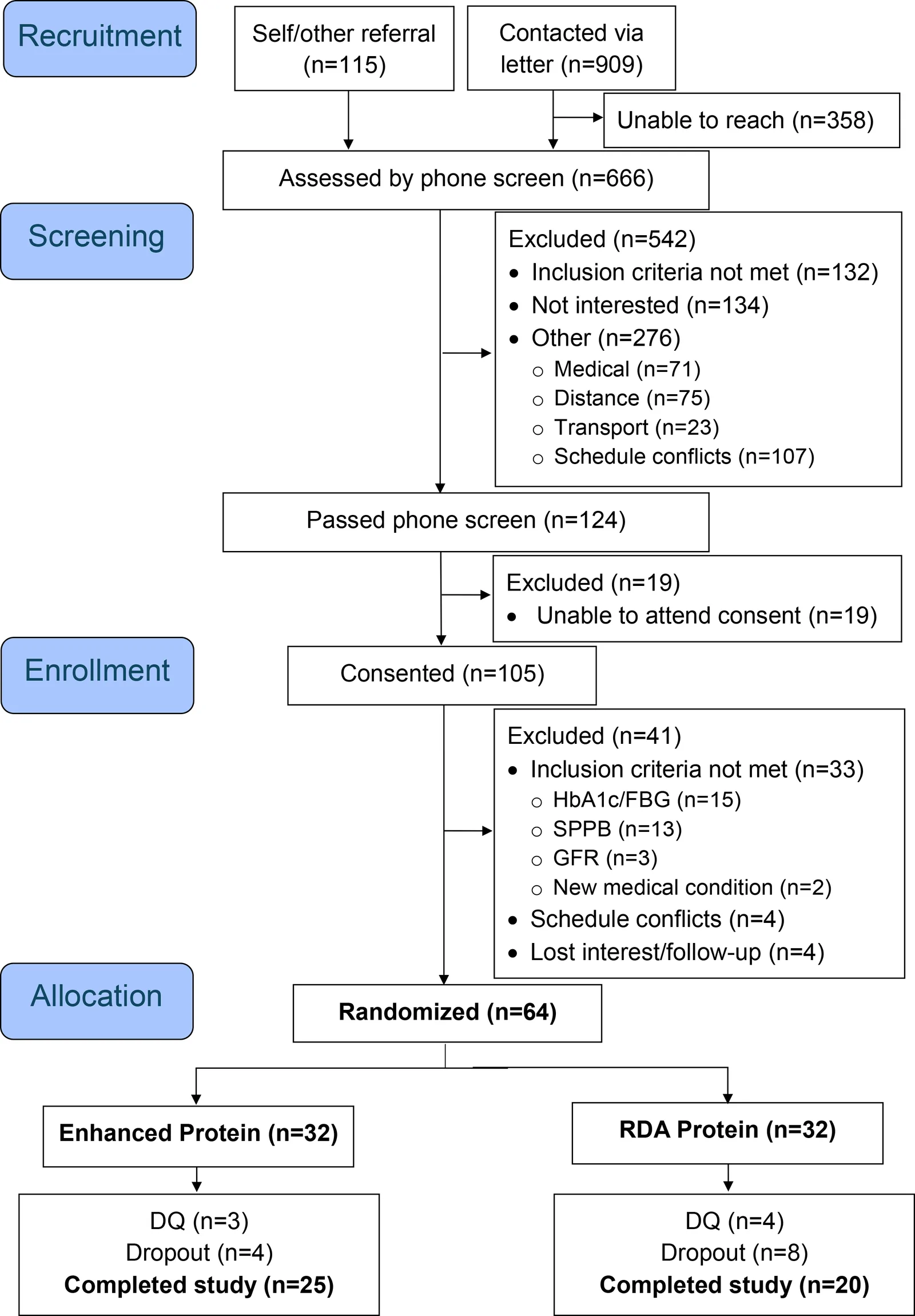
A randomized pilot trial enrolled 64 Black or White male veterans aged 55 or older with obesity and prediabetes, blood sugar above normal but below the diabetes range. Their average age was 67.6 years. Most had a six-month calorie-restricted diet-and-exercise program, targeting 1.4 versus 0.8 grams of protein per kilogram of body weight daily. Both groups were prescribed three 30-minute low-intensity exercise sessions weekly.
The higher-protein group gained more on a test combining balance, chair rises and walking. At six months, fat-free mass—body weight excluding fat—fell 0.8 kilograms versus 1.5 kilograms with standard protein. One higher-protein participant died from an unrelated cause. Health problems ended participation for three others in that group (bladder cancer, severe back pain, ankle fracture) and two standard-protein participants (debilitating pain, surgery with complications). Another standard-protein participant dropped out with medical issues.
Why it matters
Weight loss in older adults can also reduce fat-free mass. The trial addressed whether protein intake could help support physical function during weight loss in older men with obesity.
Caveats
The small trial was underpowered, 30% dropped out or were disqualified, and pandemic restrictions left some follow-up measurements missing. The findings do not cover women or people with diagnosed diabetes or substantial kidney impairment.
From the paper
- Participants
A total of 64 participants met all inclusion criteria and were randomly assigned to either the RDA Protein (n = 32) or the Enhanced Protein (n = 32) arm.
- Who took part
English-speaking male veterans, of Black or White race, aged ≥55 y, with BMI ≥30 and prediabetes, defined as fasting blood glucose (FBG) of ≥95 and <126 mg/dL or hemoglobin A1c (HbA1c, glycated hemoglobin) in the range of 5.7% to 6.4%, were enrolled.
- Ages
The participants had class II obesity (mean ± SD BMI: 35.8 ± 4.3), a mean ± SD age of 67.6 ± 7.0 y, and a mean ± SD HbA1c of 6.0% ± 0.3%.
- Duration
… Following baseline assessment, participants meeting inclusion criteria were randomly assigned to 1 of 2 study arms (1:1 allocation ratio) using block randomization to stratify by race (White, Black) for a 6-mo intervention: • Recommended dietary allowance (RDA) Protein: 0.8 g protein per kg body weight/d. • Enhanced Protein: ≥30 g of high-quality protein per meal, 1.4 g protein per kg body weight/d …
- Primary outcome
For physical function defined as the SPPB total score, there was a small effect at 3 mo (MD: −0.2 units; d = 0.23; 95% CI: <0.0.42) and a moderate and physiologically important effect at 6 mo (MD: −0.8 units; d = 0.68; 95% CI: 0.41, 0.88) for Enhanced Protein participants compared with RDA Protein.
- Limitation
A major limitation of this work is the small participant number, which occurred because of the lengthy interruption of clinical research at our facilities owing to the COVID-19 research shutdown (March 2020–October 2021).
- 6-minute walk distance
The Enhanced Protein group increased the distance walked by 63.3 ± 12.8 m (MD: 29.0 m; d = 0.53; 95% CI: <0, 1.19) and increased their handgrip strength by 3.7 ± 1.2 kg (MD: −2.8 kg; d = 0.56; 95% CI: 0.21, 0.88), relative to the RDA Protein group, which had increases of 34.4 ± 11.9 m and 0.8 ± 1.0 kg for 6MWT and handgrip strength, respectively …
Quoted word for word from the full text on PubMed Central.
Exercise is part of Bryan Johnson's Blueprint
The paper
Durham VA Health Care System; Duke University
Current Developments in Nutrition, Jul 25, 2026, Open access


