DNA study finds new links to inherited heart muscle disease
Among 411,213 UK Biobank participants, the score’s top 5% was linked to higher diagnosis risk than the lower 95%, with a hazard ratio of 3.19.
Our read
Biomarkers- Studied:
- Meta-analysis of people with hypertrophic cardiomyopathy and controls, against controls
- What changed:
- Comparing people with hypertrophic cardiomyopathy against controls identified 70 associated genetic regions, including four new ones
- The catch:
- Differences in case identification across cohorts could distort individual genetic associations
- In the record:
- The 139th paper on polygenic risk score with results in people; 456 on record in all.
- Why it’s aging research:
- It bears on staying healthy in midlife and later life.
Editor of record: Boris Djordjevic · AgingResearch.News
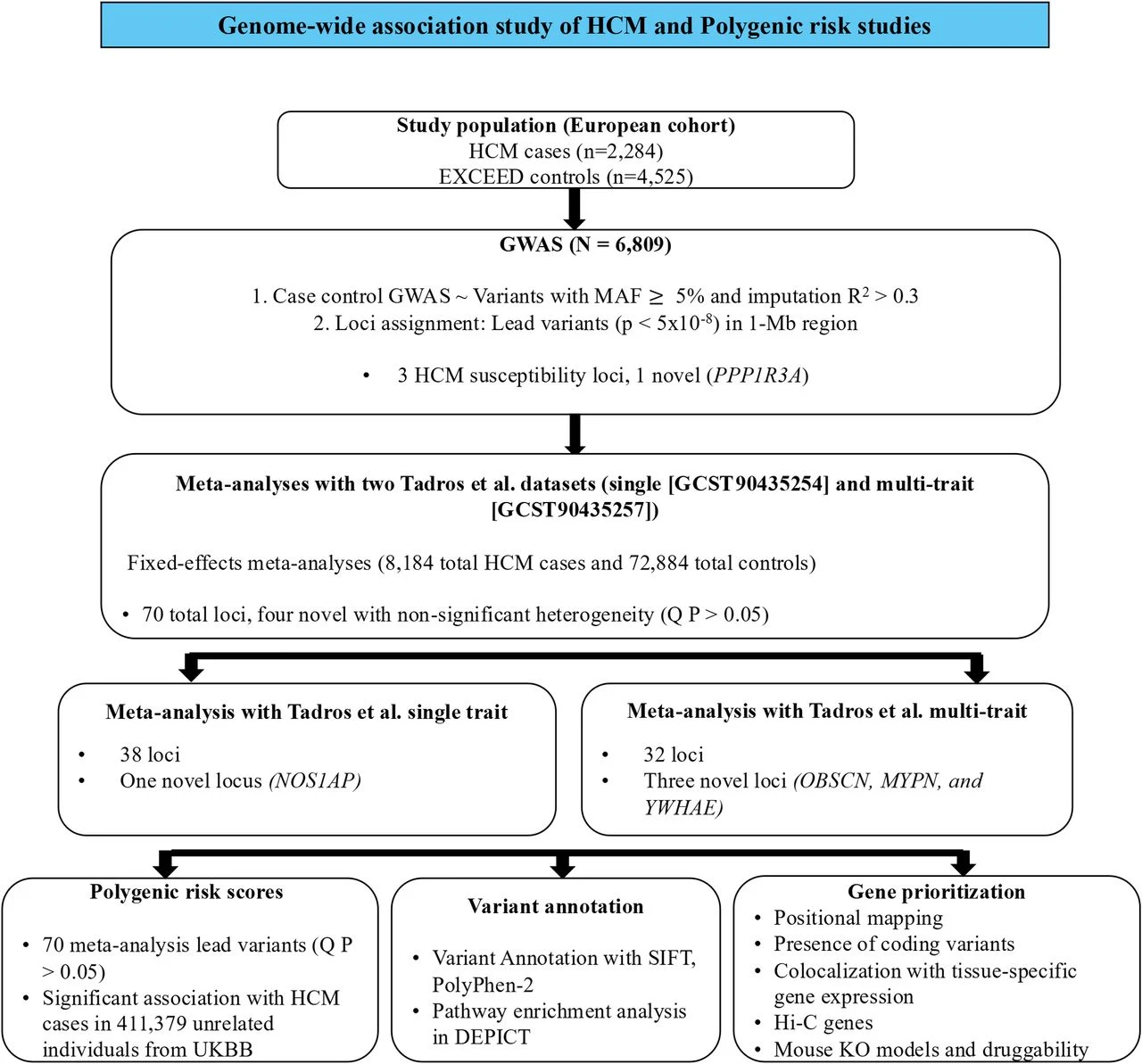
An observational genetic study compared 2,284 people of European ancestry with hypertrophic cardiomyopathy, an inherited disease involving thickened heart muscle, with 4,525 controls. The affected group averaged 54.0 years old, and 65% were men. Researchers combined their results with published genetic data in two pooled analyses. These identified 70 DNA regions associated with the disease, including four newly associated regions.
The researchers built a polygenic risk score, which combines information from many genetic variants. They tested its association with diagnosis in 411,213 UK Biobank participants. Scores in the top 5% were associated with higher diagnosis risk than scores in the lower 95%. The hazard ratio of 3.19 described relative, not absolute, risk. Among participants without the disease, higher scores were also linked to thicker walls in the heart’s main pumping chamber.
Why it matters
Inherited heart muscle disease has widely varying effects and outcomes. Understanding its genetic contributors may inform risk assessment for heart health over time, rather than biological aging itself.
Caveats
These observational associations do not establish causation or show that using the score improves care. The discovery sample had European ancestry, limiting what those findings establish for other ancestry groups.
From the paper
- Participants
The discovery GWAS comprised 6809 European individuals of whom 2284 were HCM cases and 4525 were EXCEED study controls.
- Result
The third discovery locus, PPP1R3A, reached nominal significance in the single-trait meta-analysis (OR=1.12, 95% CI 1.06 to 1.19, pdiscovery=2.75×10⁻¹⁰, pmeta=8.0×10⁻⁵), with significant heterogeneity (Q p<0.05).
- Limitation
While we identified novel loci, significant heterogeneity across cohorts used for the meta-analysis reduced the reliability of some signals.
Quoted word for word from the full text on jmg.bmj.com.
- Human genetics
- Hypertrophic cardiomyopathy
- Polygenic risk score
- Sudden cardiac death
- Left ventricular ejection fraction
- Humans
The paper
Hypertrophic cardiomyopathy: a genome-wide association meta-analysis and polygenic risk score
St Bartholomew's Hospital
Journal of Medical Genetics, Sep 4, 2026, Open access

Comments
Be the first to comment.