Lowering gene activity reduced damage in lab-grown human neurons
In experiments using three cell lines from donors with Huntington’s symptoms, lowering a gene’s activity reduced cell death, DNA damage markers and protein clumps.
Our read
Mechanisms- Studied:
- Experiments in human medium spiny neurons, against control shRNA
- What changed:
- DNA double-strand breaks were lower in Huntington disease neurons with knocked-down NFKB1 than with control shRNA
- The catch:
- Donor age partially confounds the comparison between pre-symptomatic and post-symptomatic neurons
- In the record:
- The 8th paper on NFKB1 with results in people; 112 on record in all.
- Why it’s aging research:
- It studies organisms or tissues that aged naturally.
Editor of record: Boris Djordjevic · AgingResearch.News
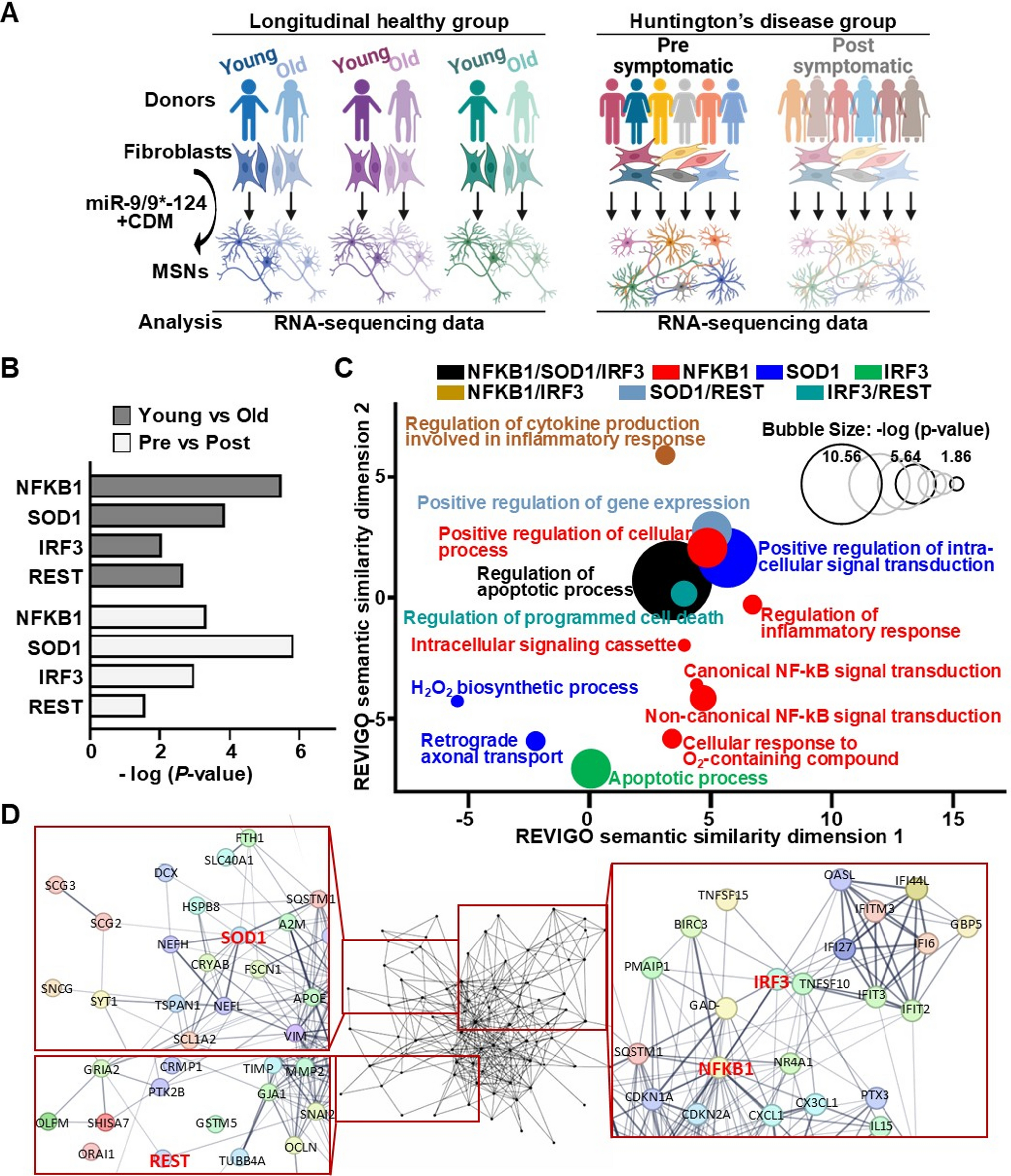
Researchers ran experiments in human medium spiny neurons, the brain cells mainly affected by Huntington’s disease, made from donors’ skin cells in the lab. They used three donor-derived cell lines per group: younger and older healthy people, and people with Huntington’s disease before and after symptoms began.
Analysis of gene activity identified four candidate regulators shared by aging and Huntington’s datasets. NFKB1, a gene that regulates other genes’ activity, was more active in neurons from older donors. Researchers reduced its activity starting 14 days after conversion began. In neurons from donors with symptoms, this reduced cell death, DNA damage markers and clumps of mutant huntingtin, the disease-associated protein. Increasing NFKB1 activity in neurons from donors without symptoms increased cell death, signs of DNA breaks and protein clumps.
Why it matters
Huntington’s disease has adult-onset symptoms, but aging’s contribution to the loss of vulnerable neurons remains unclear. The authors identified the age-associated regulator NFKB1 as a potential therapeutic target.
Caveats
The findings came from lab-grown cells, not treatment tests in people. The main comparisons used three donor-derived cell lines per group.
The paper
Mercer University
Neuroscience Bulletin, Sep 4, 2026, Open access

Comments
Be the first to comment.