Heart tracing model matched rivals with less training data
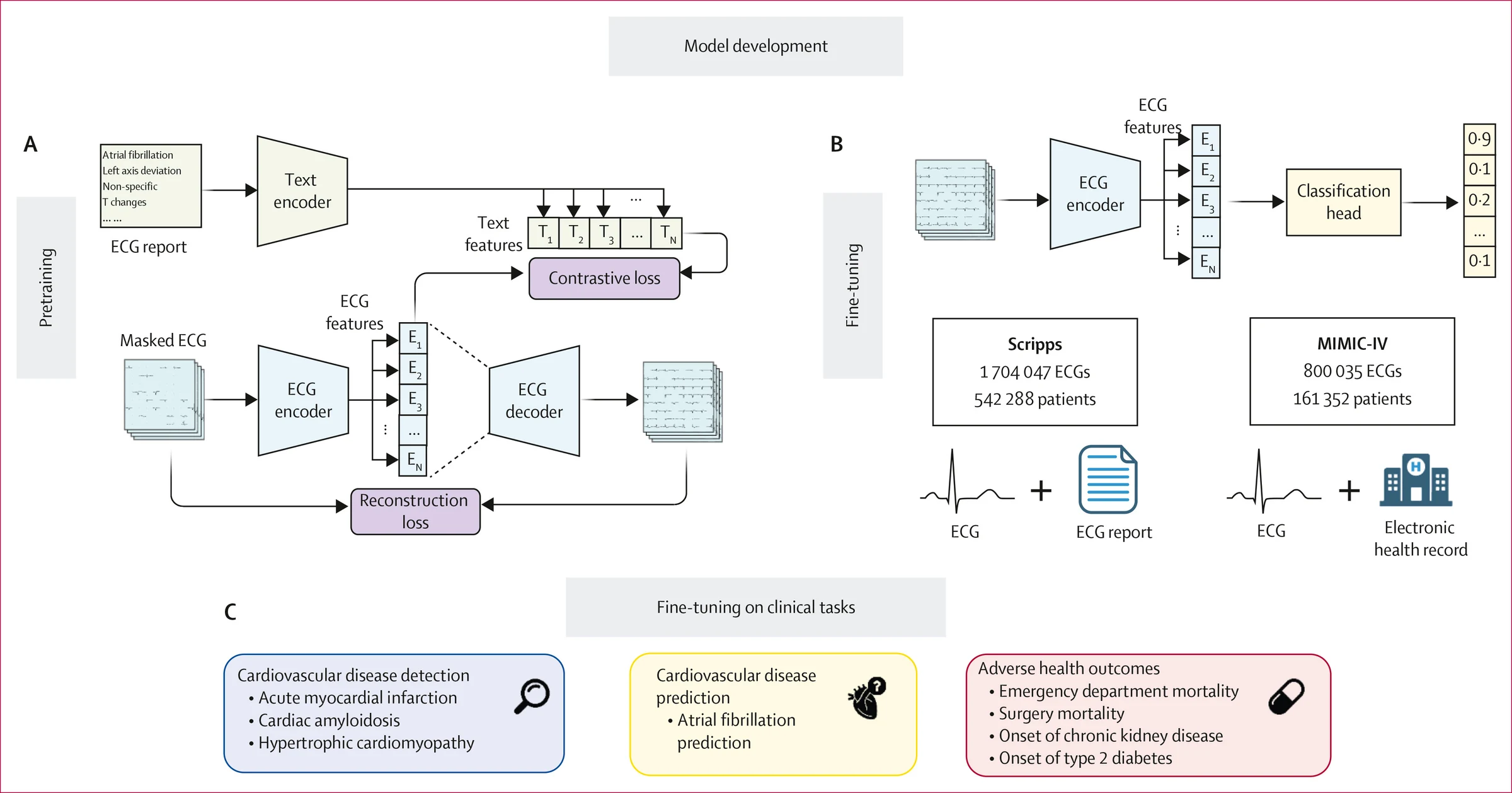
Across heart disease detection tasks, the model matched the best comparison model’s performance with an average of 90.8% less training data.
Limit: The computational study assessed predictive performance rather than patient care or health outcomes
Edited by Boris Djordjevic · AgingResearch.News
A computational study trained a prediction model using more than 1.7 million electrocardiograms from 542,288 patients. These recordings of the heart’s electrical activity were paired with clinician-reviewed reports collected between 2008 and 2019. Researchers tested the model, called ECG-CLIP, on an independent dataset containing more than 800,000 recordings.
The model outperformed two models trained with examples labeled for each task and one model not based on heart recordings across all detection and prediction tasks. These included detecting heart attacks, predicting atrial fibrillation—an irregular heartbeat—and predicting the onset of chronic kidney disease and type 2 diabetes within three years. It also outperformed models trained on heart signals alone when few labeled examples were available.
Why it matters
Heart disease, kidney disease and type 2 diabetes affect health in later life. The work addresses whether routine heart recordings can help assess risks across these conditions.
Caveats
This retrospective computational study assessed predictive performance, not whether using the model improved patient care or health outcomes.
The paper
University of California San Diego; Scripps Research Institute
The Lancet Digital Health, Sep 1, 2026, Open access

Comments
Be the first to comment.