Associations of transitions in frailty and depressive symptoms with the risk of cardiovascular disease in adults with hypertension: findings from three aging cohorts
Multicentre, declared no competing interests
Abstract
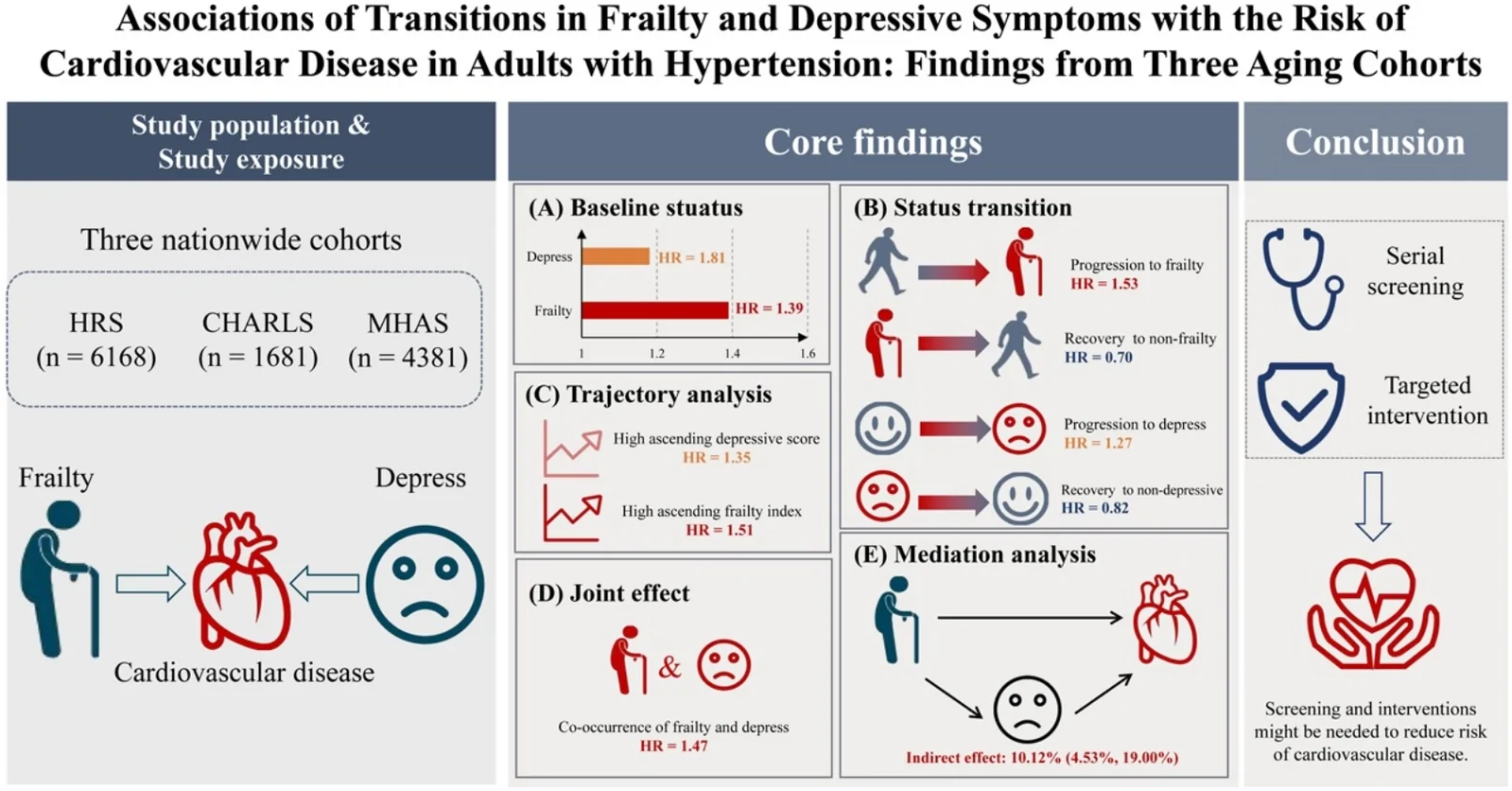
OBJECTIVES: To examine the relationships of baseline status and changes in frailty and depressive symptoms with cardiovascular disease (CVD) among older adults with hypertension. DESIGN: Multinational prospective cohort study harmonizing data from three aging cohorts (CHARLS, HRS, MHAS). SETTING: Community-based surveys conducted in China (2011-2020), the United States (2012-2020), and Mexico (2012-2021). PARTICIPANTS: A total of 12,230 older adults with hypertension, aged ≥50 years, who were free of CVD at baseline and had at least two assessments of frailty and depressive symptoms. INTERVENTION: None. MEASUREMENTS: Frailty was evaluated by the frailty index (FI) and depressive symptoms were evaluated using validated scales. Both were measured at baseline and at a follow-up visit approximately two years later. The primary outcome was incident CVD, including heart disease or stroke. Cox proportional hazards models were used to estimate hazard ratio (HR) with 95% confidence interval (CI). Mediation analysis, joint analysis, and multiple sensitivity analyses were performed. RESULTS: During a median follow-up of 8 years, 2,996 participants developed CVD. Baseline frailty (HR = 1.39, 95% CI: 1.25-1.53) and depressive symptoms (HR = 1.18, 95% CI: 1.09-1.28) were related to elevated risks for CVD. Progression from non-frailty to frailty was associated with a 53% increase in CVD risk (95% CI: 1.37-1.72), while remission to non-frailty was linked to a 30% lower risk (95% CI: 0.58-0.85). Similarly, progression to depressive status was associated with higher risk (HR = 1.27, 95% CI: 1.12-1.43), whereas reversion showed a lower risk (HR = 0.82, 95% CI: 0.73-0.92). Depressive symptoms accounted for 10.12% of the association between frailty and incident CVD. CONCLUSION: Progression of frailty and depressive symptoms was related to increased risk of CVD, while recovery was associated with protective effects. These findings suggest the potential relevance of serial monitoring of both physical and psychological status among older adults with hypertension. Public health strategies that prioritize targeted screening and interventions for frailty and depressive symptoms might reduce the risk of CVD.
From the paper
- Participants
During a median follow-up period of 8 years, a total of 2,996 participants developed CVD.
Results, Baseline status and changes in frailty with the risk of CVD
- Result
As presented in, participants with both depressive symptoms and frailty exhibited the higher risks for CVD (HR = 1.47, 95% CI: 1.30–1.66), stroke (HR = 1.72, 95% CI: 1.37–2.15), and heart disease (HR = 1.58, 95% CI: 1.38–1.81).
Results, Joint effects of frailty status and depressive symptom on risk of CVD
Quoted word for word from the full text on PubMed Central.
The paper
First Affiliated Hospital of Soochow University; Xiyuan Hospital
The Journal of Nutrition, Health & Aging, 1 Sep 2026, Open access