DNA aging clocks linked to survival to age 90 in women
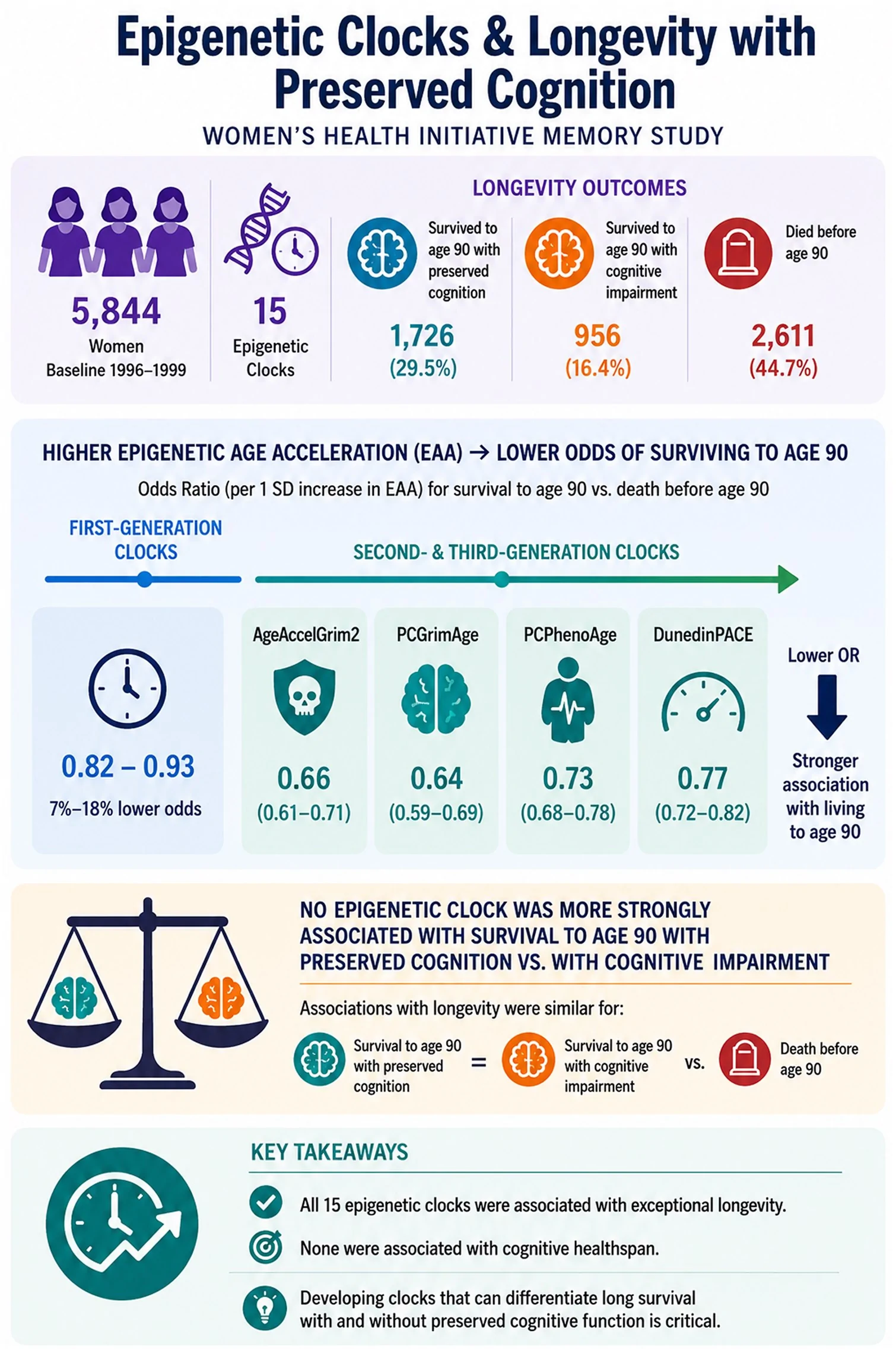
Among 5,844 older women, 15 DNA-based aging measures were linked to reaching 90, but not specifically to doing so with preserved thinking and memory.
Our read
Biomarkers- Studied:
- Cohort study of 5,844 older women cognitively unimpaired at baseline
- What changed:
- Odds of surviving to age 90 were lower with faster PCGrimAge aging (odds ratio 0.64 per standard deviation increase)
- The catch:
- Cognitive status was missing for 9.3% of women, limiting comparisons of cognitively healthy survival
- In the record:
- One of 801 papers on epigenetic clock on record: 130 with results in people, 13 in animals.
Editor of record: Boris Djordjevic · AgingResearch.News
The 5,844 women in this observational analysis were aged 65–79 and had no cognitive impairment at enrollment in the Women's Health Initiative Memory Study. Researchers measured 15 epigenetic clocks—estimates of biological aging based on chemical marks on DNA—in blood collected in 1996–1999. They tracked survival through February 2024.
For first-generation clocks, an increase of one standard deviation—a measure of variation among women—was associated with 7%–18% lower odds of reaching 90 versus earlier death. Several newer clocks had stronger associations with survival. None was more strongly associated with reaching 90 with preserved thinking and memory than with reaching that age with cognitive impairment, each compared with dying before 90.
Why it matters
For measures intended to capture healthy lifespan, the authors highlighted the need for clocks that distinguish long survival with and without preserved thinking and memory.
Caveats
Health differences not fully captured in the analysis could have influenced both clock readings and survival. All participants were initially cognitively unimpaired women, and cognitive status at 90 relied on questionnaires for 1,173 women.
From the paper
- Participants
This study included 5844 WHIMS women selected for epigenetics data measurement who were eligible to survive to age 90 as of February 17, 2024 based on their birth year.
- Result
The PC versions of the Horvath and Hannum clocks had stronger ORs than the original versions, with ORs of 0.83 (95% CI 0.78-0.89) and 0.81 (95% CI 0.76-0.87), respectively.
Quoted word for word from the full text on PubMed Central.
The paper
University of California San Diego
The Journals of Gerontology, Series A, Sep 1, 2026, Open access


Comments
Be the first to comment.