Claims-based frailty index and risk of hospitalisation for hip fracture among adults aged 60-74 years in Tokyo, Japan
Declared no competing interests
Abstract
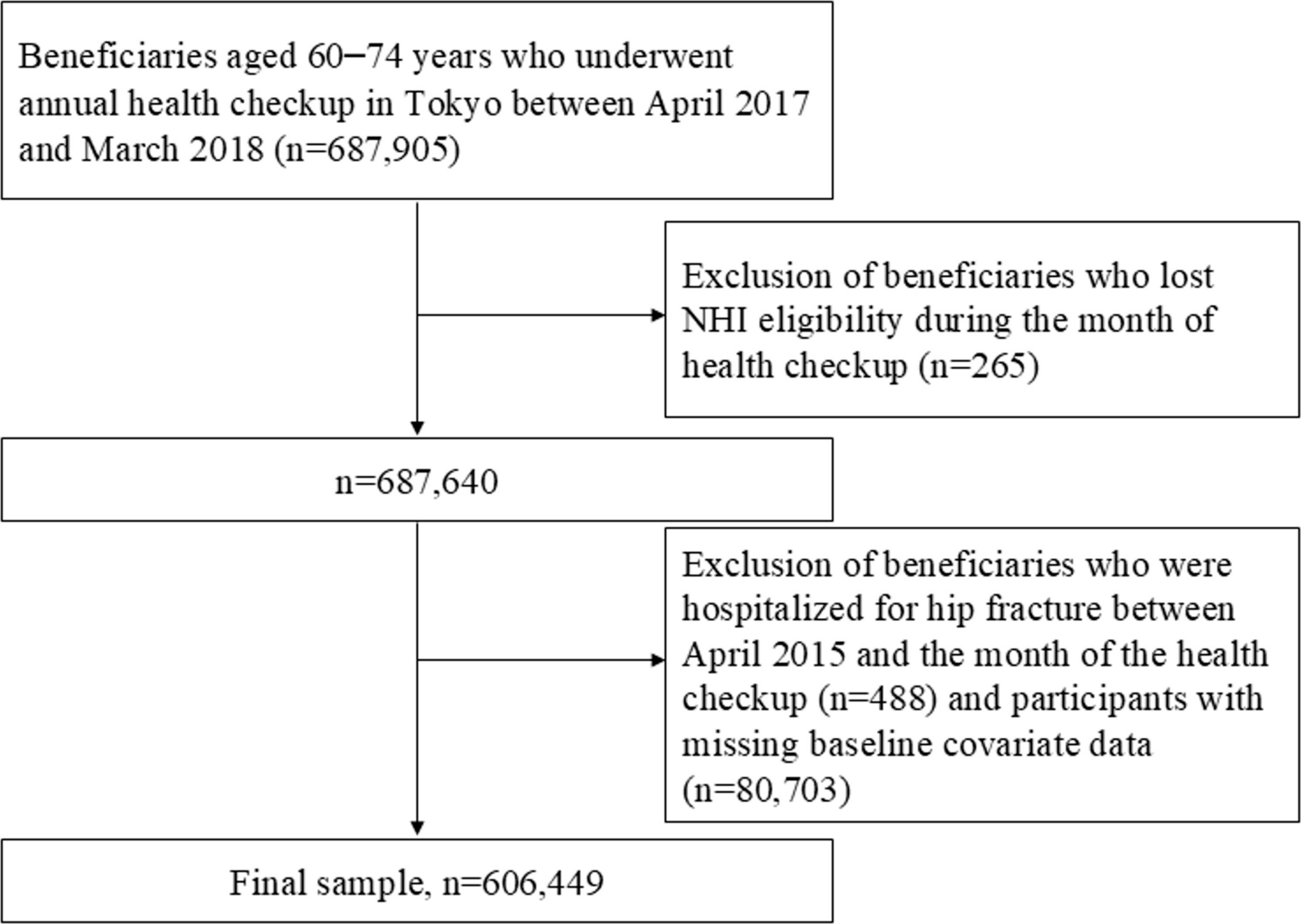
UNLABELLED: Among 606,449 adults aged 60-74 years, the claims-based frailty index categories predicted hospitalisation for hip fractures: beneficiaries classified as pre-frail or frail were at higher risk (hazard ratios, 2.17 and 3.50, respectively). The CFI can help identify individuals who can benefit from targeted interventions to prevent hip fractures. PURPOSE: Although the claims-based frailty index (CFI) may aid early identification of older adults at high risk of hip fractures, little is known about the association between the CFI and the incidence of hip fractures. The aim of this study was to examine the association between the CFI and hospitalisation for hip fractures among adults aged 60-74 years in Tokyo, Japan. METHODS: This retrospective cohort study used linked health checkup and medical claims data in Tokyo between April 2015 and March 2023. Beneficiaries of the National Health Insurance aged 60-74 years who underwent an annual health checkup between April 2017 and March 2018 were identified. Beneficiaries were followed up for hospitalisation for hip fractures through March 2023. Cox proportional hazards models, adjusted for Fracture Risk Assessment Tool (FRAX)-related variables, osteoporosis, and self-reported health status and habits, were used to examine the association between the CFI and hospitalisation for hip fractures. Harrell's C-statistics were compared between models with and without the CFI to assess the CFI's discriminative ability. RESULTS: Among 606,449 beneficiaries, 553,747 (91.3%) were classified as robust, 47,348 (7.8%) as pre-frail, and 5,354 (0.9%) as frail. Compared with beneficiaries classified as robust, the risk of hospitalisation for hip fractures was higher in those classified as pre-frail (HR 2.17; 95% CI 1.87-2.51) and frail (HR 3.50; 95% CI 2.62-4.69). The CFI modestly improved discrimination beyond FRAX-related variates. CONCLUSIONS: The CFI can help identify individuals who may benefit from targeted interventions to prevent hip fractures.
The paper
Tokyo Metropolitan Institute of Gerontology
Osteoporosis International, 1 Sep 2026