A hybrid mathematical framework for morphogenesis and regeneration
Abstract
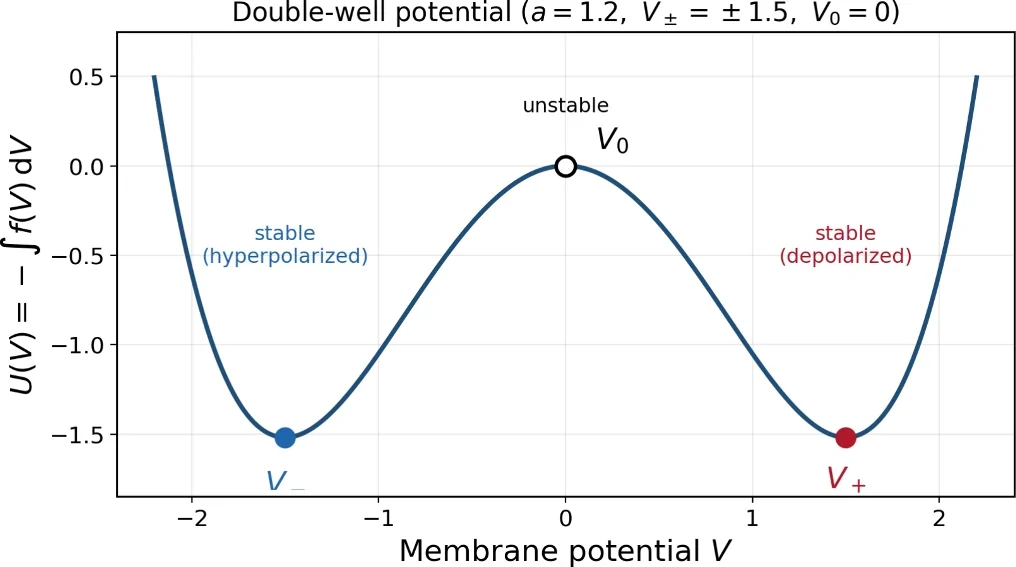
We introduce a hybrid mathematical framework for morphogenesis and regeneration motivated by bioelectric phenomena documented in highly regenerative organisms, particularly planaria. The model couples four dynamical layers on a discrete cellular network: (i) a bistable bioelectric layer, in which each cell admits stable hyperpolarized and depolarized equilibria connected through gap-junction currents; (ii) a synthetic intracellular gene regulatory network (GRN) with proliferation, differentiation, positional-identity, and regenerative-response modules; (iii) adaptive gap-junction conductances that evolve in response to electrical state, regenerative activity, and tissue identity; and (iv) a slow tissue-memory variable representing persistent cellular commitment at an epigenetic timescale. Damage is represented by a propagating wound signal on the cellular graph. The central conceptual departure from classical models is that target morphology is not prescribed externally but emerges as an attractor of the coupled multiscale dynamics, in the spirit of distributed attractor-based memory. The framework is designed to capture anatomical homeostasis, regeneration after lesion, attractor switching induced by transient electrical perturbations, regenerative thresholds, and axial polarity. The paper establishes three analytical results for reduced subsystems: single-cell bistability, absence of a Turing instability in the reduced bioelectric-regulatory subsystem, and Lyapunov descent for the pure bioelectric layer. These are complemented by a set of open mathematical questions and numerical experiments that investigate pattern nucleation, regeneration robustness, polarity reversal, and adaptive energy-landscape reshaping in the full multiscale model.
The paper
Universidad Nacional Autónoma de México
Journal of Mathematical Biology, 31 Aug 2026