Refining the simplified frailty scale to improve the risk stratification of patients with multiple myeloma
Independent replication, declared ties to: AbbVie, Chugai Pharmaceutical, Sanofi and 23 more
Abstract
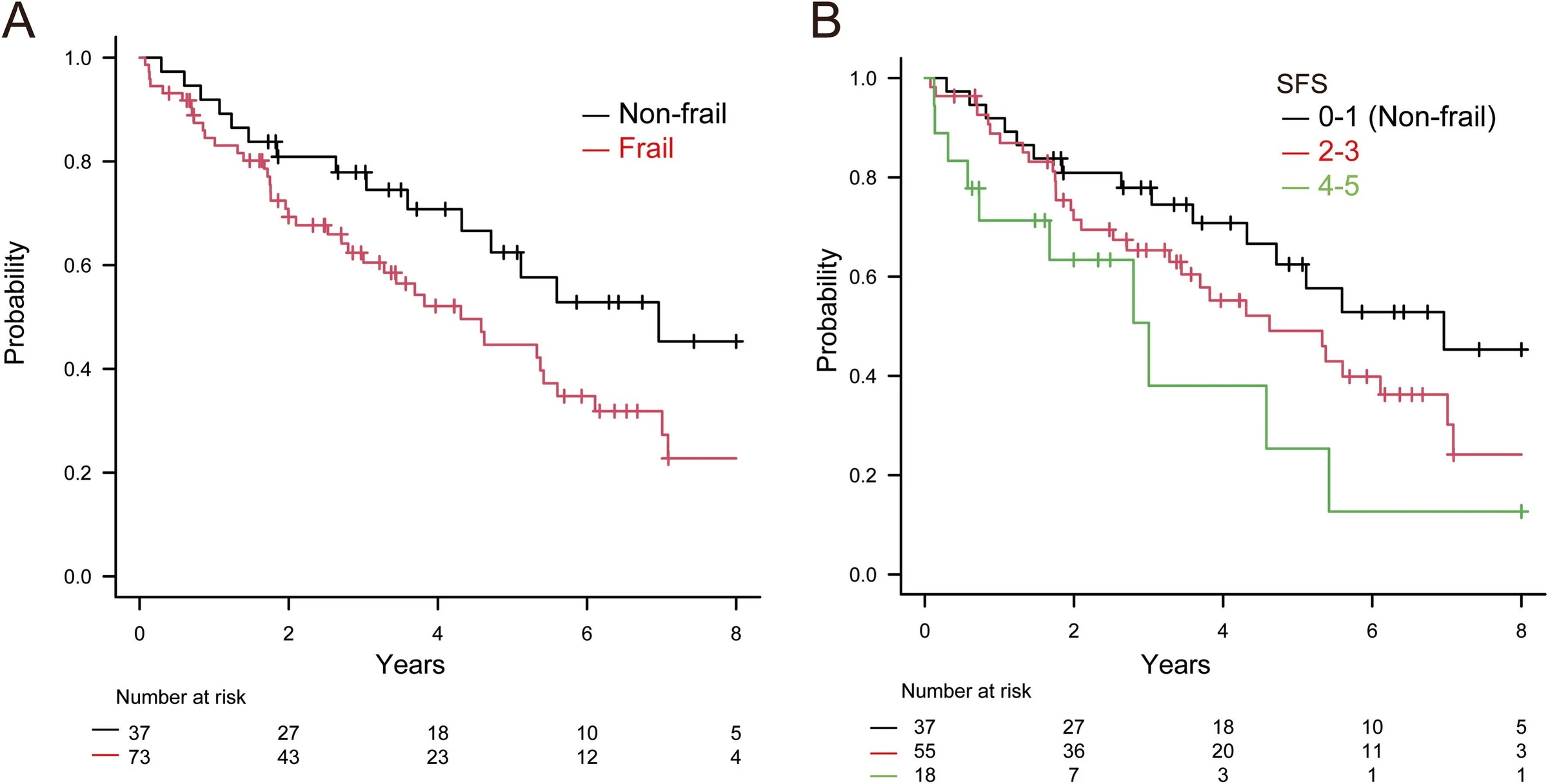
INTRODUCTION: Frailty assessment is essential in managing the care of older patients with multiple myeloma, as frailty influences treatment tolerability and clinical outcomes. The Simplified Frailty Scale is widely used due to its simplicity; however, its binary classification-non-frail (scores of 0 and 1) vs. frail (scores of 2-5)-may not fully capture the heterogeneity within the frail group. We aimed to refine the Simplified Frailty Scale by further stratifying frail patients into moderate and severe frailty subgroups. MATERIALS AND METHODS: We retrospectively analyzed 313 patients aged ≥70 years with newly diagnosed multiple myeloma (110 in the training cohort and 203 in the validation cohort). RESULTS: Based on overall survival in the training cohort, we identified optimal cutoff scores for moderate (scores of 2 and 3) and severe (scores of 4 and 5) frailty. In the validation cohort, the median overall survival was not reached for non-frail patients, while it was 4.0 years for moderate-frail and 1.2 years for severe-frail patients. Multivariate analysis confirmed the three-class Simplified Frailty Scale classification as an independent prognostic factor (hazard ratio: 2.35). Additionally, the incidence of serious adverse events increased with the frailty level. DISCUSSION: These findings support the clinical utility of the refined Simplified Frailty Scale in predicting prognosis and treatment-related toxicity in older patients with multiple myeloma, especially in real-world settings.
The paper
Nagoya City University
Journal of Geriatric Oncology, 29 Aug 2026