Local resources linked to slower aging on two DNA measures
An observational analysis of 3,786 Health and Retirement Study participants found associations with two of five DNA-based aging measures.
Cohort study
Limit: DNA-based aging clocks are proxies, not observed changes in health or lifespan
Edited by Boris Djordjevic · AgingResearch.News
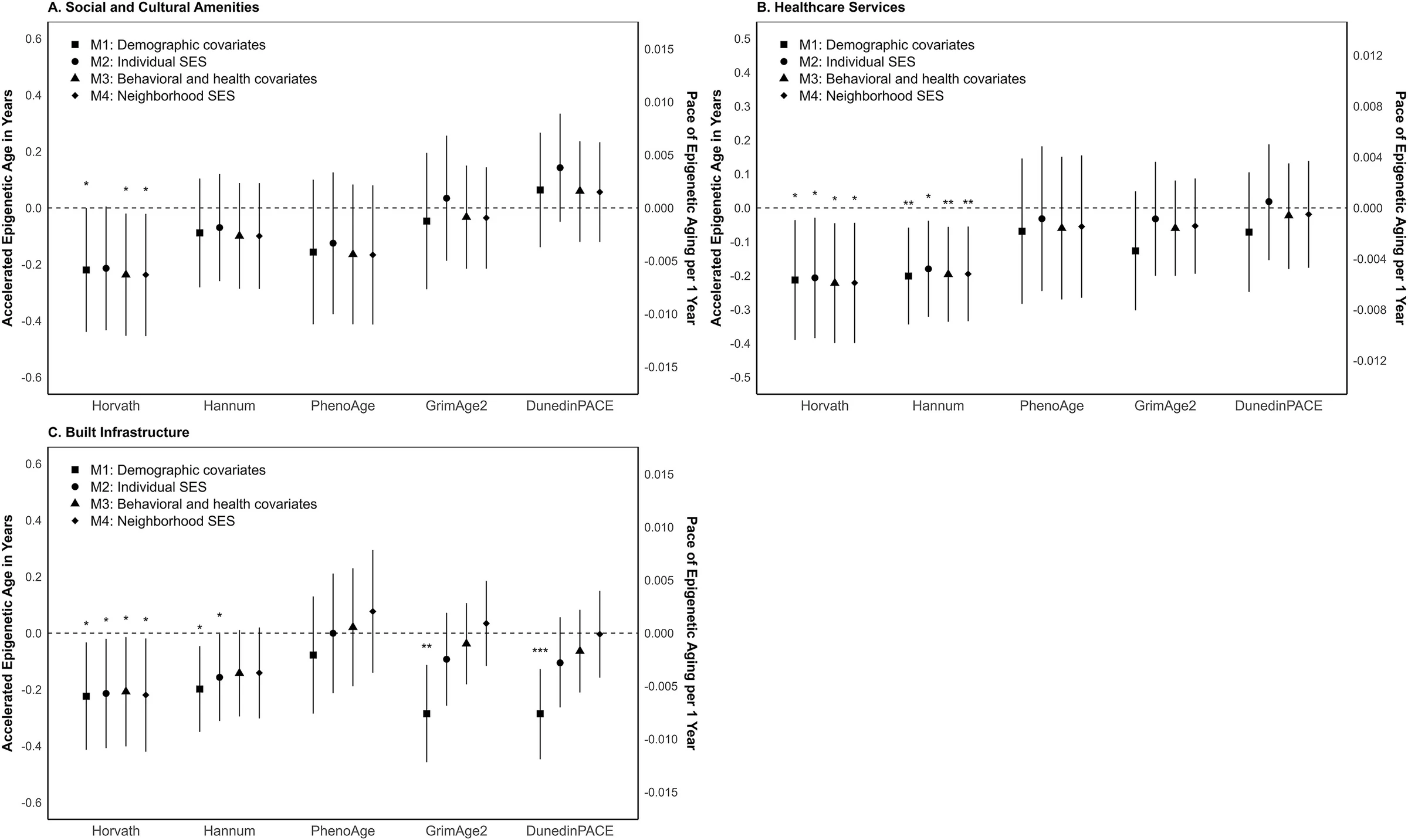
An observational study of 3,786 Health and Retirement Study participants examined neighborhood resources and epigenetic aging, which estimates biological aging from chemical marks on DNA. Researchers linked five aging measures from 2016 blood data to 13 neighborhood indicators covering amenities, health services and built infrastructure.
Greater resource availability was associated with slower age acceleration. These links were statistically significant only for two measures, the Horvath and Hannum clocks. The associations were largely similar across sex, race and ethnicity. Built infrastructure was also indirectly associated with slower aging through increased physical activity on the measures called PhenoAge, GrimAge2 and DunedinPACE.
Why it matters
Epigenetic aging is a proposed pathway linking neighborhood environments to health. The authors suggest that improving local resources could be a promising strategy for promoting healthy aging.
Caveats
The observational design cannot establish cause and effect. DNA-based aging measures are not the same as observed changes in health or lifespan.
The paper
Neighborhood amenities, health services, and built infrastructure and epigenetic aging
Rutgers, The State University of New Jersey; University of Pittsburgh
Social Science & Medicine, Aug 22, 2026, Open access


