Supplement may aid attention in adults with cognitive complaints
A randomized trial in 276 healthy adults with cognitive complaints found attention scores changed differently over time across supplement and placebo groups.
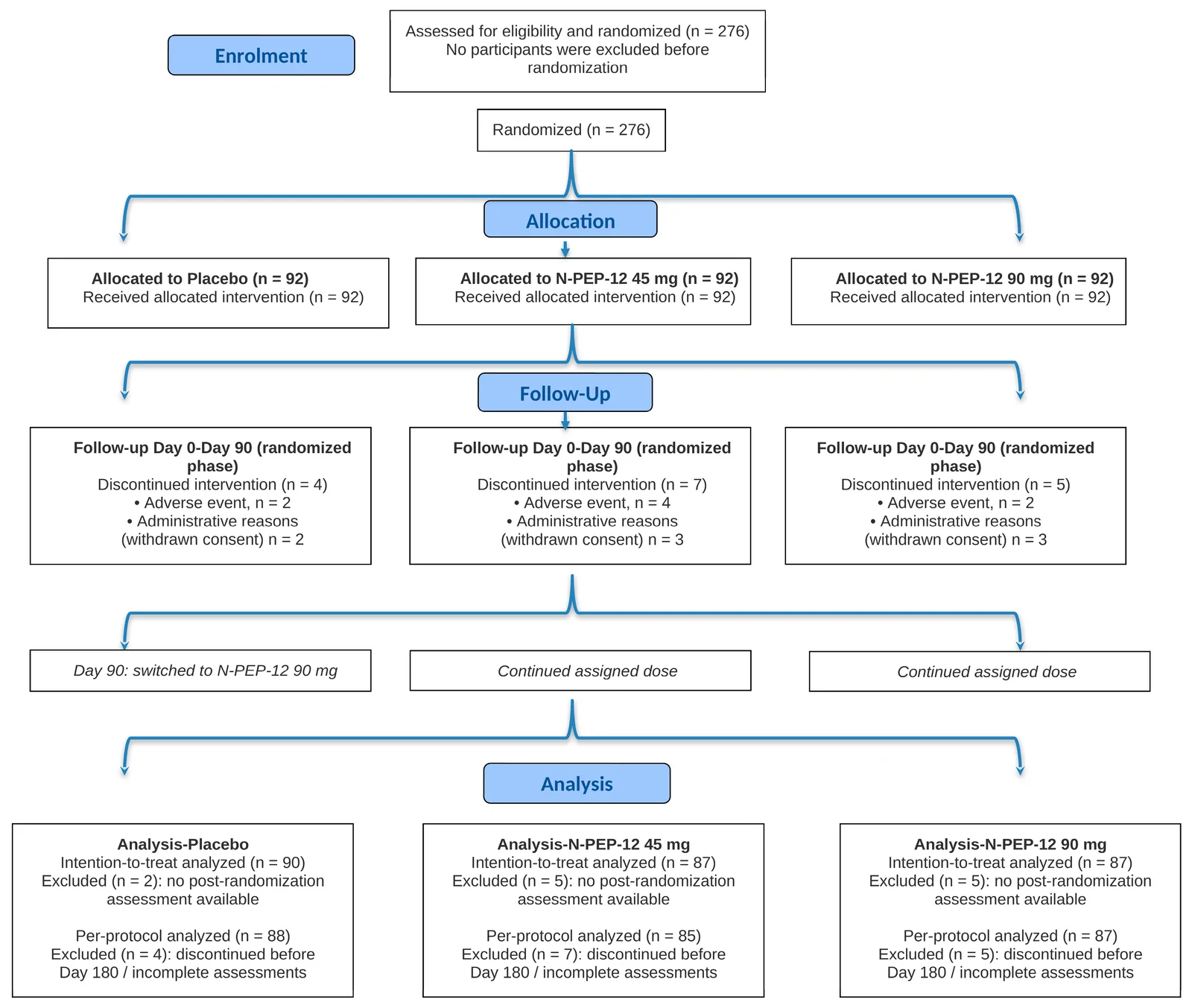
180 days, double-blind, placebo-controlled
Limit: EVER Neuro Pharma GmbH supplied the supplement
Edited by Boris Djordjevic · AgingResearch.News
Researchers randomized 276 healthy adults aged 50–75, including 199 women, with self-reported cognitive complaints but no clinically significant cognitive impairment. In the double-blind trial, participants took placebo or N-PEP-12, a supplement derived from pig-brain proteins, at 45 or 90 mg daily for 90 days. Supplementation continued to day 180; placebo recipients switched to 90 mg.
Attention-test scores changed differently across groups over time, with no statistically clear overall group difference. Exploratory comparisons favored both doses over placebo for attention and memory at 90 days. There were 20 mild or moderate adverse events: seven with placebo, eight with 45 mg and five with 90 mg. Eight people stopped following an event: two, four and two, respectively. No serious events occurred.
Why it matters
Self-reported cognitive complaints may reflect early cognitive changes associated with aging. The authors said the findings support further investigation of N-PEP-12 for these early complaints.
Caveats
Individual-test comparisons were exploratory, and the extension lacked a placebo control; the main analysis filled in missing scores using assumptions unfavorable to supplementation. The findings do not extend to people outside ages 50–75 or with clinically significant cognitive impairment; harms were collected through open questioning.
From the paper
- Participants
The study enrolled a total of 276 subjects, equally distributed across the three arms (n = 92 per arm; ).
- Who took part
The study assessed the efficacy of N-PEP-12 supplementation on attentional performance, cognitive function, and mental wellbeing in healthy middle-aged and older adults with subjective cognitive complaints, with primary evaluation at 90 days and additional assessments at 30 and 180 days.
- Ages
The mean age at enrollment was 61.4 ± 7.4 years (range, 50 to 75 years), and the majority of participants were females (199, 72.1%).
- Harms
A total of 20 adverse events (AEs) were reported between enrollment and the third visit, with a similar distribution across study groups (placebo: n = 7; N-PEP-12 45 mg: n = 8; N-PEP-12 90 mg: n = 5; χ² test, p = 0.686).
- Limitation
Firstly, some of the outcomes, such as stress, mood and sleep, were based on self-reported measures, which may be influenced by personal perception and the time of data collection.
- Attentional performance
Regarding alertness, both the N-PEP-12 45 mg group (Wilcoxon rank-sum test, p < 0.001, δ = 0.405 CI 95% [0.252 to 0.538]) and the 90 mg group (p < 0.001, δ = 0.446 CI 95% [0.3 to 0.572]) demonstrated significantly greater improvements compared to placebo.
Quoted word for word from the full text on PubMed Central.
- N-pep-12
- Subjective cognitive complaints
- EQ-5D-5L visual analog scale
- Test of Attentional Performance
- WAIS-IV Digit Span
- Humans
The paper
Iuliu Hațieganu University of Medicine and Pharmacy
Nutrients, Aug 21, 2026, Open access
