Lipoprotein(a) Levels and Embolic Stroke of Undetermined Source in Patients with Patent Foramen Ovale
Declared no competing interests
Abstract
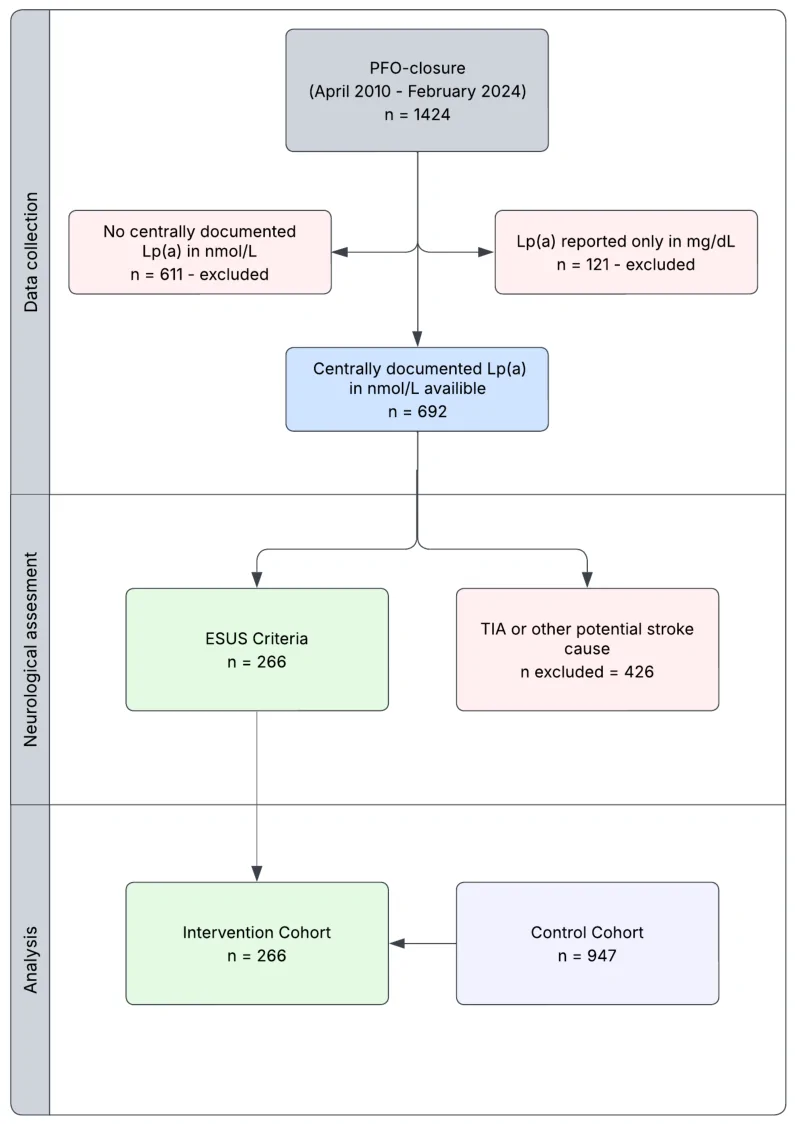
Background: Elevated levels of lipoprotein(a) [Lp(a)] are an independent risk factor for the development of atherosclerotic cardiovascular disease (ASCVD). However, there is only limited data investigating the role of elevated Lp(a) levels in patients with patent foramen ovale (PFO)-associated embolic stroke of undetermined source (ESUS). Methods: We included 266 patients with PFO-associated ESUS who underwent percutaneous PFO closure and had Lp(a) measurements available. These patients were matched according to age, sex and previously documented statin treatment to 947 hospital controls without stroke. Results: Median age was 51 years (IQR 43-59) and 40% were female. Median Lp(a) levels were higher in cases (24 IQR 12-88 nmol/L) than in controls (21 IQR 7-75 nmol/L; p = 0.003). This association appeared more pronounced in men than in women. In males, patients with Lp(a) in the second tertile had an odds ratio (OR) of 1.64 (95% CI, 1.03-2.62) and patients with Lp(a) in the third tertile had an odds ratio of 2.18 (95% CI 1.38-3.44) independent of age, statin use, HbA1c and eGFR. In contrast, in females the second (OR 2.08 [95% CI 1.22-3.54]) but not the third tertile (OR 0.88 [95% CI 0.49-1.59]) of Lp(a) was associated with case status. Conclusions: In this retrospective matched case-control study, higher Lp(a) concentrations were associated with case status in a selected cohort of patients with PFO-associated ESUS, particularly in men. These findings should be considered hypothesis-generating and require confirmation in prospective studies with more representative comparison cohorts.
The paper
Medical University of Vienna; Ludwig Boltzmann Institute for Cardiovascular Research
Journal of Clinical Medicine, 10 Aug 2026, Open access