Three-Dimensional Motion Analysis of Finger in Sport Climbing in Different Age Groups
Abstract
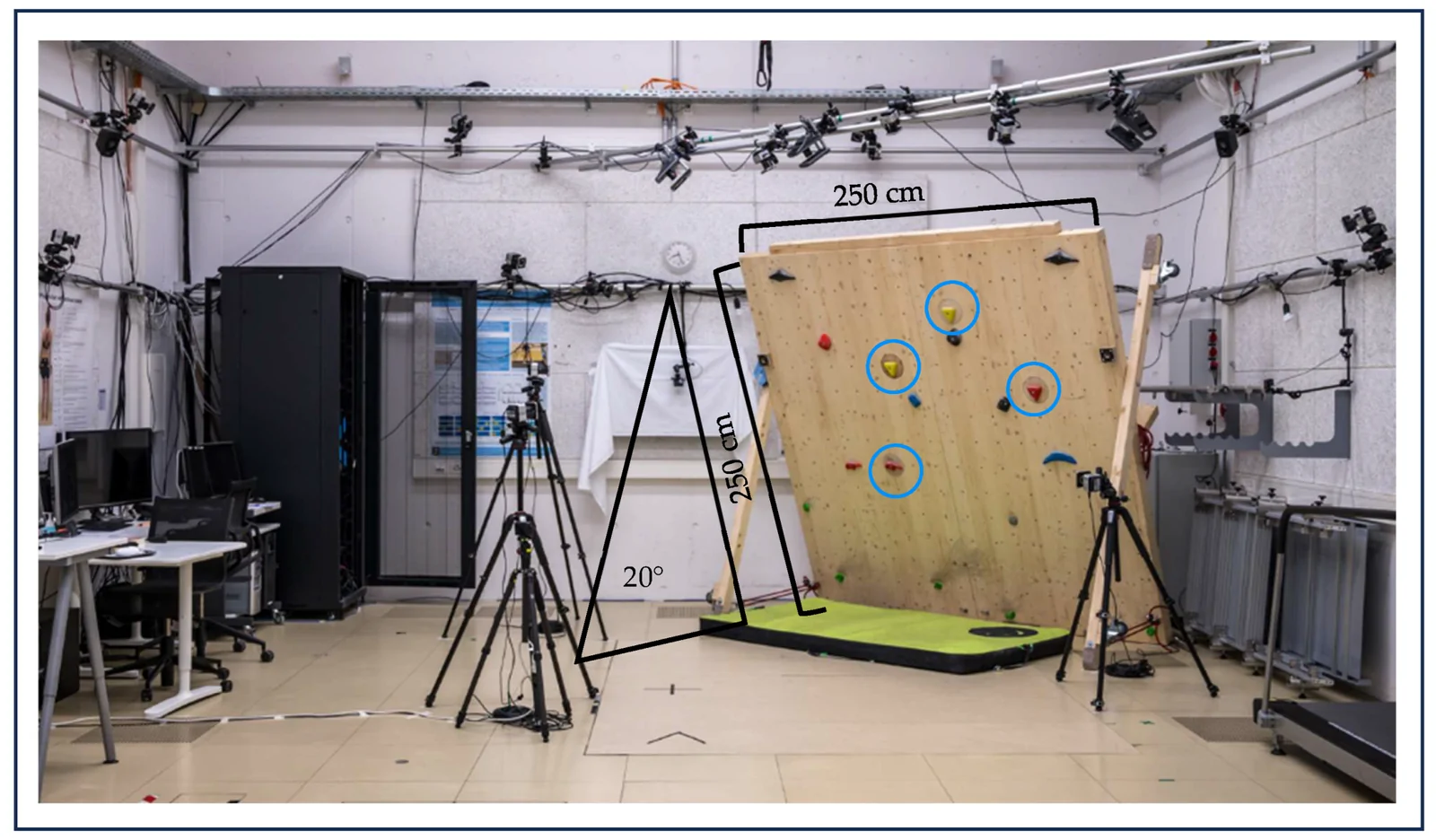
Climbing with extreme finger positions is a risk factor for osteoarthritic changes. Our initial study revealed a large variation in PIP joint flexion, especially in older climbers. This study compares finger joint motion between age groups and examines relations to degenerative changes. Nine young (~33.9 years) and 11 old (~55.8 years) participants climbed a defined boulder problem in four grip positions: crimp, half-crimp, open-hand and participant-selected grip. Finger and wrist kinematics were recorded by an optical motion capture system, contact forces were measured using four instrumented holds, osteophytes were assessed using ultrasound and maximal finger strength was measured separately. Older climbers demonstrated significantly (p < 0.0001) reduced PIP flexion compared to younger climbers in crimp (65° vs. 85°), half-crimp (53° vs. 75°), and self-selected grip positions (56° vs. 76°), with no difference observed in open-hand grip (33° vs. 37°; p = 0.44), which is biomechanically less demanding on the PIP joints. The self-selected grip corresponded to the half-crimp position. Osteophytes were rare in younger climbers (PIP: 8.33%, DIP: 16.67%) but common in older climbers (PIP: 68.18%, DIP: 81.82%), with a negative correlation with PIP flexion and a positive correlation with DIP flexion without age differences in maximal force (limited to male climbers). The half-crimp position generated higher maximal finger strength than the open-hand grip, and maximal finger strength was applied with a more open hand position. Older climbers apply lower finger forces and demonstrate less extreme finger joint kinematics associated with higher osteophyte prevalence, while preserving maximal finger strength, suggesting adaptive, joint-protective movement patterns.
The paper
Universitätsklinik Balgrist
Bioengineering, 27 Jul 2026, Open access