Associated factors of elastic and stiffening components of pulse pressure based on 45 517 database of 24 h ambulatory blood pressure monitoring
Declared no competing interests
Abstract
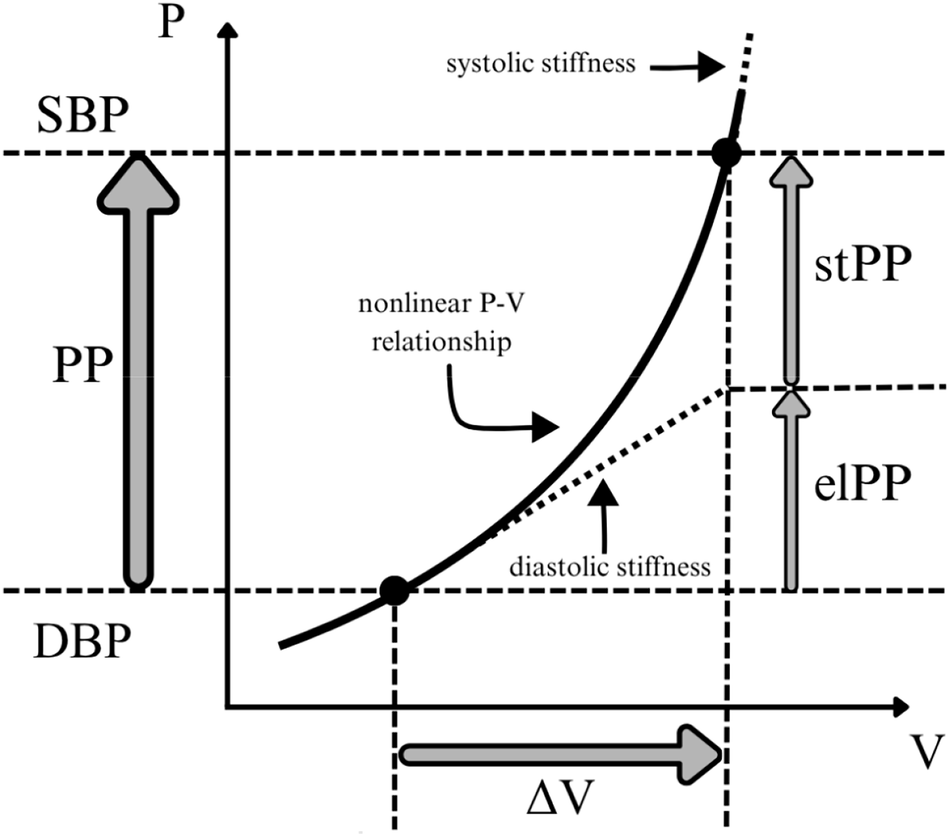
Pulse pressure (PP), which has been proposed to be a marker of hypertension-mediated organ damage (HMOD) in elderly, can be divided into two components: elastic PP (elPP) and stiffening PP (stPP). Thus, the aim of our study was to explore the associated factors of 24 h elPP and stPP. ABPM data of 45 517 subjects (age: 56.4 ± 14.9 years, male: 20 897 (45.9%)) were collected from the Hungarian ABPM Registry between September 2020 and August 2024. Subjects' clinical data were analyzed together with ABPM curves. elPP and stPP were calculated according to published formulas. The elPP was higher in men than in women (46.4 ± 8.2 vs 45.8 ± 9.2 mmHg, p < 0.05), whereas stPP was higher in women than in men (8.9 ± 5.8 vs 8.3 ± 5.5 mmHg, p < 0.05). elPP showed a U-shaped curve with age, which had a higher value below 40 years (47.3 ± 8 mmHg), then it decreased between 40-49 and 50-59 years (43.7 ± 7.3 and 43.9 ± 8 mmHg, respectively) and it increased again reaching 49.4 ± 9.7 mmHg above the age >70 years, while stPP progressively increased with ageing. Multiple correlates of elPP and stPP were identified based on age groups, sex, heart rate and antihypertensive medication. In conclusions, the evaluation of the associated factors of elPP and stPP and of elPP decrease in middle-aged subjects can help to better understand the pathomechanisms responsible for the development of HMOD and the role of pulse pressure in the prediction of CV outcome.
The paper
Petz Aladár Megyei Oktató Kórház; Semmelweis University
Journal of Human Hypertension, 26 Aug 2026