Obesity as a risk factor for multimorbidity: a 23-years population-based prospective study
23 years, declared ties to: Orion Pharma, Oriola, Aktivolabs and 1 more
Abstract
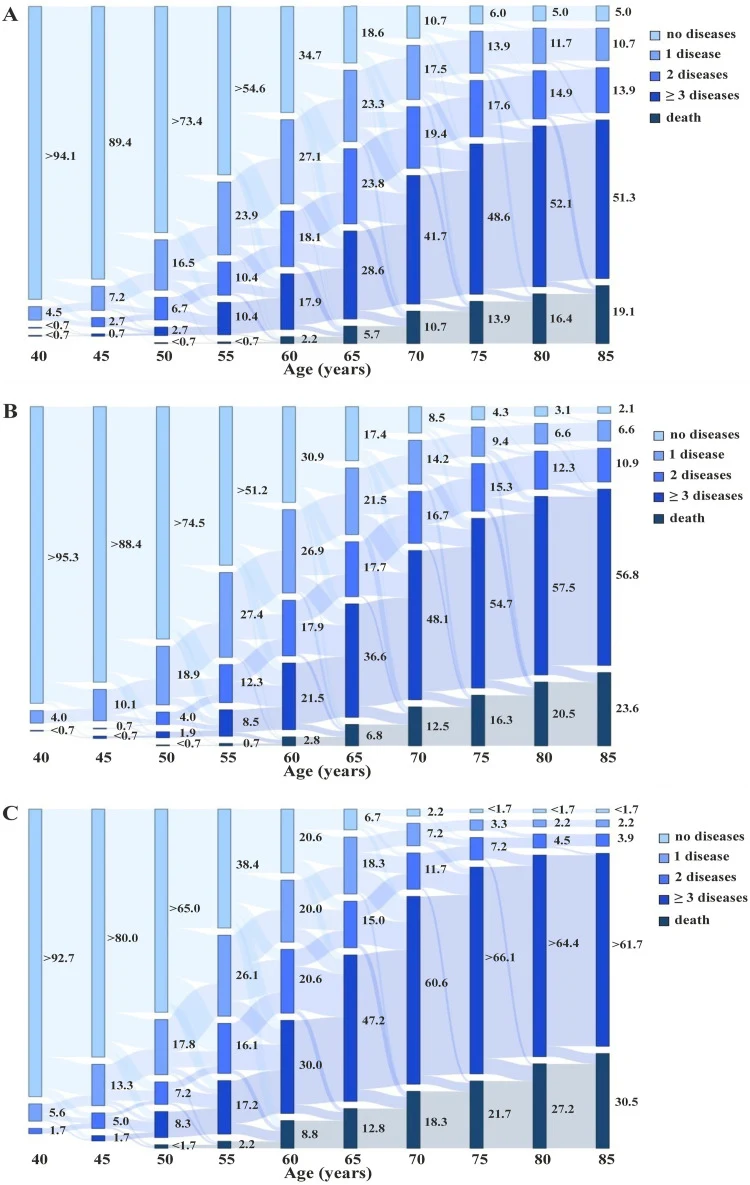
BACKGROUND: Obesity and multimorbidity are increasing challenges for public health. While obesity is a well-recognized risk factor for multimorbidity, evidence commonly comes from cross-sectional studies using body mass index (BMI). Evidence on the body roundness index (BRI), a novel indicator of central obesity, remains limited. OBJECTIVES: This study assessed midlife obesity as a risk factor for multimorbidity in a Finnish population cohort during 23 years of follow-up. METHODS: A total of 1007 participants born between 1933 and 1956 and living in the Savitaipale municipality were enrolled between 1994 and 1996. Baseline data were collected using questionnaires and clinical examinations. Information on 38 chronic diseases was obtained from health registers. Obesity was assessed using BMI, waist circumference (WC), and BRI. Cox proportional hazards models estimated associations with incident multimorbidity, and receiver operating characteristic (ROC) analysis was used to derive BMI, WC and BRI thresholds with the best sensitivity-specificity balance. RESULTS: Over 23 years, obesity defined by BMI and WC, as well as higher BRI, was associated with increased multimorbidity risk. Hazard ratios ranged from 1.52 (95% CI: 1.21-1.92) to 2.17 (95% CI: 1.59-2.97) in women and from 2.41 (95% CI: 1.82-3.19) to 2.79 (95% CI: 2.00-3.90) in men, depending on obesity and multimorbidity definitions. ROC-derived thresholds for multimorbidity prediction were: BMI 26.4 in women and 26.1 in men; WC 76.3 cm and 93.3 cm; and BRI 3.41 and 3.70, respectively. CONCLUSION: This 23-year study highlights midlife obesity as a risk factor for multimorbidity in later life.
The paper
Oulu University Hospital
Journal of Multimorbidity and Comorbidity, 17 Aug 2026