Japanese Dietary Pattern and All-Cause and Cardiovascular Disease Mortality Across Diverse Topographical Settings: The Japan Collaborative Cohort Study
Dose-response, declared no competing interests
Abstract
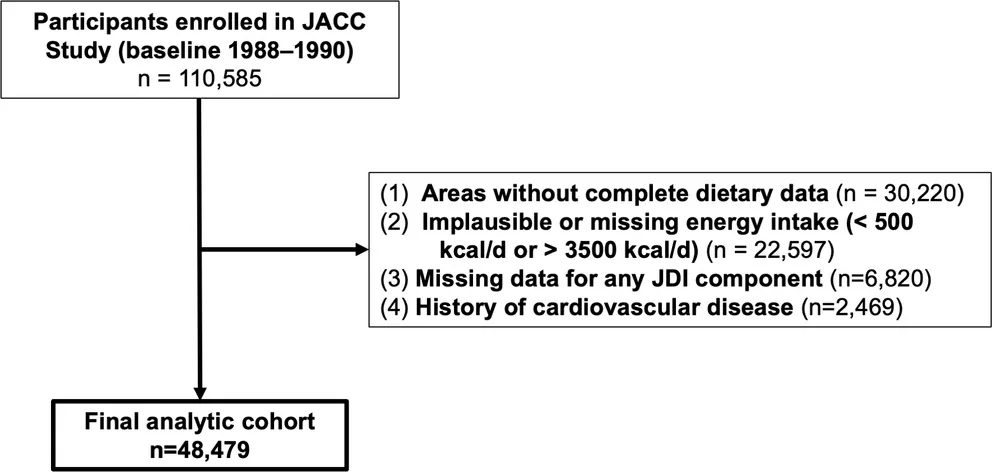
OBJECTIVE: We examined whether the association between adherence to the Japanese dietary pattern and all-cause and cardiovascular disease (CVD) mortality is consistent across diverse residential topographical settings in Japan. METHODS: This prospective cohort study included 48 479 adults aged 40-79 years from the Japan Collaborative Cohort Study, with baseline dietary assessment in 1988-1990. Adherence was quantified by the Japanese Diet Index 8 (JDI-8), with components dichotomized at sex-specific medians. Residential municipalities were classified as coastal, urban inland, flat/intermediate inland, or mountainous inland. Shared frailty Cox proportional hazards models with a municipality-level random intercept (33 municipalities) estimated hazard ratios (HRs) and 95% confidence intervals (CIs). We tested effect modification by residential area using interaction tests and stratified analyses. RESULTS: During a median follow-up of 19.2 years, 9304 all-cause deaths and 2685 CVD deaths occurred. Comparing the highest with the lowest JDI-8 quartile, HRs were 0.929 (95% CI, 0.872-0.990; p for trend = 0.034) for all-cause mortality and 0.862 (95% CI, 0.766-0.970; p for trend = 0.023) for CVD mortality. Interactions by residential area were not statistically significant (p for interaction = 0.246 for all-cause and 0.185 for CVD mortality). Component-level distributions varied by area, with urban inland residents having lower proportions of miso soup, rice, and fish intake. CONCLUSIONS: Higher adherence to the Japanese dietary pattern was associated with lower all-cause and CVD mortality, with directionally consistent associations across diverse residential settings. The absence of significant heterogeneity supports generalizability within Japan, although stratified estimates are exploratory.
The paper
Mie University
Geriatrics & Gerontology International, 1 Aug 2026