Blood particle carries fats linked to cardiovascular disease
An observational analysis of 623 community participants linked triglycerides carried by lipoprotein(a), a blood particle, to newly occurring cardiovascular disease.
Our read
Mechanisms- Studied:
- Cohort study of 623 community participants
- What changed:
- Triglycerides carried by lipoprotein(a) were linked to incident cardiovascular disease
- The catch:
- The abstract does not report a risk estimate, follow-up duration or participants' ages
- Stake:
- An author founded Kleanthi Diagnostics and holds shares in it.
- In the record:
- The 190th paper on lipoprotein with results in people; 679 on record in all.
- Why it’s aging research:
- It bears on staying healthy in midlife and later life.
Editor of record: Boris Djordjevic · AgingResearch.News
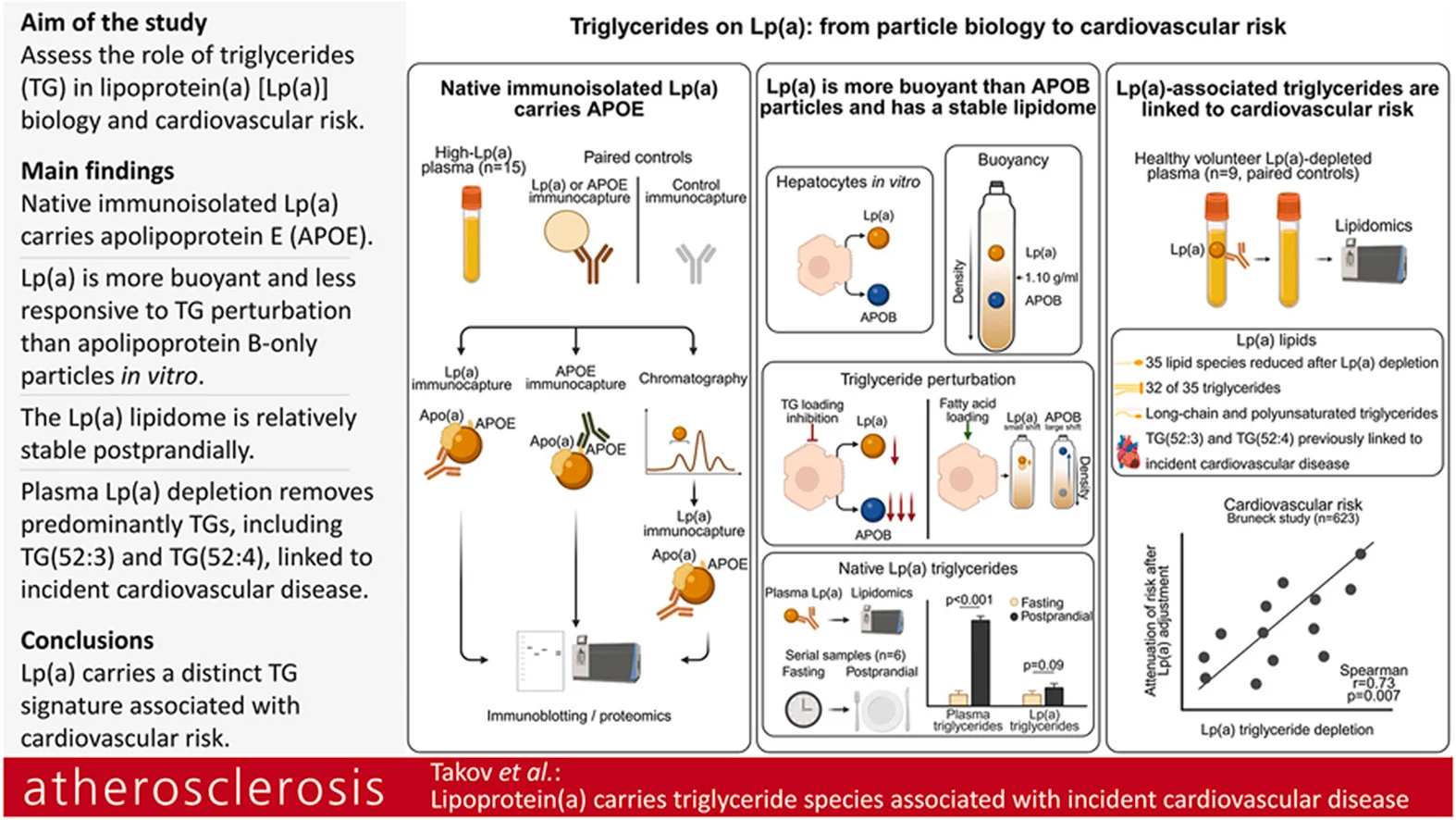
An observational analysis of 623 participants in the community-based Bruneck Study examined links between cardiovascular disease and fats carried by lipoprotein(a), a fat-carrying blood particle. Separate blood-sample experiments included 15 patients with high lipoprotein(a), nine healthy volunteers and six people sampled before and after meals.
Removing lipoprotein(a) from plasma in the lab reduced 35 types of fat, mostly triglycerides, a type of blood fat. These included two triglycerides previously linked to newly occurring cardiovascular disease. The size of those laboratory reductions correlated with how much the fats’ cardiovascular risk links weakened after accounting for lipoprotein(a) in the Bruneck Study. The particle’s fat composition changed less after meals than fats in plasma overall. The authors concluded that lipoprotein(a) carried a defined triglyceride signature linked to newly occurring cardiovascular disease.
Why it matters
Cardiovascular disease is an important concern as people age. The work highlights blood particles’ fat composition as a subject for research into cardiovascular risk.
Caveats
The cardiovascular findings were observational and cannot establish cause and effect. The abstract does not report a risk estimate, follow-up duration or participants’ ages.
The paper
Lipoprotein(a) carries triglyceride species associated with incident cardiovascular disease
Imperial College London
Atherosclerosis, Aug 5, 2026, Open access
doi.org/10.1016/j.atherosclerosis.2026.121866PubMed 42612337


Comments
Be the first to comment.