Midlife social disadvantage linked to faster brain decline
Scores on a thinking-skills test fell 0.72 points per five years in the most disadvantaged quarter, versus 0.55 in the least disadvantaged quarter.
Our read
Populations- Studied:
- Cohort study of 3,488 Black and White US adults, 10 years, against the least disadvantaged quarter
- What changed:
- Thinking-skills scores fell 0.72 points per five years in the most disadvantaged quarter, versus 0.55 in the least disadvantaged quarter
- The catch:
- The brain-scan subgroup was more educated and more often White than the full cohort
- Why it’s aging research:
- It measures an outcome that worsens with age.
Editor of record: Boris Djordjevic · AgingResearch.News
An observational cohort study included 3,488 Black and White US adults aged 32 to 55, averaging 40; 57% were women. Researchers combined 12 measures covering finances, education, social relationships, neighborhoods and health care access into a social-disadvantage score. They tracked cognition over 10 years; 645 participants also had repeated brain scans.
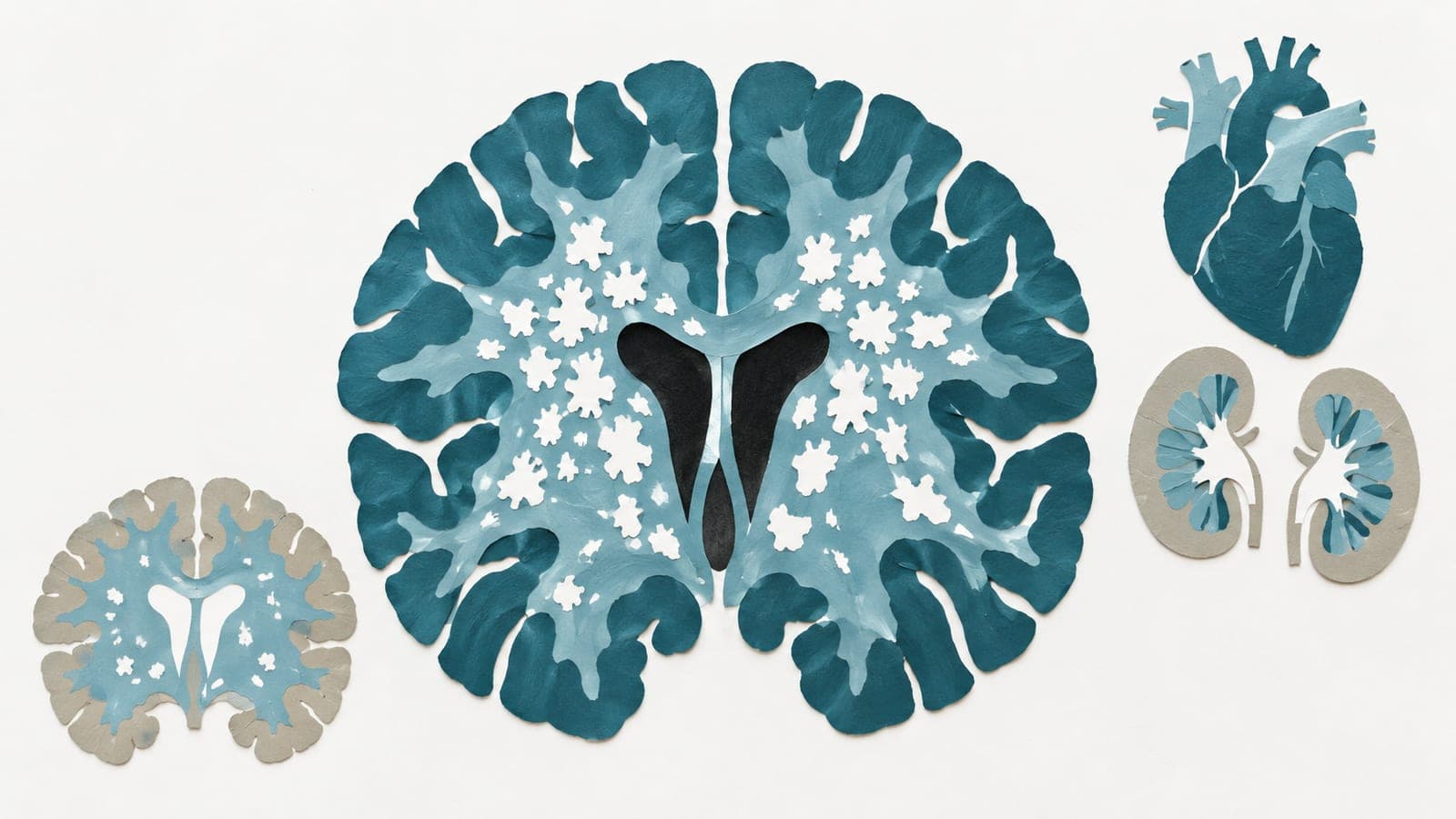
The most disadvantaged quarter initially scored worse on all three cognitive tests than the least disadvantaged quarter. They declined faster on a test of speed, attention and working memory, but not on the other two tests. In the brain-scan subgroup, greater disadvantage was linked to faster buildup of bright areas in the brain’s connecting tissue and steeper declines in the volume of gray matter, which is rich in nerve cells. These links remained after accounting for vascular risks and depressive symptoms.
Why it matters
The authors suggested that strategies to reduce social disadvantage in midlife may help preserve cognitive and brain health as people age.
Caveats
This observational study cannot show that social disadvantage caused the changes or that reducing it would prevent them. Participants came from four US cities, and the brain-scan subgroup was more educated and more often White than the full cohort.
- Digit Symbol Substitution Test
- Rey Auditory Verbal Learning Test
- Social determinants of health index
- Stroop test
- Total gray matter volume
- Humans
The paper
Comprehensive social determinants of health and brain health in midlife
University of California, San Francisco
The Journal of Prevention of Alzheimer's Disease, Aug 10, 2026, Open access
Comments
Be the first to comment.