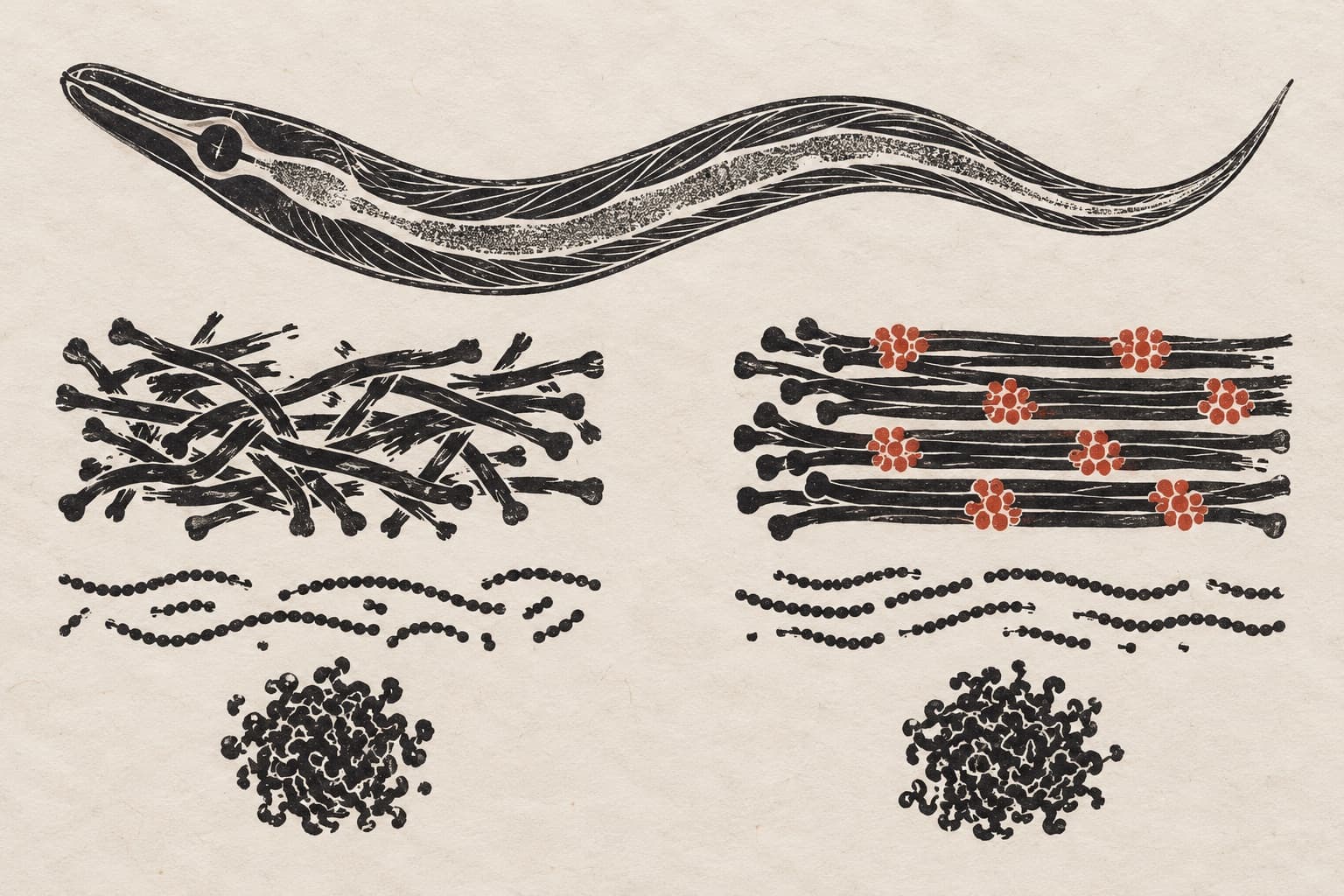
Global Proteotoxicity Caused by Human β₂ Microglobulin Variants Impairs the Unfolded Protein Response in C. elegans
By Good SC, Dewison KM, Radford SE et al.
Abstract
Aggregation of β₂ microglobulin (β₂m) into amyloid fibrils is associated with systemic amyloidosis, caused by the deposition of amyloid fibrils containing the wild-type protein and its truncated variant, ΔN6 β₂m, in haemo-dialysed patients. A second form of familial systemic amyloidosis caused by the β₂m variant, D76N, results in amyloid deposits in the viscera, without renal dysfunction. Although the folding and misfolding mechanisms of β₂ microglobulin have been widely studied in vitro and in vivo, we lack a comparable understanding of the molecular mechanisms underlying toxicity in a cellular and organismal environment. Here, we established transgenic C. elegans lines expressing wild-type (WT) human β₂m, or the two highly amyloidogenic naturally occurring variants, D76N β₂m and ΔN6 β₂m, in the C. elegans bodywall muscle. Nematodes expressing the D76N β₂m and ΔN6 β₂m variants exhibit increased age-dependent and cell nonautonomous proteotoxicity associated with reduced motility, delayed development and shortened lifespan. Both β₂m variants cause widespread endogenous protein aggregation contributing to the increased toxicity in aged animals. We show that expression of β₂m reduces the capacity of C. elegans to cope with heat and endoplasmic reticulum (ER) stress, correlating with a deficiency to upregulate BiP/hsp-4 transcripts in response to ER stress in young adult animals. Interestingly, protein secretion in all β₂m variants is reduced, despite the presence of the natural signal sequence, suggesting a possible link between organismal β₂m toxicity and a disrupted ER secretory metabolism.
The paper
Good SC, Dewison KM, Radford SE et al.
International Journal of Molecular Sciences, 4 Oct 2021