Wearable measures often put people in different activity groups
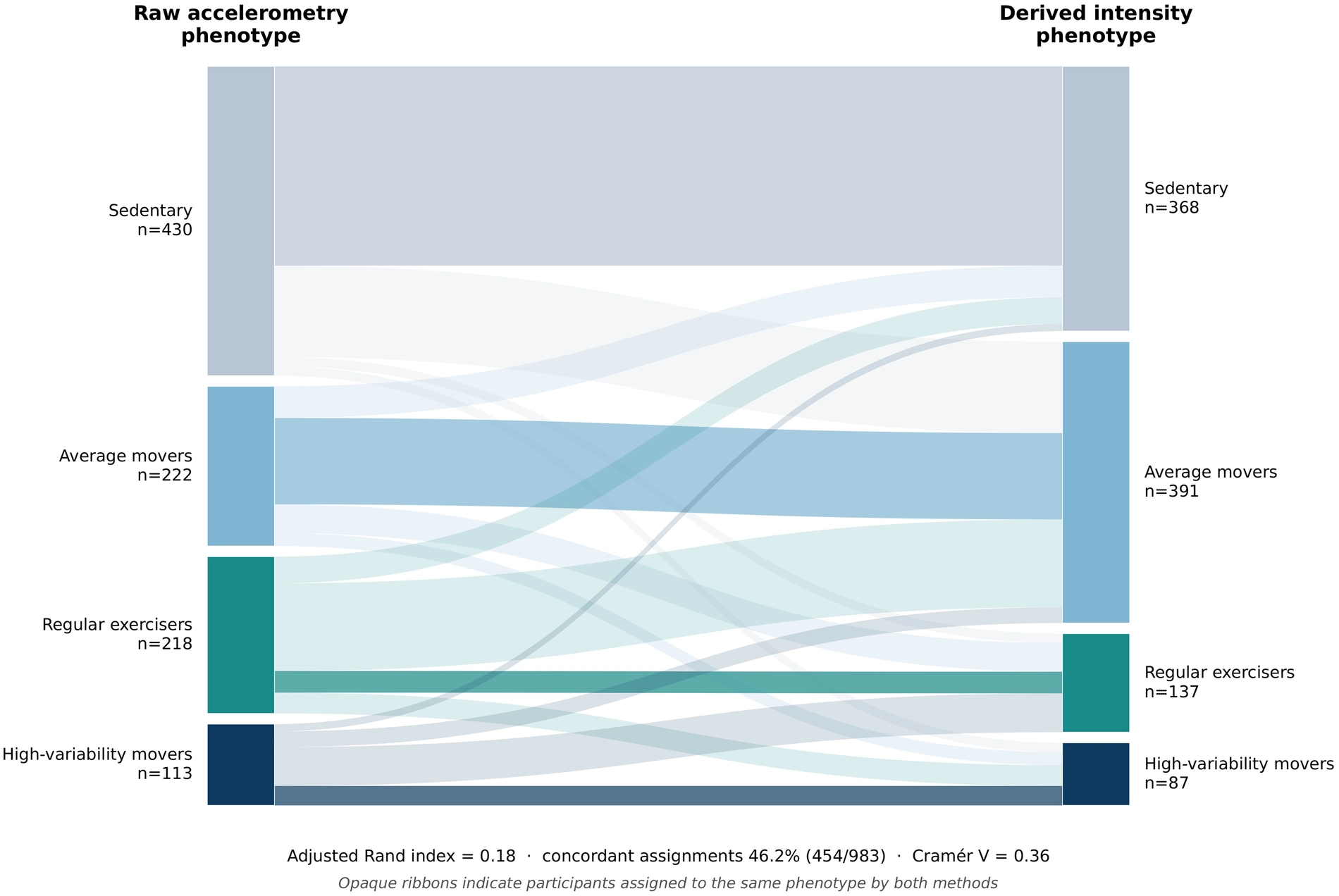
Measures based on steps, distance and floors climbed agreed with device-derived intensity measures on activity group assignments for only 46.2% of participants.
984 adults
Limit: Partial-wear days counted as valid could inflate day-to-day activity variability
Edited by Boris Djordjevic · AgingResearch.News
In this observational study, 984 adults from the SingHEART cohort wore movement sensors for a mean of 7.1 valid days. Their mean age was 45.6 years, and 48.3% were male. Researchers grouped them separately using movement totals, such as steps, and intensity estimates calculated by the device.
The classifications agreed poorly. With volume-based groups, active and sedentary participants differed across 106 of 250 blood biomarkers. Researchers observed no corresponding difference between active and sedentary groups defined by intensity measures. Across 16 body composition and heart-imaging measures, volume-based groups were associated with 11 and intensity-based groups with six. The authors concluded that volume-based groups showed more consistent biological associations.
Why it matters
For research on activity and healthy aging, the study raises a measurement question: which wearable measures best reflect differences in body composition and heart structure?
Caveats
These observational associations cannot show that activity patterns caused the biological differences. Participants were middle-aged on average, so the findings are not specific to older adults.
From the paper
- Participants
… the final analytical dataset comprised 984 participants with complete accelerometry and clinical phenotyping, of whom 983 had complete assignments across both phenotyping models and 876 had complete serum ¹H-NMR metabolomics data.
- Limitation
First, the cross-sectional design prevents us from establishing causal relationships between activity patterns, metabolomic profiles, body composition, and cardiac remodeling.
Quoted word for word from the full text on frontiersin.org.
The paper
National University of Singapore; National Heart Centre Singapore
Frontiers in Digital Health, Oct 26, 2026, Open access, CC BY


Comments
Be the first to comment.