Age-related blood condition linked to spinal disc degeneration
Participants with the condition had higher risk than those without it, with a hazard ratio of 1.153, a measure comparing risk over time.
Our read
Populations- Studied:
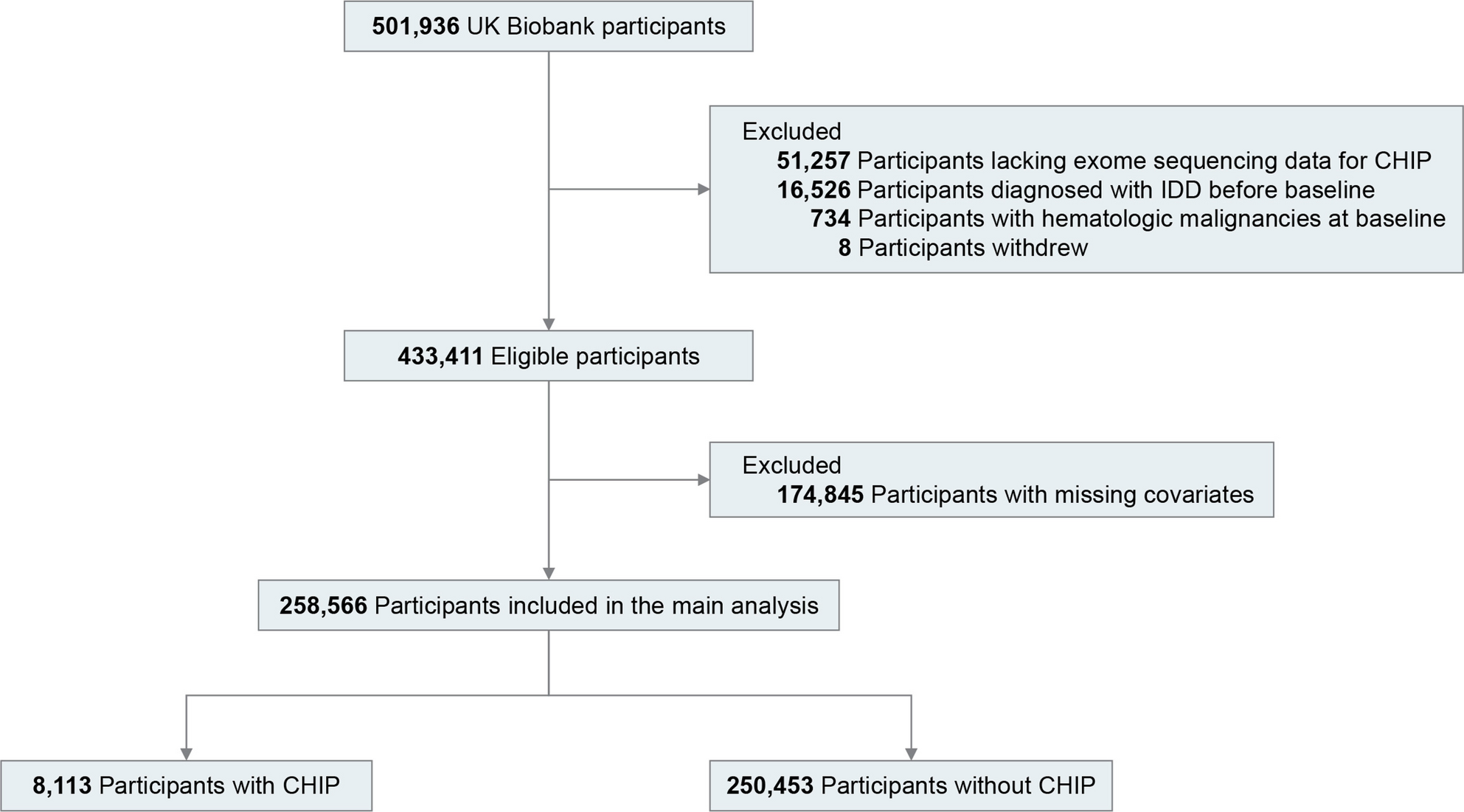
- Cohort study of 258,566 UK Biobank participants, against people without the blood-cell condition
- What changed:
- Spinal disc degeneration risk was higher in people with the blood-cell condition than those without it (hazard ratio 1.153)
- The catch:
- Diagnosis codes can miss disc degeneration that never receives a clinical diagnosis
- In the record:
- The 286th paper on clonal hematopoiesis of indeterminate potential with results in people; 653 on record in all.
Editor of record: Boris Djordjevic · AgingResearch.News
Among 258,566 UK Biobank participants in a prospective cohort study, 8,113 had clonal hematopoiesis of indeterminate potential, an age-related condition involving acquired mutations in blood-forming stem cells. The researchers used genetic sequencing to identify the condition and clinical diagnosis codes to identify new cases of degeneration in the discs between spinal bones.
The condition was associated with higher disc degeneration risk after adjustment for other factors. A similar association appeared for degeneration in the lower back. Evidence for degeneration in the neck was less consistent. Further analyses suggested that blood markers of inflammation may partly account for the association, with estimated contributions of 2.15%–4.41%.
Why it matters
Age-related changes in blood-forming cells may be relevant to degeneration elsewhere in the body. The authors suggest inflammatory signaling may play a role in disc disease.
Caveats
People with the blood-cell condition may also have had other health differences that affected disc degeneration risk. The findings may not extend beyond UK Biobank participants with genetic sequencing and complete analysis data.
Where the evidence stands
Inflammation
- 1,047 independent labs in 77 countries
- 205 findings against
- Funders: National Institutes of Health and others
- 382 of 4,611 findings with company ties
- Inflammation
- Clonal hematopoiesis of indeterminate potential
- Cervical disc degeneration
- Intervertebral disc degeneration
- Lumbar disc degeneration
- Humans
The paper
Journal of Orthopaedic Surgery and Research, Nov 11, 2026, CC BY-NC-ND


Comments
Be the first to comment.