Associations between emerging metabolic and inflammatory indices and cardiovascular events and all-cause mortality in patients with cardiovascular-kidney-metabolic syndrome: a narrative review
Abstract
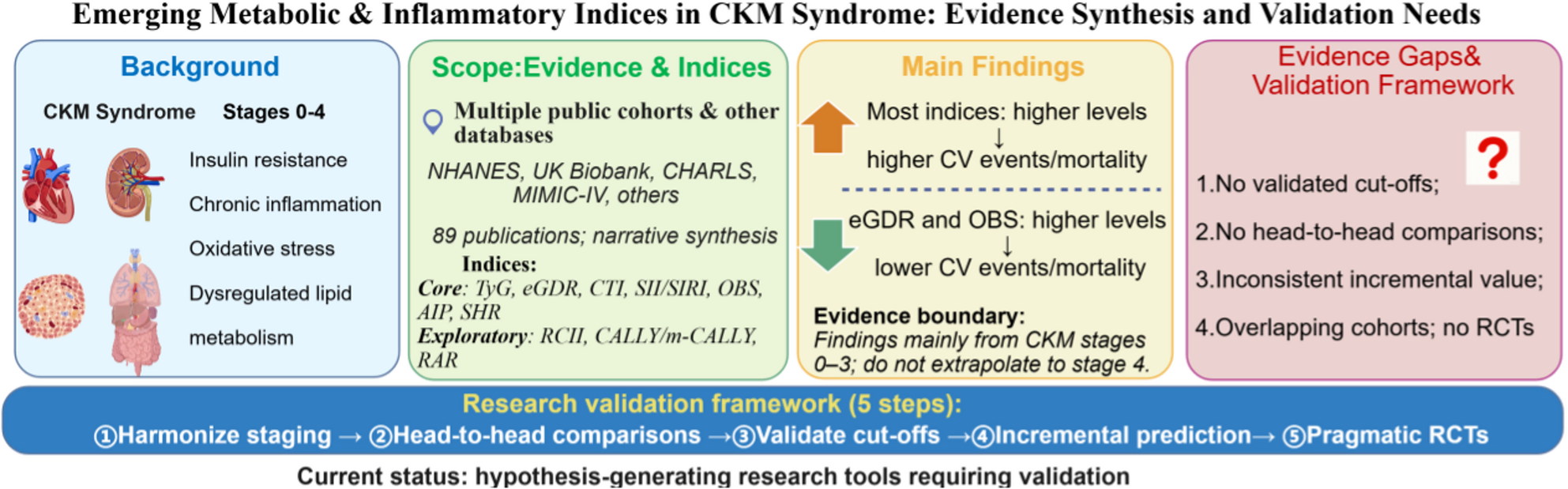
In 2023, the American Heart Association proposed “cardiovascular–kidney–metabolic (CKM) syndrome” to encapsulate the interplay among cardiovascular, renal, and metabolic disorders. Several composite indices derived from routine blood tests have been developed. This review synthesizes evidence from several large public databases, predominantly the National Health and Nutrition Examination Survey (NHANES), the UK Biobank, and the China Health and Retirement Longitudinal Study (CHARLS), with additional evidence from other cohorts. A structured search of the PubMed, Web of Science, Cochrane Library, Embase, and Cumulative Index to Nursing and Allied Health Literature (CINAHL) databases was performed from inception to September 8, 2026. Cohort studies reporting associations between specified indices and outcomes in CKM populations were included. Because of heterogeneity across studies, a structured narrative synthesis was performed; hazard ratios were not compared across indices. Seven index families were reviewed: the triglyceride–glucose (TyG) index and its derivatives, the estimated glucose disposal rate (eGDR), the C-reactive protein–triglyceride–glucose index (CTI), the systemic immune-inflammation index (SII) and systemic inflammation response index (SIRI), the oxidative balance score (OBS), the atherogenic index of plasma (AIP) and its adiposity-adjusted derivatives, the stress hyperglycaemia ratio (SHR), and exploratory indices, including the remnant cholesterol inflammatory index (RCII), the C-reactive protein-albumin-lymphocyte (CALLY) index and its modified version (m-CALLY), and the red blood cell distribution width-to-albumin ratio (RAR). Across CKM stages 0–3, higher levels of most indices were associated with a higher risk of cardiovascular events and mortality, whereas higher eGDR and OBS were associated with a lower risk. However, head-to-head comparisons are lacking, validated cut-offs are unavailable, and incremental predictive value is inconsistently reported. No randomized trial has tested whether index-guided management improves outcomes. These indices should therefore be considered hypothesis-generating research tools rather than guideline-ready clinical instruments. What is currently known about this topic? Individual cohort studies link novel metabolic indices to adverse outcomes in CKM, but the evidence is heterogeneous in CKM staging, exposure scaling, and outcome definitions. Direct head-to-head comparisons and validated cut-off values are largely lacking. What is the key research question? How consistent are the associations of routinely derived indices with cardiovascular events and mortality across CKM stages and databases, and what evidence supports their incremental predictive value beyond established risk models? What is new? This review synthesizes seven index families across several large public databases, predominantly NHANES, UK Biobank, and CHARLS, with additional evidence from MIMIC-IV, hospital-based cohorts, and other multicohort datasets. How might this influence clinical practice? These indices are inexpensive and routinely available, but current evidence does not support clinical decision-making. They may help identify high-risk individuals in research settings, but prospective validation, head-to-head comparisons, and intervention trials are needed before clinical translation.
- Cardiovascular-kidney-metabolic syndrome
- Atherogenic index of plasma
- C-reactive protein-albumin-lymphocyte index
- C-reactive protein-triglyceride-glucose index
- Estimated glucose disposal rate
- Humans
The paper
Southern University of Science and Technology
Cardiovascular Diabetology, Oct 15, 2026, Open access, CC BY-NC-ND