Increased daily walking is associated with changes in psychological well-being and small changes in body composition in adults with cardiometabolic disease
3 months, registered NCT07674459
Abstract
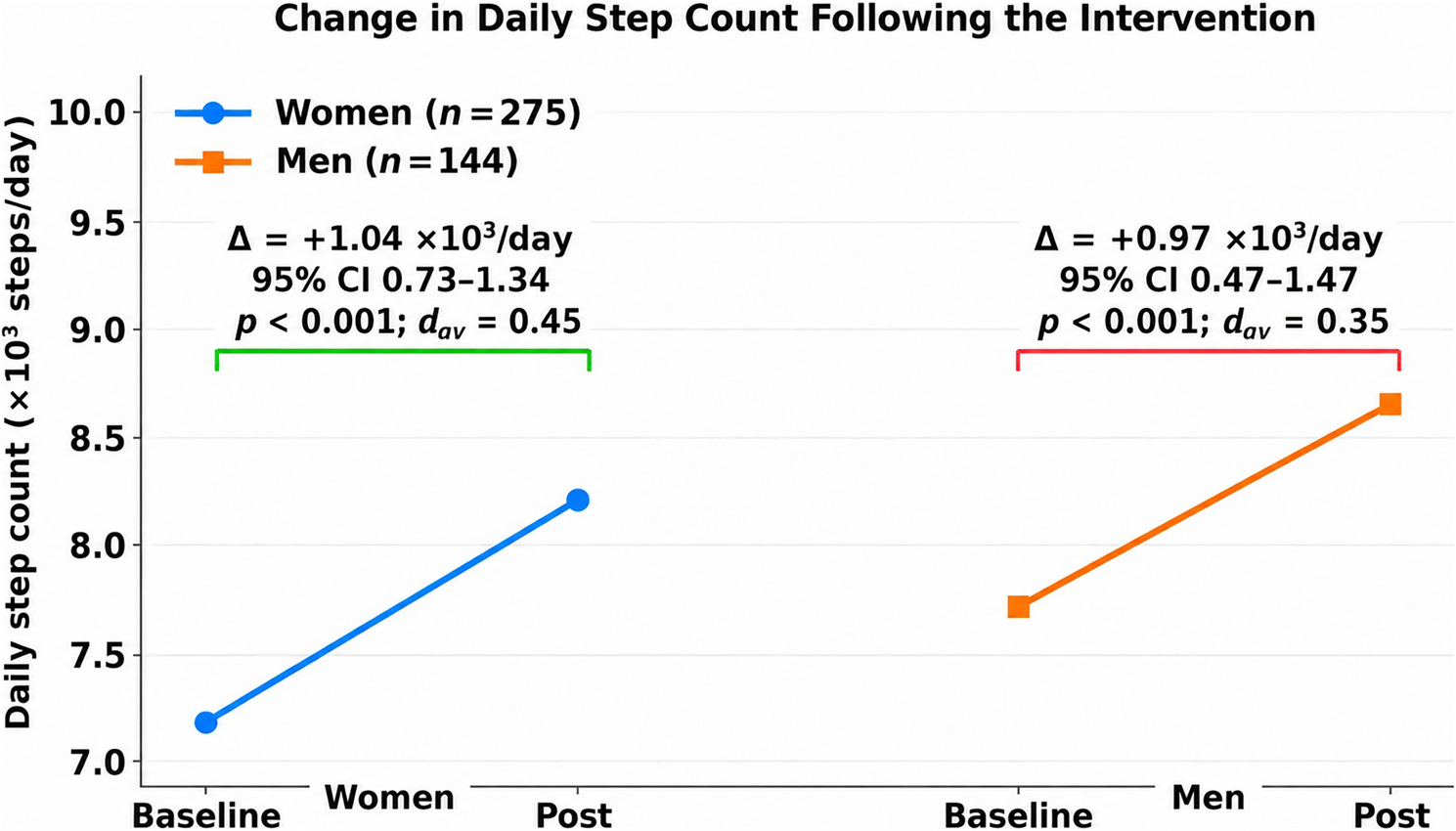
Daily step count is increasingly recognized as a practical indicator of physical activity and health; however, little is known about how modest increases in habitual walking are associated with psychological well-being and body composition in adults with cardiometabolic disease. In this three-month quasi-experimental study, 419 adults with cardiovascular disease and/or type 2 diabetes participated in a smartphone-supported walking intervention. Daily steps were objectively monitored using smartphone-connected wearable devices, and psychological, behavioral, functional, and body-composition outcomes were assessed before and after the intervention. Changes over time and Gender × Time effects were evaluated, with Benjamini–Hochberg false discovery rate correction for multiple comparisons. Multivariable linear regression with HC3 robust standard errors was used to examine factors associated with changes in body weight and vigor. Daily step count increased by approximately 1,000 steps/day ( d ₐ v = 0.41). Favorable changes were observed in vigor ( d ₐ v = 0.34), well-being ( d ₐ v = 0.17), and happiness ( d ₐ v = 0.15), together with a reduction in stress ( d ₐ v = −0.20); the reduction in anxiety did not remain statistically significant after BH-FDR correction. No significant Gender × Time interactions were observed after BH-FDR correction, indicating broadly similar patterns of change in women and men. Body weight, BMI, and body fat percentage decreased significantly, whereas no statistically significant changes were observed in absolute lean mass or handgrip strength; all body-composition effects were small (| d ₐ v | ≤ 0.06). Increased daily step count was independently associated with greater improvement in vigor (β = 0.144, p = 0.003), whereas greater weight loss was associated with higher baseline body weight (β = −0.247, p < 0.001). In adults with cardiometabolic disease, a three-month smartphone-supported walking intervention was accompanied by approximately 1,000 additional daily steps and favorable changes in psychological well-being, whereas changes in body composition were small. These changes were broadly similar in women and men. Smartphone-supported walking may therefore represent a simple and scalable approach to increasing physical activity and supporting psychological well-being, although controlled studies are needed to establish causality and clinical significance. ClinicalTrials.gov Identifier: NCT07674459. Registration Date: 29 June 2026.
The paper
Vytautas Magnus University
BMC Public Health, 12 Oct 2026, Open access, CC BY-NC-ND