Geriatric interdisciplinary intermediate care after hip fracture: associations with immobility and recurrent falls
Multicentre
Abstract
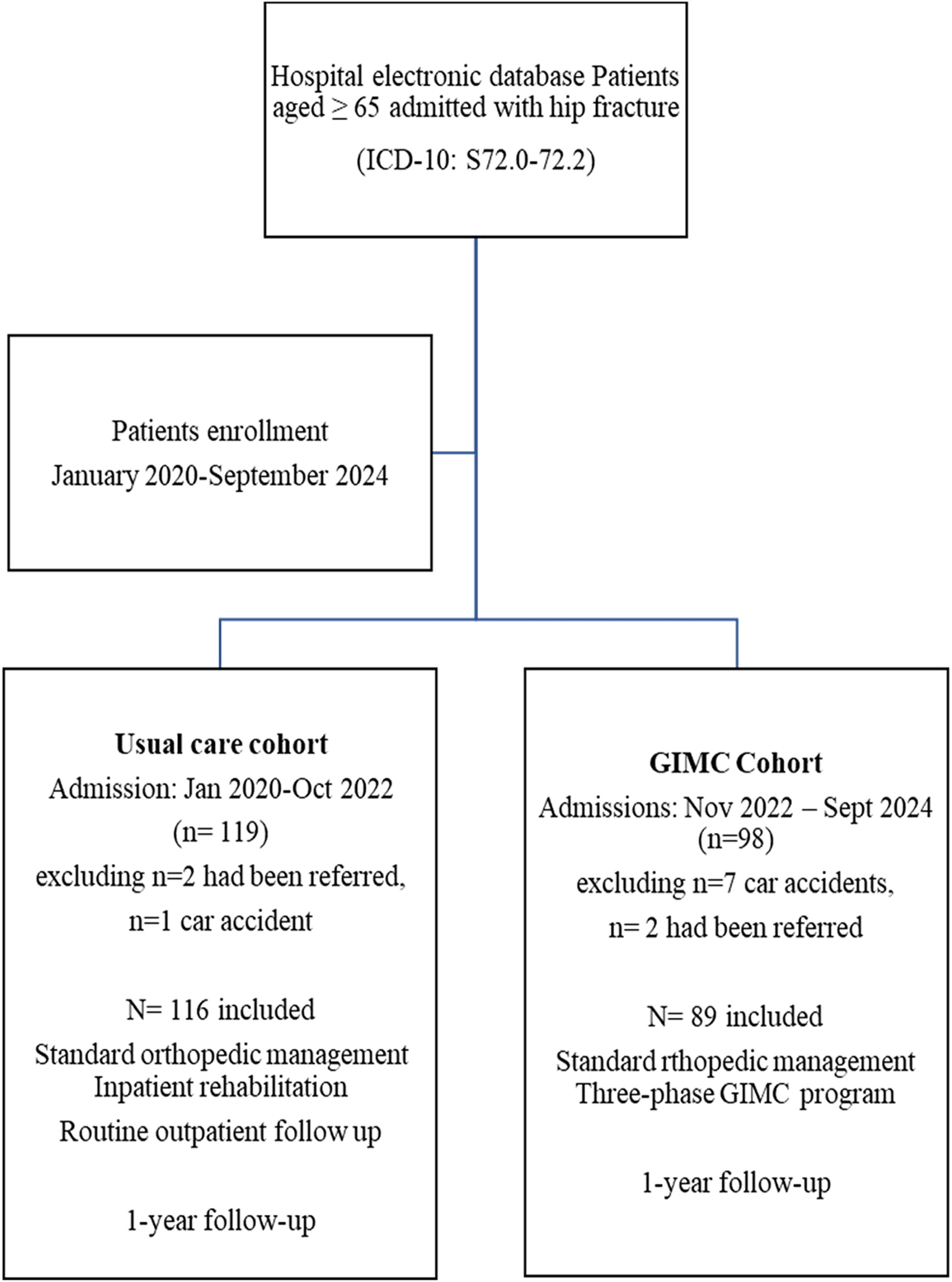
Older adults sustaining hip fractures are at high risk of recurrent falls, functional decline, hospital readmission, and mortality. Although orthogeriatric and transitional care models have been increasingly implemented, evidence regarding the association between geriatric interdisciplinary intermediate care (GIMC) and post-hip fracture outcomes remains limited. This study aimed to evaluate the association between a GIMC program and clinical outcomes among older adults treated for hip fractures. We conducted a retrospective observational cohort study of patients aged 65 years or older admitted with hip fractures between January 2020 and September 2024. Patients receiving usual care were compared with those enrolled in the GIMC program, which included inpatient geriatric assessment, home-based follow-up, and multidisciplinary outpatient fall clinic care. The primary outcome was the number of falls during the one-year follow-up. Secondary outcomes included second fracture, immobility, 30-day and 120-day readmission, and mortality. A total of 205 patients were included (116 usual care; 89 GIMC). During one year of follow-up, 31 patients experienced at least one fall (15.5% in the usual care cohort vs. 14.6% in the GIMC cohort), while recurrent falls (≥ 2 falls) were less common, occurring in 6 patients (5.2%) in the usual care cohort and 1 patient (1.1%) in the GIMC cohort. Second fractures were uncommon in both cohorts (2.6% vs. 2.2%). Patients in the GIMC cohort were more likely to be ambulatory at one year (82.0% vs. 67.3%), and less likely to be immobile (17.0% vs. 32.7%) than those receiving usual care. In multivariable analysis, surgical treatment was independently associated with lower odds of immobility (OR 0.206; 95% CI 0.062–0.683). Differences in readmission and mortality between the cohorts were not statistically significant. Patients receiving GIMC had lower observed immobility and fewer recurrent falls (≥ 2 falls) than those receiving usual care, although the adjusted association with immobility was not significant. These findings suggest a potential role for coordinated interdisciplinary care in supporting functional recovery after hip fracture, however they should be interpreted cautiously given the retrospective observational design and potential for residual confounding. Prospective multicenter studies are needed to confirm these findings. Not applicable
- Geriatric interdisciplinary intermediate care
- Surgical treatment
- Hip fracture
- Recurrent falls
- Second fracture
- Humans
The paper
Ramathibodi Hospital
BMC Geriatrics, 14 Oct 2026, Open access, CC BY-NC-ND