Two-assessment patterns of past-year hospitalization reporting and subsequent functional deterioration and mortality among older adults in China: a two-window longitudinal prognostic factor study
Abstract
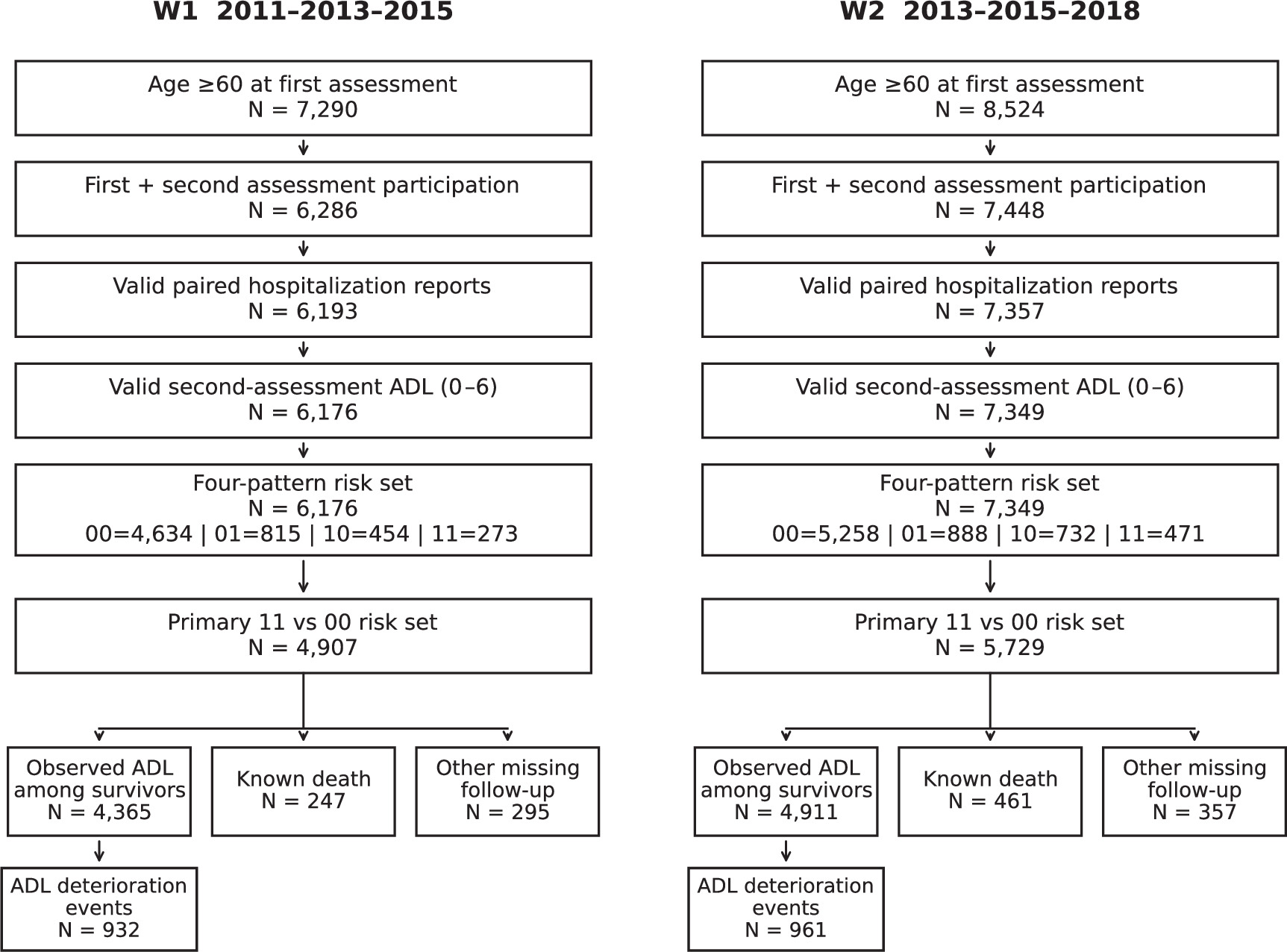
Background: Past-year hospitalization reports may identify older adults with adverse subsequent prognosis, but two assessments do not continuously observe hospital use and their incremental information beyond one-wave reporting is uncertain. Methods: We analysed two three-wave windows of the China Health and Retirement Longitudinal Study (CHARLS): 2011 (Wave 1) and 2013 (Wave 2) hospitalization reports with 2015 (Wave 3) outcomes, and 2013 (Wave 2) and 2015 (Wave 3) reports with 2018 (Wave 4) outcomes. Patterns were 00 (neither assessment), 01 (second only), 10 (first only) and 11 (both). The prespecified primary analysis compared 11 with 00 for survivor-conditional ADL deterioration (increase ≥1) among participants with observed outcome-assessment ADL. Modified Poisson models used community-clustered robust covariance and 50 multiply imputed datasets. Four-pattern, one-wave, mortality, composite, sequential complete-covariate, cognition missing-not-at-random (MNAR), and inverse-probability-of-censoring weighting (IPCW) analyses were also examined. Results: ADL deterioration occurred in 932/4,365 observed survivors in Window 1 and 961/4,911 in Window 2. Adjusted RRs for 11 versus 00 were 1.230 (95% CI 1.007–1.502) and 1.094 (0.906–1.320), respectively. RRs for 11 versus pooled 01 + 10 were 1.229 (1.000–1.511) and 1.019 (0.845–1.228). Mortality RRs were 1.461 (0.986–2.166) and 1.482 (1.187–1.849), and death-or-deterioration RRs were 1.240 (1.054–1.459) and 1.166 (1.031–1.319). In fixed complete-covariate sequential analyses, 11-versus-00 point estimates moved markedly toward or below the null after multidimensional health adjustment, with wide confidence intervals. Cognition MNAR estimates changed little; IPCW point estimates were similar in magnitude (Window 1 RR 1.222, 95% CI 0.999–1.494; Window 2 RR 1.092, 0.905–1.317). Conclusions: The 11 pattern marked less favorable prognosis relative to 00, but the survivor-conditional functional association varied across calendar windows and analytic strategies, and two reports did not consistently distinguish risk from one-wave reporting. These related within-cohort windows do not constitute independent replication. Results support cautious prognostic interpretation, not a causal effect, verified recurrent-admission measure or stand-alone screening rule.
- Hospitalization
- Activities of Daily Living
- Two-assessment past-year hospitalization reporting pattern
- Humans
The paper
BMC Geriatrics, 15 Oct 2026, CC BY