Association between selected disease combinations and suspected dementia: a community-based cross-sectional study
Registered ChiCTR1900020923
Abstract
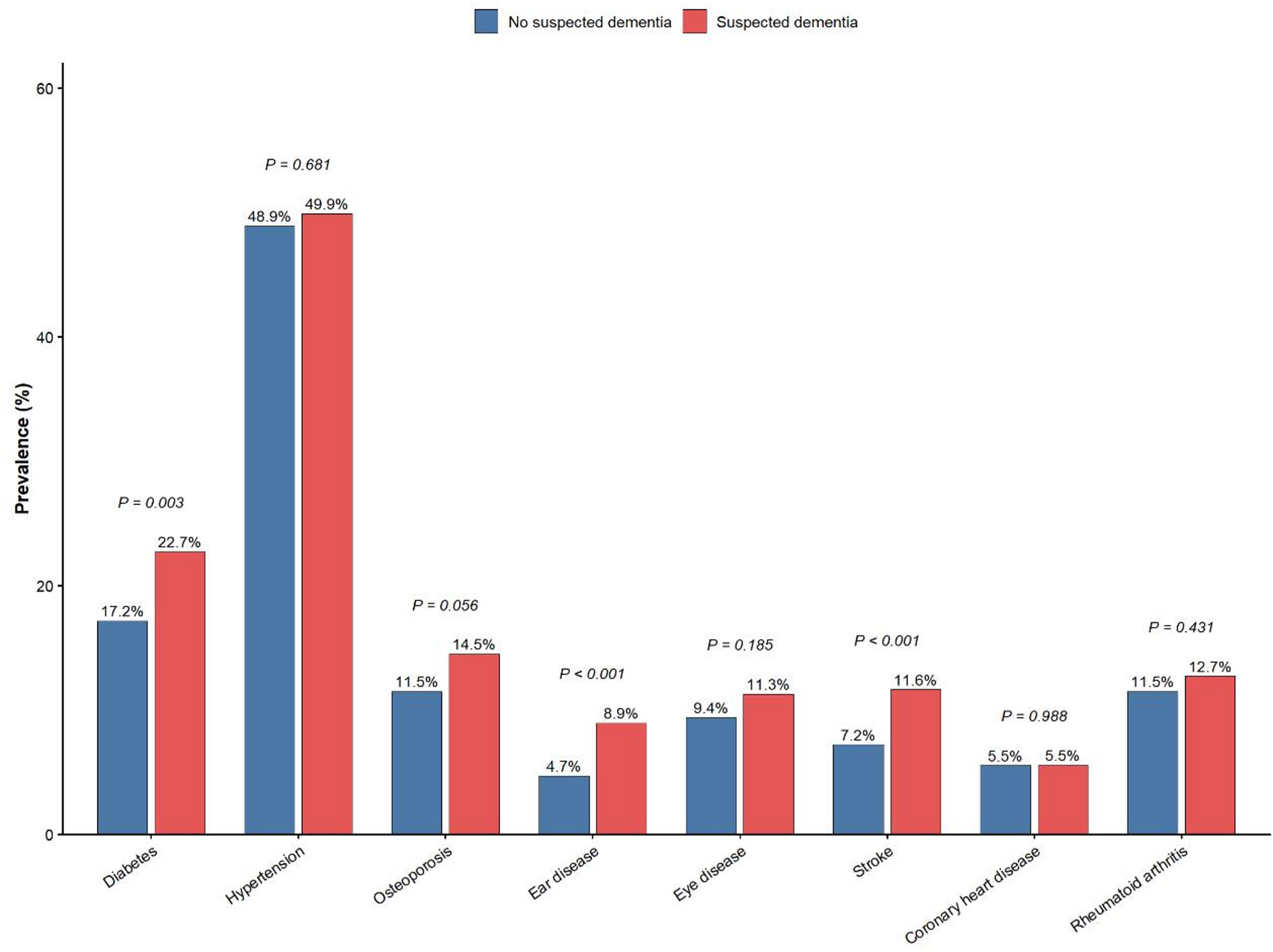
This study examined associations of individual chronic diseases and selected disease combinations with suspected dementia, while secondarily exploring disease interactions and neuropsychiatric symptom heterogeneity. This cross-sectional study included adults aged 60 years or older from three districts in Nantong, China. Suspected dementia was identified using the Revised Hasegawa Dementia Scale. Eight chronic diseases were evaluated from medical history. Logistic regression was used to assess individual diseases and two- and three-disease combinations, with Firth penalized logistic regression applied when sparse data or separation occurred. Missing covariate data were handled using multiple imputation. Additive and multiplicative interactions were explored, and latent class analysis of Neuropsychiatric Inventory Questionnaire symptoms was performed among participants with suspected dementia. Among 2,458 participants, 559 (22.7%) had suspected dementia. Two or more chronic diseases were present in 38.8% of participants with suspected dementia versus 31.6% of those without suspected dementia, and three or more diseases in 15.6% versus 9.7%, respectively. After full adjustment, diabetes mellitus was associated with higher odds of suspected dementia (odds ratio 1.33, 95% confidence interval 1.03–1.70), as was ear disease (OR 1.57, 95%CI 1.06–2.33). Among pairwise combinations, the coexistence of hypertension and ear disease was associated with higher odds of suspected dementia (OR1.83, 95%CI 1.09–3.10). Secondary analyses further characterized associations involving three-disease combinations and disease interactions. Latent class analysis identified distinct neuropsychiatric symptom profiles among participants with suspected dementia, with broader somatic disease associations observed in the sleep-appetite disturbance and agitated-irritable classes. Suspected dementia was associated with both individual chronic diseases and selected disease combinations. Considering the composition of coexisting chronic conditions may provide information beyond disease counts alone. Larger prospective studies incorporating a broader range of chronic conditions are needed to confirm these findings. This study was registered with the Chinese Clinical Trial Registry (ChiCTR1900020923).
- Suspected dementia
- Agitated-irritable symptoms
- Sleep-appetite disturbance
- Diabetes mellitus
- Ear diseases
- Humans
The paper
Nantong University; Affiliated Hospital of Nantong University
BMC Geriatrics, Oct 15, 2026, Open access, CC BY-NC-ND