White matter injury linked to older-appearing brains
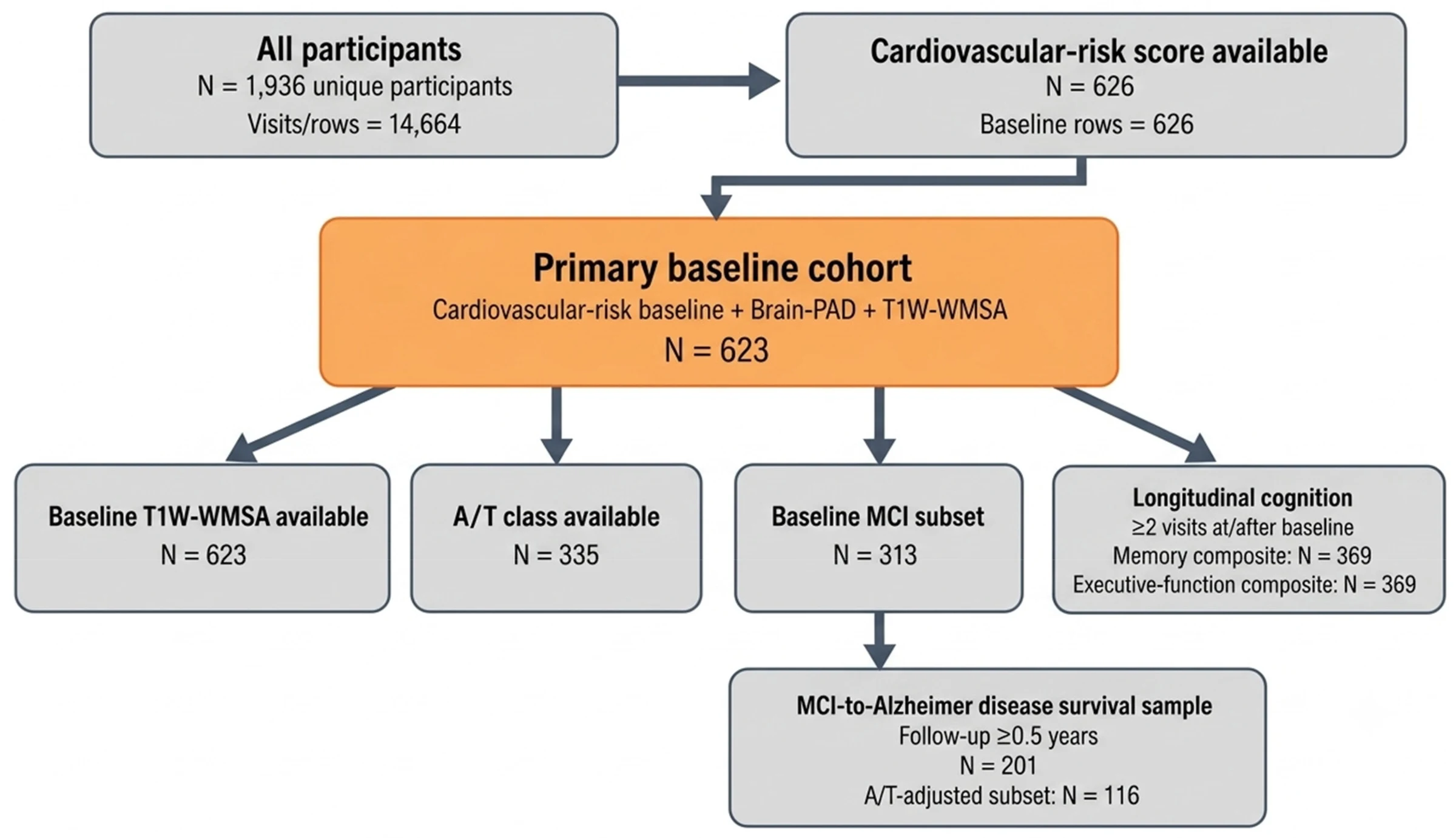
Among 601 people, each unit increase in white matter injury on a logarithmic scale was linked to a 6.95-year larger brain-age gap.
Cohort study
Limit: Scan-predicted brain age is a structural proxy, not a direct measure of biological aging
Edited by Boris Djordjevic · AgingResearch.News
In an observational study of 601 people with complete data, greater injury to white matter—the brain’s nerve-fiber tissue—was associated with older-appearing brain structure. Researchers measured injury using brain scans and compared scan-predicted brain age with actual age. They expressed injury burden on a logarithmic scale, which compresses large differences.
Among 369 participants, a larger brain-age gap was linked to faster declines in memory and executive function, the ability to plan and manage tasks. Among 201 participants with mild cognitive impairment, or problems with memory or thinking, it was associated with progression to Alzheimer’s disease. That association persisted in a subset after accounting for amyloid and tau status—indicators of Alzheimer’s-related proteins—assessed before the outcome. Cardiovascular risk was not associated with this white matter injury measure.
Why it matters
The work addresses a question in brain aging: whether brain structure adds information about future cognitive decline beyond Alzheimer’s-related protein measurements.
Caveats
These observational analyses cannot establish cause and effect; the progression result concerns people who already had mild cognitive impairment. The abstract does not report participants’ ages or follow-up duration.
Where the evidence stands
MAPT
- 81 independent labs in 26 countries
- 7 findings against
- 9 trials
- Funders: National Institute on Aging and others
- 23 of 200 findings with company ties
- 9 of 9 trials sponsored by developers of drugs on it
The paper
White matter injury, brain aging, and cognitive decline beyond amyloid/tau
Red River College Polytechnic; Academic College of Tel Aviv-Yaffo
Journal of Alzheimer's Disease, Nov 3, 2026, CC BY-NC

Comments
Be the first to comment.