Age linked to changing advantages for melanoma mutations
An observational analysis of 5,472 melanomas linked patient age to shifts in which cancer-driving mutations had the greatest advantage.
Our read
Mechanisms- Studied:
- Cross-sectional study of 5,472 melanoma tumors
- What changed:
- The advantage of BRAF V600E mutations in melanoma declined with patient age
- The catch:
- Cohort-level neutral mutation rates can miss individual exposure histories and bias age trends
Editor of record: Boris Djordjevic · AgingResearch.News
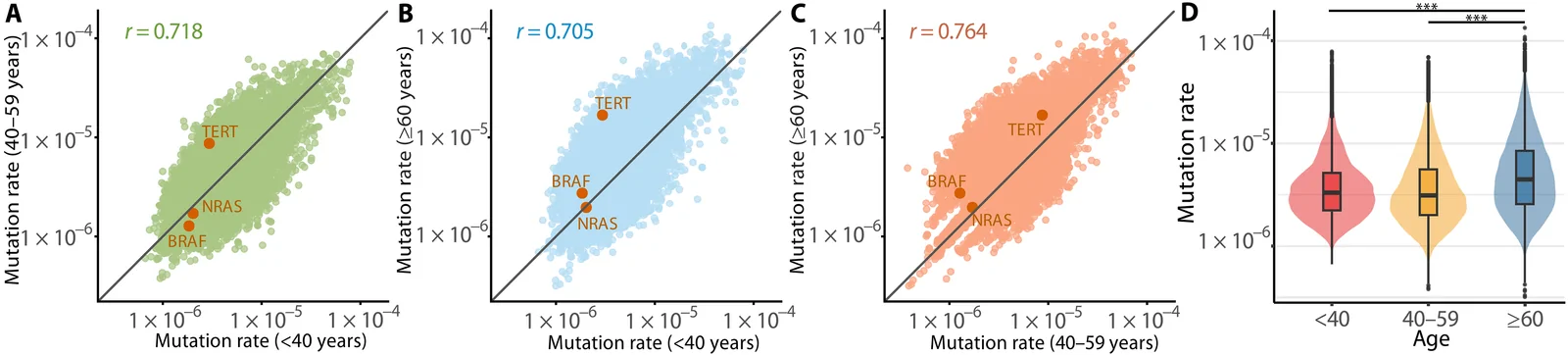
Across 5,472 melanomas from patients, an observational analysis estimated how the advantage associated with individual cancer-driving mutations varied with age. It accounted for differences in rates of neutral mutations, which do not confer an advantage. Neutral mutation rates rose only modestly with age. Ultraviolet damage remained the predominant source of mutations, although processes within the body contributed increasingly in older patients’ tumors.
BRAF V600E, a cancer-driving mutation, lost advantage sharply with age. Another group of cancer-driving mutations, called NRAS Q61, gained advantage. Mutations in a region controlling the TERT gene’s activity became more frequent but less advantageous. The authors concluded that aging reshaped melanoma evolution primarily through selection—the process favoring some mutations over others—rather than through changes in mutation rates.
Why it matters
Aging is a major risk factor for melanoma. The authors said the findings motivate evaluating treatments and biological markers used in care with age in mind.
Caveats
Mutation advantages were estimated from melanoma data. These estimates do not show whether choosing treatments according to patient age would improve outcomes.
The paper
Age reshapes selection on melanoma driver mutations
Yale University; Yale Cancer Center
Science Advances, Nov 6, 2026, Open access



Comments
Be the first to comment.