Tumors mix younger- and older-like molecular aging patterns
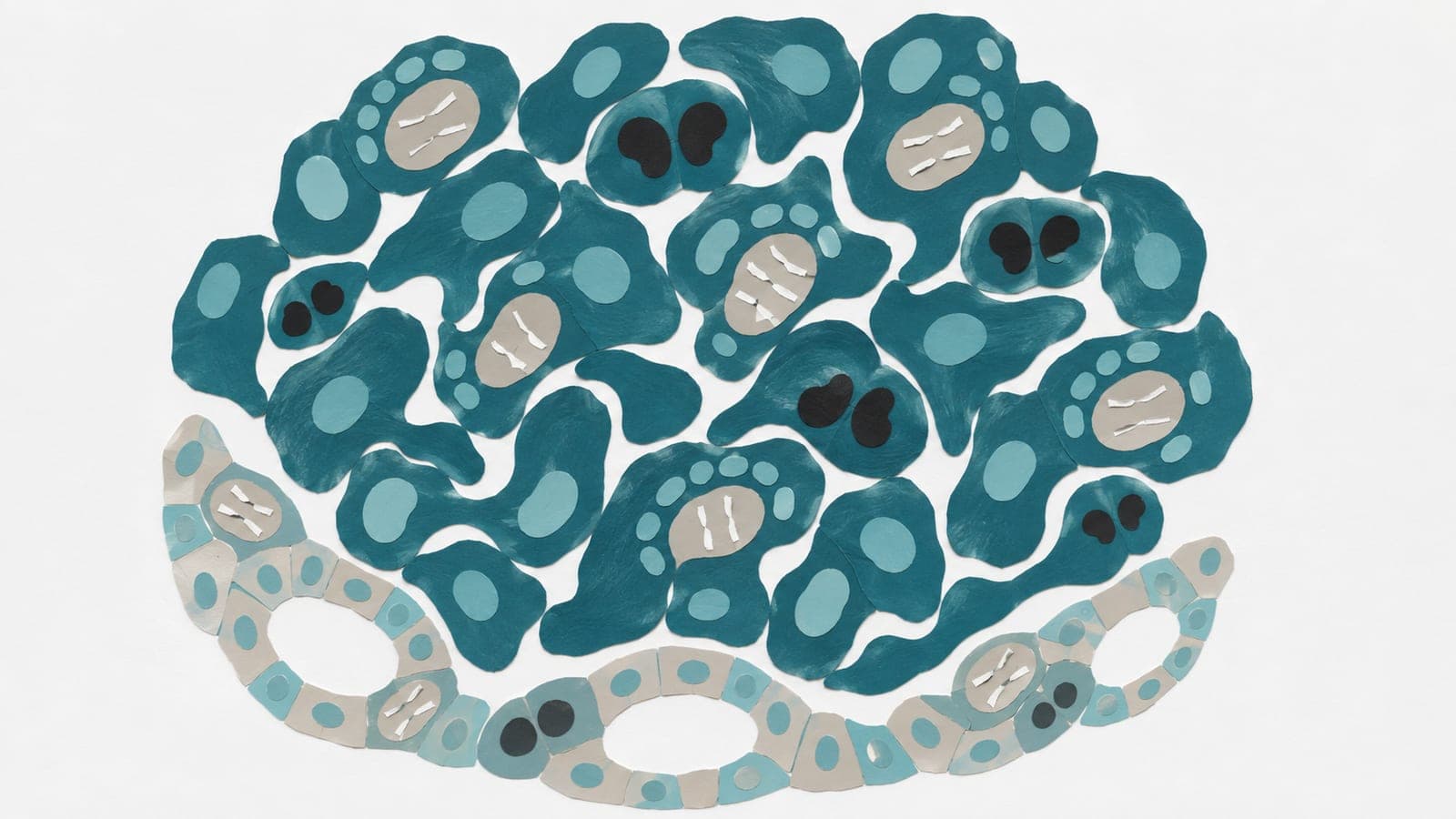
An analysis of breast cancer and five other cancers found mixed aging patterns, partly resembling those in normal tissue of the same origin.
Our read
Biomarkers- Studied:
- Preprint: computational study of tumors from breast and other cancers, against matched normal tissues (Independent replication)
- What changed:
- Tumors showed younger-like cell multiplication patterns but older-like damage-response and signaling patterns compared with expected tissue aging
- The catch:
- Other tumor features could explain the clock’s survival link rather than aging-related changes
Editor of record: Boris Djordjevic · AgingResearch.News
Tumors from breast cancer and five other cancers showed mixed molecular aging patterns in a pan-cancer analysis. Age-related molecular changes depended on the tissue where the cancer originated and partly mirrored changes in corresponding normal tissue.
The researchers built tissue-specific aging clocks to measure each tumor’s departure from expected tissue aging. They then assessed which biological processes contributed to those departures. Processes involved in cell multiplication showed younger-like patterns, while damage responses and cell signaling showed older-like patterns. In breast cancer, a clock trained only on normal tissues reproduced its deviations and process-level patterns in two independent cohorts comprising about 9,700 tumors, without retraining. Its results also aligned with breast cancer subtypes and predicted survival.
Why it matters
Aging involves different molecular changes in different tissues. The authors offer a framework for interpreting aging clocks when diseases such as cancer reshape those patterns.
Caveats
In breast cancer, the analysis leaves open whether the clock’s link to survival reflected aging-related changes or other tumor features. The work is a preprint and has not been peer-reviewed.
The paper
Decomposing tissue-of-origin aging clocks reveals composite aging states across cancers
Boston University
bioRxiv, Nov 16, 2026, Open access, CC BY-NC-ND, Preprint, not yet peer-reviewed
Comments
Be the first to comment.